- Polyester sewing thread is the better all-purpose option for most modern apparel, repairs, and wholesale orders.
- Cotton sewing thread is preferred when a natural finish, lower luster, or traditional construction matters more than strength.
- Thread choice should match fabric type, seam stress, wash cycle, and machine speed, not just price.
- For B2B sourcing, ask for ticket size, tensile strength, colorfastness, package format, and MOQ before placing a bulk order.
- In 2026, buyers increasingly choose thread based on performance consistency, not just fiber identity.
Polyester sewing thread and cotton sewing thread are not interchangeable in every sewing situation, and that difference becomes obvious when you compare seam durability, shrinkage behavior, and machine performance. For example, ISO 2062 specifies tensile testing for textile yarns, while ISO 4915 defines the lockstitch structure commonly used in garments, which means thread selection affects both seam formation and final seam strength. In industrial sewing, even a small mismatch can create skipped stitches, seam puckering, or premature breakage, so the right choice is a technical buying decision, not just a material preference. For wholesale buyers, the strongest sourcing strategy is to align thread fiber with end use, then confirm specifications such as ticket number, spool format, and color range through a supplier such as sewing thread wholesale, sewing accessories, and DIY tools.
Polyester Sewing Thread vs Cotton Sewing Thread: The Core Difference
Polyester sewing thread is a synthetic filament or spun yarn designed for strength, abrasion resistance, and dimensional stability.
Cotton sewing thread is a natural-fiber thread valued for softness, low sheen, and compatibility with traditional or heat-sensitive applications.
The most important difference is not appearance; it is how each thread behaves under stress, moisture, and repeated washing.
| Attribute | Polyester Sewing Thread | Cotton Sewing Thread | Why It Matters |
|---|---|---|---|
| Typical strength | Higher tensile strength | Moderate tensile strength | Polyester better for high-stress seams |
| Moisture behavior | Low moisture absorption | Higher moisture absorption | Cotton can shrink more after laundering |
| Surface look | Slight sheen to semi-matte | Matte, natural look | Cotton suits traditional finishes |
| Abrasion resistance | High | Lower than polyester | Polyester lasts longer in friction-heavy use |
| Best use case | Apparel, repairs, uniforms, DIY | Quilting, heritage garments, natural-fiber projects | Match use case to fiber behavior |
Which Sewing Thread Performs Better in Real Use?
Polyester sewing thread performs better in most modern garment and repair situations because it resists breakage and keeps seams stable after laundering.
When a seam is exposed to repeated washing, garment flex, or machine speed, polyester usually delivers the more reliable result.
Cotton sewing thread performs better when the project prioritizes natural appearance, traditional handwork, or controlled heat response.
In practical production, that means a polyester thread is usually the default for bulk sewing thread orders aimed at uniforms, everyday apparel, and home repairs, while cotton thread is more selective and often linked to specialty finishing or craft use.
Strength, abrasion, and seam life
Polyester sewing thread is engineered to survive repeated friction better than cotton sewing thread.
That matters because seam failure often starts at rubbing points such as side seams, hems, cuffs, and bag attachments.
In machine sewing, higher abrasion resistance usually means fewer breaks, fewer interruptions, and more predictable output.
| Test or Metric | Polyester Sewing Thread | Cotton Sewing Thread | Interpretation |
|---|---|---|---|
| ISO 2062 tensile testing | Commonly used for synthetic sewing yarns | Commonly used for natural sewing yarns | Same test method, different fiber behavior |
| Abrasion resistance | High | Moderate | Polyester usually lasts longer in wear |
| Seam stability after laundering | Very good | Good to moderate | Cotton may relax or shrink more |
| Machine break risk at high speed | Lower | Higher in demanding settings | Polyester is easier to run in production |
Shrinkage, washing, and finish quality
Cotton sewing thread can shrink with the fabric if it is not pretreated or if the garment sees frequent hot washing.
Polyester sewing thread is more dimensionally stable, so it tends to keep stitch tension and seam appearance more consistent.
That consistency is one reason apparel factories often prefer polyester for mass production, especially when garments must pass through multiple wash cycles before reaching end users.
For wholesale buyers sourcing from a supplier like sewing accessories wholesale, consistency across batches is often more valuable than a lower unit price.
When Cotton Sewing Thread Is the Better Choice
Cotton sewing thread is the better choice when the thread itself should visually disappear into a natural-fiber or heritage-style product.
It also makes sense for projects where a soft hand feel and low shine matter more than mechanical strength.
That is why quilters, costume makers, and some restoration specialists still choose cotton sewing thread even when polyester is available.
Best-fit applications for cotton
- Quilting and decorative piecing where matte appearance matters
- Natural-fiber garments with traditional finishing expectations
- Historical reproduction and costume work
- Hand sewing where softness and tactile control matter
- Projects exposed to moderate heat where fiber compatibility is important
Heat tolerance can matter in specialty work because cotton is less thermoplastic than polyester and behaves differently under pressing or ironing.
In practice, the safer rule is to match the thread fiber to the fabric fiber and the finishing process, especially for premium or restoration-level work.
When Polyester Sewing Thread Is the Better Choice
Polyester sewing thread is the better choice for most commercial sewing, repair, and DIY applications because it balances strength, flexibility, and cost efficiency.
It is especially useful when the buyer wants one thread type that can cover many fabric categories without creating frequent performance problems.
For wholesale sourcing, that versatility reduces inventory complexity and simplifies color and package planning.
Best-fit applications for polyester
- Mass apparel production
- Uniforms and workwear
- Everyday repairs and alterations
- DIY sewing kits and travel repair sets
- Decorative but durable home sewing projects
If you are building a product range for international buyers, polyester thread also fits the broader logic of DIY tools wholesale and accessory bundles because it works in more end-use scenarios than cotton.
That makes it easier to sell as a standard SKU in bulk orders, sample packs, and mixed sewing kits.
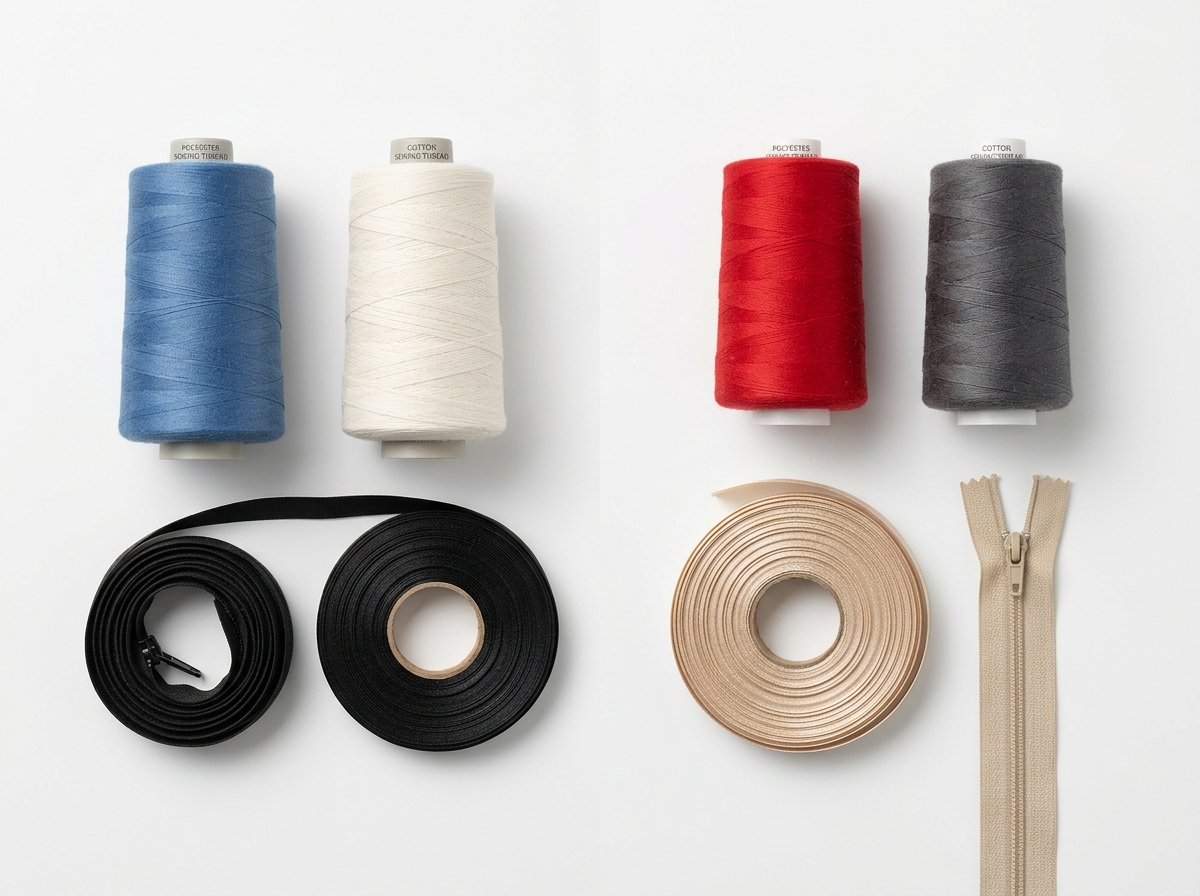
How to Choose Sewing Thread by Fabric, Stitch, and End Use
The right sewing thread is the one that matches the fabric’s movement, the stitch type, and the final care cycle.
That is the selection logic professional buyers use when they compare polyester sewing thread and cotton sewing thread.
A lightweight cotton blouse, for example, does not have the same stress profile as a polyester work shirt or a denim repair seam.
| Fabric or Project | Recommended Thread | Reason | Risk if Wrong Thread Is Used |
|---|---|---|---|
| Denim repair | Polyester sewing thread | High abrasion and seam stress | Breakage and seam wear |
| Quilting | Cotton sewing thread | Natural finish and traditional look | Gloss mismatch or stiffness |
| Uniforms | Polyester sewing thread | Frequent washing and wear | Premature seam failure |
| Heritage garments | Cotton sewing thread | Historical compatibility | Visual inconsistency |
| DIY repair kit | Polyester sewing thread | Versatile all-purpose performance | Lower usefulness across fabrics |
Decision checklist for buyers
- Identify the fabric type and care method.
- Check whether the seam is structural or decorative.
- Estimate friction, stretch, and wash frequency.
- Choose polyester for durability, cotton for appearance and tradition.
- Confirm ticket size, spool size, and color consistency before bulk purchase.
For B2B buyers, this checklist is more useful than shopping by material name alone, because the same thread can perform differently when paired with different fabrics and stitch densities.
What Wholesale Buyers Should Ask Before Placing a Bulk Order
Wholesale thread sourcing becomes easier when you request specifications in a structured way.
That is especially important for export buyers, garment factories, and retailers building mixed sewing kits.
New Swell’s product structure is well suited to this kind of procurement because its catalog combines sewing thread, ribbons, zippers, lace, and tools into a practical accessory supply system.
- What is the fiber content: 100% polyester, 100% cotton, or blended?
- What is the ticket size or count system used for the thread?
- What is the package format, such as cone, spool, or card?
- What is the MOQ for color-specific orders?
- Can the supplier provide lab dip, color swatches, or sample cones?
- What is the estimated lead time for repeat orders?
For channel planning, buyers often combine thread with complementary items such as wholesale ribbon and wholesale lace, especially for wedding, women’s wear, and DIY retail bundles.
Standards and Testing That Help You Compare Sewing Thread
Standards are the cleanest way to compare polyester sewing thread and cotton sewing thread across suppliers.
They reduce guesswork by giving buyers a repeatable basis for tensile strength, stitch behavior, and quality control.
Among the most useful references are ISO 2062 for tensile properties of textile yarns, ISO 4915 for seam types, and ASTM D2256 for tensile properties of yarns by the single-strand method.
These standards do not tell you which thread is automatically better, but they do help you compare products on measurable performance rather than marketing language.
| Standard | What It Measures | Why Buyers Use It |
|---|---|---|
| ISO 2062 | Tensile properties of textile yarns | Compare thread strength objectively |
| ISO 4915 | Stitch classification | Match thread to seam construction |
| ASTM D2256 | Single-strand yarn tensile properties | Evaluate break behavior and strength |
| NIST textile resources | Measurement guidance and metrology context | Support more reliable quality control |
For measurement consistency, NIST SI Units is useful background because textile testing depends on clear units, repeatable instruments, and documented methods.
Cost, Inventory, and Sourcing Strategy in 2026
Polyester sewing thread usually offers the best total cost of ownership for wholesale buyers because it covers more applications and reduces the need to stock multiple thread types.
Cotton sewing thread can be the better commercial choice when product differentiation is driven by finish, tradition, or craft positioning.
The real sourcing decision is therefore about inventory efficiency, not just fiber price.
For a bulk buyer, carrying one versatile polyester thread line often simplifies purchasing, packaging, and restocking.
- Use polyester as the default SKU for general-purpose sewing and repair.
- Add cotton only for customer segments that specifically need natural-fiber thread.
- Bundle thread with matching accessories for weddings, women’s wear, and DIY kits.
- Request samples before locking in color and packaging for export orders.
In many wholesale catalogs, thread is more successful when sold as part of a broader sewing accessories assortment rather than as a standalone item.
Practical Recommendation: Which Sewing Thread Should You Choose?
Polyester sewing thread should be your default choice if you want one thread that works across most modern sewing scenarios.
Cotton sewing thread should be your choice when the visual finish, fiber authenticity, or traditional construction is part of the product value.
If you are a wholesale buyer, the smartest approach is to stock both, but position polyester as the core volume item and cotton as the specialty option.
That strategy fits garment factories, home sewing customers, and DIY retailers because it balances performance, price, and assortment depth.
FAQ
Is polyester sewing thread stronger than cotton sewing thread?
Yes, polyester sewing thread is generally stronger and more abrasion-resistant than cotton sewing thread, which is why it is preferred for most apparel and repair applications.
Does cotton sewing thread shrink?
Cotton sewing thread can shrink or behave differently after washing, especially in hot laundering conditions, while polyester stays more dimensionally stable.
Which sewing thread is better for beginners?
Polyester sewing thread is usually better for beginners because it is more forgiving across fabric types and machine settings.
Which sewing thread is better for quilting?
Cotton sewing thread is often preferred for quilting because it offers a matte, natural finish and aligns well with traditional quilt construction.
Can I use polyester sewing thread on cotton fabric?
Yes, polyester sewing thread is commonly used on cotton fabric, especially when durability and wash resistance matter more than a fully natural material match.
Is cotton sewing thread more heat resistant?
Cotton sewing thread behaves differently under heat and pressing, which can be useful in specialty work, but the best choice still depends on the fabric and end use.
What should wholesale buyers ask for before buying sewing thread in bulk?
Wholesale buyers should confirm fiber content, ticket size, package format, color range, MOQ, sample policy, and lead time before placing a bulk order.

Post time: Aug-04-2026