- For children’s garments, nylon coil zippers usually offer the best balance of comfort, flexibility, and durability.
- Safety evaluation should focus on pull size, tape quality, tooth integrity, seam security, and resistance to snagging.
- Wholesale buyers should spec zippers by garment type, wash cycle, color range, length, and MOQ before sampling.
- Reliable sourcing is about consistency across lots, not only about the zipper’s initial appearance.
For children’s clothing zipper sourcing, the right choice is usually a safety zipper with smooth operation, stable tape, and low abrasion, especially for daily-wear garments that must survive frequent washing and repeated opening cycles. A practical benchmark many buyers use is zipper performance aligned with textile testing and product safety expectations, including zipper durability checks, seam strength verification, and child-garment risk review; for example, ASTM D2061 is widely used for zipper strength and operability testing, while the U.S. Consumer Product Safety Commission provides guidance on hazards such as small parts and sharp edges in children’s products. For design references and testing standards, see ASTM D2061, CPSC Small Parts Regulations, and CPSC Sharp Points and Edges Guidance. For wholesale buyers, this topic is also tightly linked to garment category planning, so the right internal starting points are nylon zippers, garment zippers, and sewing accessories.
Why a children’s clothing zipper must be different from an ordinary garment zipper
A children’s clothing zipper must prioritize comfort, safety, and repeated use over decorative impact.
Parents notice what adults often overlook: a zipper that feels acceptable on the first try can become irritating after a full day of movement, sleeping, washing, and tugging. Children’s garments are also exposed to more stress than many buyers expect, because they are pulled quickly, bent while seated, and washed more frequently than occasion wear. That means the best garment zipper for this category is not automatically the strongest-looking one. It is the zipper that keeps running smoothly after multiple wash cycles, does not scratch the skin, does not twist the tape, and does not create a sharp or overly rigid closure line.
In wholesale practice, this is why many buyers move away from heavy metal styles and choose soft coil constructions for everyday kidswear. Nylon coil zippers flex with the fabric, making them suitable for hoodies, rompers, sleepwear, casual jackets, and schoolwear. They also tend to be quieter, which matters more than many sourcing teams realize. A zipper that sounds harsh or catches often gets returned as a “quality issue” even when it technically closes.
| Zip type | Typical best use | Comfort on skin | Flexibility | Wholesale note |
|---|---|---|---|---|
| Nylon coil | Everyday kidswear, hoodies, dresses | High | High | Best all-round choice for bulk sourcing |
| Plastic molded | Jackets, outerwear, utility garments | Medium | Medium | Useful when visible structure is acceptable |
| Metal | Denim, fashion garments, heavier items | Lower | Low | Often less ideal for children’s daily comfort |
For buyers managing a broader trim program, the zipper decision should be coordinated with fabric, thread, and finishing details, not made in isolation. That is especially true in children’s clothing, where the closure sits close to the face, neck, and hands. A smooth zipper can support the whole product experience; an inconsistent one can make an otherwise good garment feel cheap.
Children’s clothing zipper safety: what to check before bulk purchase
Safety testing for a children’s clothing zipper should begin with the puller, then move to the tape, teeth, and seam attachment.
The first risk is small-parts failure. If a puller breaks off under use, it can become a hazard. The second risk is sharp-edge or burr exposure, which is more common when metal components are poorly finished. The third risk is snagging, especially around delicate knits, brushed fleece, or lining fabrics. In a child’s garment, the zipper should open and close without forcing the user to adjust the fabric each time.
From a technical sourcing perspective, a good safety zipper should have:
- Stable slider motion with no binding at the top stop or bottom stop.
- Consistent tape weave and edge finish to reduce seam distortion.
- A pull size that is easy for adults but not oversized or heavy.
- Good dye consistency across production lots to avoid shade mismatch.
- Reliable top and bottom end stops to reduce accidental separation.
Testing programs commonly combine visual inspection with functional checks. ASTM D2061 covers zipper strength and slider performance under repeated operation, which is useful when comparing suppliers. For children’s items, many buyers also map zipper components against broader product safety review methods that identify choking and breakage risks. That process is especially important in wholesale procurement because a sample can look excellent while a full lot varies in slider feel, tape tension, or colorfastness.
| Safety checkpoint | What to inspect | Typical failure sign | Buyer action |
|---|---|---|---|
| Puller security | Attachment and break resistance | Loose or rattling puller | Reject or request redesign |
| Teeth or coil continuity | Uniform engagement | Skipping or split closure | Test across full length |
| Tape edges | Surface smoothness | Scratchy or curling tape | Check fabric compatibility |
| Slider motion | Open-close force consistency | Sticking or sudden drag | Request batch comparison |
For sourcing teams, the key point is simple: safety is not one feature. It is the sum of pull strength, smoothness, finishing quality, and consistent production control.
Best zipper materials for children’s clothing zipper sourcing
Nylon coil zippers are usually the most versatile material choice for children’s clothing.
Material selection determines how the zipper behaves after wear, washing, and flexing. Nylon coil has a softer hand feel and bends better on curved seams than stiffer constructions, which is helpful for dresses, babywear, and lightweight jackets. Plastic molded styles can be useful for outerwear when buyers want a more structured look, but they are usually less forgiving on soft fabrics. Metal options are durable and visually strong, yet they can feel heavier and less comfortable for children’s everyday garments.
That material logic aligns well with garment design. For example, a baby romper often needs a zipper that stays smooth against the skin, while a school hoodie needs a zipper that can handle repeated daily operation without looking bulky. In both cases, the most important issue is not only material strength, but how the closure interacts with the fabric package.
Fabric compatibility matters because zipper tension can distort lightweight knits and stretch panels. A more flexible zipper reduces seam stress and improves appearance after washing. Wholesale buyers should therefore match zipper material to garment category, not just length and color.
| Material | Main advantage | Main limitation | Best children’s garment use |
|---|---|---|---|
| Nylon coil | Flexible, smooth, lightweight | Less rigid structure | Daily-wear kidswear, dresses, hoodies |
| Plastic molded | Clear shape, good visual definition | Less flexible on curves | Jackets, sportswear, outerwear |
| Metal | Strong visual presence, durable feel | Heavier, less soft | Fashion denim or heavier garments |
If the garment is intended for frequent washing, buyers should also review color stability and tape performance after laundering. Even when a zipper closes correctly out of the box, a poor tape or dye process can reduce appearance quality after only a few wash cycles.
How to choose the right garment zipper by age group and use case
The right garment zipper for children depends on age, fabric weight, and how often the product will be worn and washed.
Infant clothing usually requires the softest, smoothest construction possible because skin contact is more sensitive and the garments are smaller, meaning the zipper sits closer to the body. Toddler clothing needs a zipper that tolerates frequent movement, bending, and quick dressing. Older children’s apparel often needs higher cycle durability because children begin to zip and unzip items independently.
That means the sourcing logic should differ by application. A baby sleepwear zipper may need a gentler pull and finer finish, while a school jacket zipper should prioritize operating life and easy grip. For fashion dresses, hidden or low-profile zipper placement can improve aesthetics, but the closure still must remain reliable after repeated dressing.
- Define the garment category first: babywear, toddlerwear, schoolwear, or outerwear.
- Match zipper weight to fabric weight to avoid puckering or sagging.
- Choose slider style based on user handling, not visual preference alone.
- Request wash and cycle samples before approving bulk production.
- Lock color, length, and tape width before scaling the order.
Wholesale buyers who treat the zipper as a configurable component rather than a commodity usually reduce rework. That is especially true for factories and sourcing offices that need consistent results across multiple garment styles.
Wholesale buying guide for safety zipper and garment zipper procurement
Wholesale purchasing should evaluate consistency, minimum order quantity, sample approval, and packing format before price.
A low unit price can hide higher downstream costs if the zipper lot has mixed slider feel, uneven color, or weak stops. For B2B buyers, the real cost includes sorting, rework, returns, and delayed production. This is why the best procurement process starts with a sample pack and a detailed specification sheet.
Important purchase fields include zipper length, tape color, chain type, slider finish, MOQ, lead time, and carton packing. For children’s clothing, buyers often also ask for low-profile pullers, nickel-free finishes where relevant, and stable color matching against garment panels.
| Spec item | Why it matters | Buyer target | Risk if ignored |
|---|---|---|---|
| Length | Fit to pattern and seam allowance | Exact garment spec | Production mismatch |
| Tape color | Appearance and wash consistency | Lab-dyed match or approved shade | Visible contrast errors |
| MOQ | Inventory planning | Factory-appropriate lot size | Overstock or shortage |
| Lead time | Production schedule control | Aligned with sewing plan | Shipment delay |
When comparing suppliers, buyers should ask for the same test conditions across all samples. If one supplier is evaluated on a fresh sample and another on a pre-opened sample, the comparison is not meaningful. Reliable sourcing depends on controlled comparison, not just visual inspection.
 Children’s clothing zipper performance testing in real production
Production testing should simulate how the zipper will actually be used, not only how it looks on a showroom sample.
In real factories, zipper issues are often discovered when garments enter mass sewing, not when samples are approved. The zipper may be slightly too stiff for the fabric, or the tape may shift during insertion, creating a twisted line. To avoid that, production teams typically run practical tests: open-close cycles, seam alignment checks, wash tests, and visual inspection after laundering.
ASTM D2061 is useful because it standardizes zipper testing around strength and operability, making supplier comparisons more objective. A good internal test plan may also include garment wear simulation, especially for products intended for children who move constantly and rarely handle clothing gently.
In day-to-day sourcing, the most useful question is not “Does the zipper close?” It is “Does the zipper still close cleanly after repeated use, washing, and seam stress?” That question separates a basic sample from a production-ready component.
- Test zipper function before and after stitching into the garment.
- Verify color match under daylight and factory light.
- Check seam smoothness on curved and straight sections.
- Inspect after washing to catch shrinkage or tape distortion.
For brands and wholesalers, these controls reduce complaints and improve repeat order confidence.
Table of practical buying signals for children’s clothing zipper quality
The best quality signals are simple, measurable, and visible during sampling.
| Signal | Good result | Bad result | Decision |
|---|---|---|---|
| Slider feel | Smooth, even resistance | Jerky or sticky motion | Request replacement sample |
| Tooth or coil line | Uniform engagement | Gaps or uneven closure | Reject for production |
| Tape edge | Flat and stable | Curling or fraying | Check construction method |
| Puller shape | Secure and easy to grip | Sharp or loose feel | Redesign for kidswear |
| Wash appearance | Minimal change | Shade shift or distortion | Require wash test |
This kind of table helps sourcing teams make faster decisions because it turns a subjective quality review into a repeatable checklist. That is especially important in wholesale ordering, where many styles may share the same zipper spec but differ in fabric, color, and end use.
Why New Swell’s product structure matters for zipper sourcing
A mixed accessories catalog can support better sourcing when buyers need complementary items in one place.
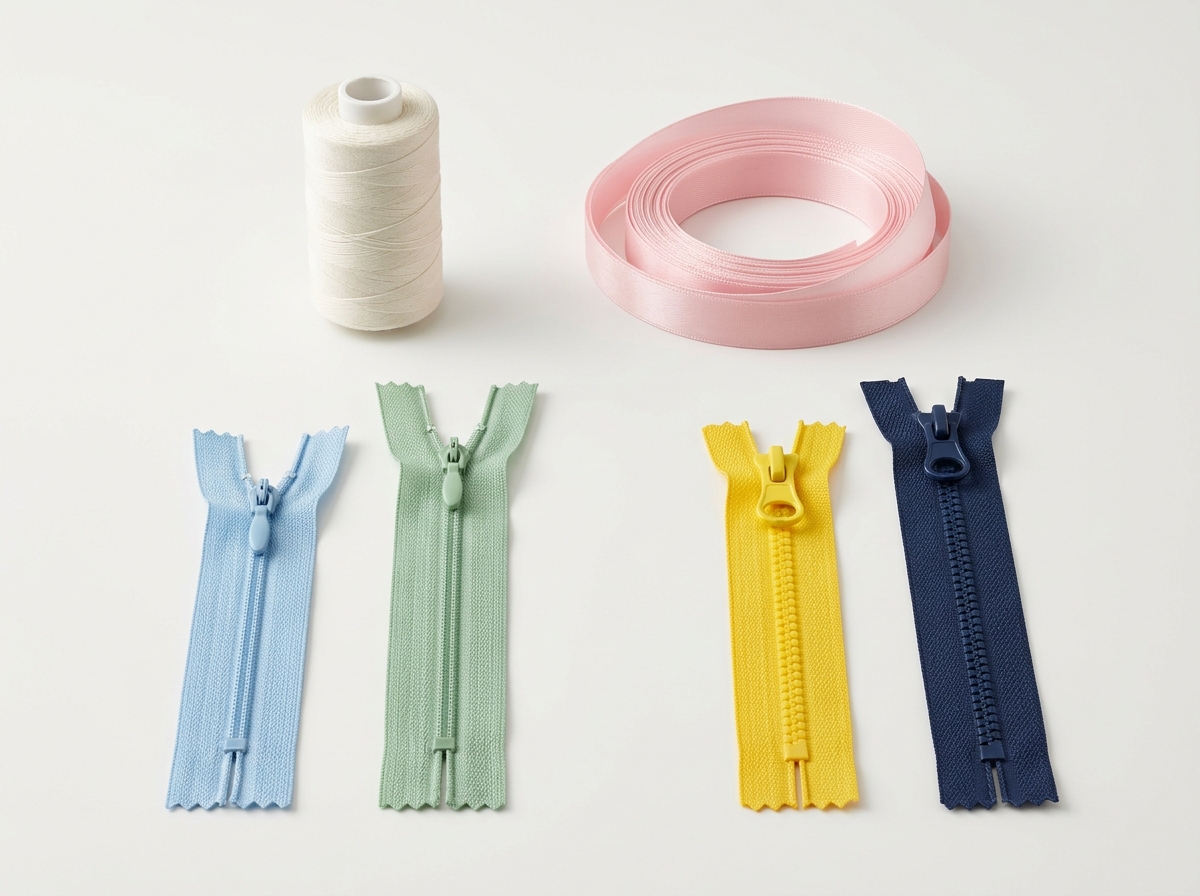
For wholesale and export buyers, zipper procurement is often tied to other sewing and trim decisions. A children’s clothing zipper may be ordered alongside sewing thread, ribbons, lace, or broader sewing accessories for a complete production package. This matters because one supplier relationship can simplify sampling, color coordination, and shipment planning across multiple trim categories.
Buyers working on uniforms, schoolwear, dresses, or DIY children’s projects often need both functional and decorative elements. A supplier with a broader accessories structure can help coordinate order planning, particularly when the same color family needs to be repeated across multiple components.
For example, a kidswear brand may source zippers for hoodies, ribbons for packaging, and sewing thread for assembly in one procurement cycle. That type of planning is more efficient than managing separate vendors for every trim line. It also reduces the chance of mismatch between garment components.
For buyers building a catalog strategy, useful starting pages include nylon zippers, sewing thread, ribbons, and lace.
Common mistakes when sourcing safety zipper products for children
The most common sourcing mistakes are overfocusing on appearance and underchecking function.
- Choosing by color only and ignoring slider smoothness.
- Accepting one sample without batch comparison.
- Using a zipper that is too rigid for a soft children’s fabric.
- Skipping wash tests before mass production.
- Ignoring the puller size and edge finish.
These mistakes are expensive because zipper failures show up late, usually after sewing, packing, or customer use. In children’s clothing, the issue is even more sensitive because product comfort and safety are judged quickly by parents. A zipper that is technically acceptable but annoying in practice can still lead to negative feedback.
A disciplined sourcing process reduces this risk. It also improves supplier communication, because specifications become measurable rather than subjective.
FAQ
What is the best zipper type for children’s everyday clothing?
Nylon coil zippers are usually the best overall choice because they are smooth, flexible, and comfortable on daily-wear garments.
Are metal zippers safe for children’s clothing?
They can be used in some garments, but they are often less comfortable and less forgiving than coil zippers in everyday kidswear.
How do I test a safety zipper before bulk order?
Check slider motion, puller security, seam compatibility, and wash performance, then compare multiple samples under the same conditions.
What standards are useful for zipper testing?
ASTM D2061 is a practical reference for zipper strength and operability testing, while CPSC guidance is useful for small-parts and sharp-edge risk review.
How can I reduce zipper complaints in children’s garments?
Match zipper material to fabric weight, request wash samples, and lock color and length before production begins.
What should wholesale buyers ask suppliers?
Ask for MOQ, lead time, tape width, slider type, color options, and test samples from the same production lot.
Why do some children’s zippers fail after washing?
Common causes include weak tape construction, poor finishing, inconsistent dyeing, or a zipper style that is too stiff for the fabric.

Post time: Jul-13-2026