- Wholesale buyers now expect an accessories supplier to deliver speed, consistency, and scene-based assortment, not only low unit prices.
- For garment accessories, the most important checks are material stability, color matching, packaging quality, and replenishment reliability.
- For OEM supplier evaluations, ask for MOQ, sampling time, bulk lead time, and spec sheets before discussing price.
- Wedding, women’s wear, and DIY are the strongest purchase contexts for ribbons, lace, zippers, sewing thread, and tools.
- Supplier readiness is easier to judge when product depth is organized by use case rather than by a single SKU page.
Buyer expectations are changing because the wholesale accessories market now rewards precision, documentation, and dependable replenishment as much as price. In textile manufacturing, even small dimensional or quality deviations can cascade into rework, and standards such as ISO 9001:2015 emphasize process control, while ISO 12947-2 defines abrasion testing methods that help buyers compare durability claims more consistently. For export-oriented garment accessories, that matters because buyers are sourcing not a single item, but a supply chain of ribbons, lace, zippers, sewing thread, and DIY tools from an OEM supplier they can rely on.
Why the modern accessories supplier must think like a wholesale partner
The best accessories supplier today helps buyers reduce sourcing risk, not just add catalog depth. Wholesale customers want product consistency across repeats, traceable specifications, and clear handling of color, width, length, and packaging details.
This shift is especially visible in garment accessories, where product mismatch is expensive. If a lace edge is too stiff, a ribbon shade drifts between lots, or a zipper tape does not match the garment fabric, the buyer pays twice: once in procurement and again in quality correction. That is why many sourcing teams now evaluate suppliers through the lens of process stability, sample speed, and export readiness.
For buyers, a good rule is simple: if the supplier cannot explain the product in measurable terms, it is not ready for wholesale-scale decision-making. That includes data such as width, length, stitch density, material composition, and package count per carton.
| Buyer expectation | What it means in practice | Why it matters |
|---|---|---|
| Stable specifications | Width, length, color code, and packing format remain consistent across reorders | Reduces mismatch and returns |
| Clear MOQ | Minimum order quantity is stated before sampling | Helps importers plan cash flow |
| Predictable lead time | Samples and bulk orders have separate timelines | Supports seasonal buying |
| Export packaging | Carton labels, inner packs, and barcode options are available | Reduces warehouse handling errors |
For a more diversified sourcing structure, buyers should also check whether the catalog includes DIY tools and yarn, because accessory demand often clusters around project-based purchasing rather than single-SKU replenishment.
What buyers really want from garment accessories and OEM supplier listings
Buyer intent is broader than price comparison, and that is the part many suppliers miss. When someone searches for an accessories supplier or garment accessories wholesale partner, they are usually trying to answer four questions: can the supplier deliver the right product, can it repeat that product consistently, can it ship on time, and can it support export documentation without friction?
In the garment and craft trade, these questions are not abstract. A wedding buyer may need lace in a specific visual finish, while a factory buyer may need sewing thread that runs consistently in production, and a DIY seller may need ribbon or scissors packaged for retail shelves. The same supplier must serve different intent layers without confusing the buyer.
That is why the strongest catalog structures are scene-based. A buyer exploring lace for bridal decoration has a different decision path from a buyer sourcing sewing thread for factory consumption or scissors for home sewing kits.
| Search intent | Typical buyer goal | Best content response |
|---|---|---|
| Accessories supplier | Find a dependable wholesale source | Show category depth, MOQ, and export service |
| Garment accessories | Match products to apparel use cases | Explain material and function differences |
| OEM supplier | Secure repeatable specs for private label or bulk programs | Provide spec sheets and packaging options |
| Wholesale for DIY | Buy project-friendly assorted items | Show sets, bundles, and starter kits |
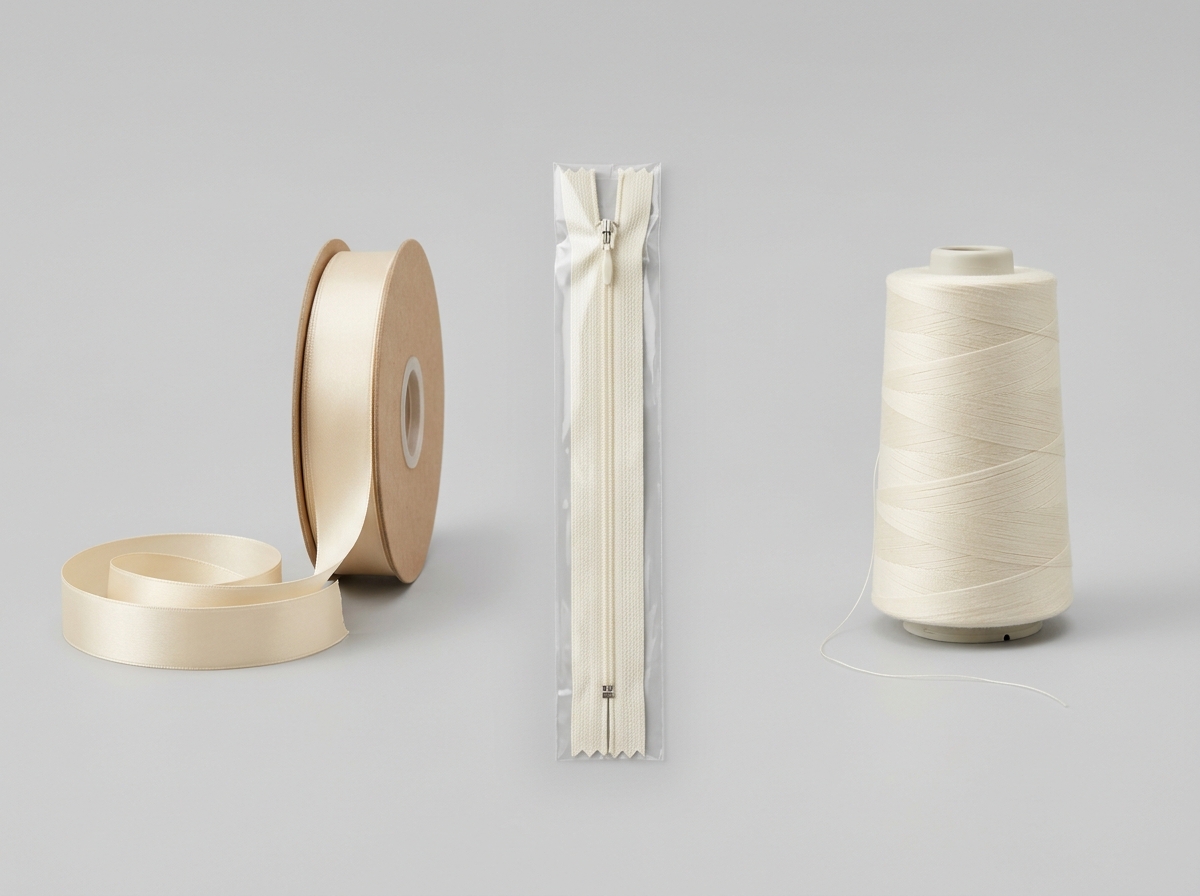
For buyers who need the basics of apparel auxiliary materials, polyester ribbon remains one of the most versatile SKUs because it serves gift packaging, wedding decoration, garment trim, and craft projects in one product family.
 How to evaluate ribbon, zipper, thread, and lace quality before placing bulk orders
Quality evaluation should begin with measurable attributes, not visual impressions alone. For wholesale procurement, the goal is to make the hidden variables visible before an order scales up.
Polyester ribbon is usually assessed by width, edge finish, weave tightness, and color consistency. Nylon invisible zippers are judged by tape alignment, smooth slider action, and how discreetly the zipper sits in the garment seam. Polyester sewing thread must be checked for tensile consistency, twist uniformity, and splice quality. Lace products should be reviewed for pattern clarity, edge stability, softness, and appearance after handling.
Even if the end buyer is choosing on aesthetics, the supplier needs to explain performance in functional terms. A bridal buyer cares about drape and visual delicacy, while a women’s wear manufacturer may care more about seam behavior and repeatability. A DIY seller may prioritize easy cutting, packaging appeal, and low breakage during handling.
| Product | Key check | Common buying scenario |
|---|---|---|
| Polyester ribbon | Width, edge finish, color stability | Gift packaging, wedding decor, trim |
| Invisible nylon zipper | Slider smoothness, tape alignment | Dresses, skirts, formal wear |
| Polyester sewing thread | Twist consistency, break resistance | Factories, home sewing, repairs |
| Lace | Pattern clarity, softness, edge stability | Bridal wear, womenswear, home textiles |
When buyers want a broader assortment, it is worth checking whether the supplier groups products into usable family pages such as elastic bands and knitting and crochet tools, because bundleability often improves wholesale order value.
Wedding, women’s wear, and DIY are the three strongest wholesale demand drivers
Scene-based buying is now more important than product-only browsing. Wedding, women’s wear, and DIY are the three demand clusters most likely to generate repeat orders for an accessories supplier.
Wedding buyers often need lace, ribbon, and decorative trims that look refined in photographs and remain consistent across event batches. Women’s wear buyers tend to source invisible zippers, lace, and thread because these items affect both garment appearance and production efficiency. DIY buyers are more likely to purchase sewing kits, scissors, crochet tools, and assorted accessories because they value convenience, variety, and easy packaging.
These three scenes also influence merchandising. A supplier that can present one category in multiple use cases creates stronger commercial trust than a supplier that only lists product names. In other words, the same lace can be sold as bridal edge trim, womenswear decoration, or home craft material if the catalog language helps the buyer see the application clearly.
| Scene | High-fit products | Commercial priority |
|---|---|---|
| Wedding | Lace, ribbon, decorative trims | Appearance and consistency |
| Women’s wear | Invisible zippers, lace, sewing thread | Function and finish quality |
| DIY | Scissors, sewing kits, crochet tools | Ease of use and assortment |
For scene-driven buyers, it helps when a wholesale catalog includes a ready-made sewing set, because starter kits reduce friction for gift retail, travel emergency use, and entry-level home sewing.
What a ready OEM supplier should disclose before a buyer asks twice
A ready OEM supplier gives essential purchasing information up front. Wholesale buyers should not need multiple email exchanges to learn MOQ, sample policy, color options, packaging format, or expected lead time.
In export sourcing, documentation is part of the product. Buyers want to know whether the supplier can support custom labeling, carton marking, assorted packing, and repeat production under the same specification. That is especially important for accessories because many items are standardized, which makes service quality a major differentiator.
The most efficient suppliers usually provide a clear decision bundle: product spec, minimum order quantity, sample availability, carton details, and reorder conditions. When those details are missing, the buyer must assume friction later in the process.
- Confirm the exact product family and use case before asking for price.
- Request spec sheets for size, material, and packing format.
- Check MOQ and sample time separately from bulk lead time.
- Verify color matching and repeat-order consistency.
- Ask how export packaging is labeled and stacked.
For buyers building a broader sourcing basket, it is also useful to review a supplier’s hair accessories and craft supplies pages, because these lines often support cross-sell opportunities in the same order cycle.
How standards and testing logic help buyers judge accessory quality
Testing logic matters because it turns subjective product claims into comparable data. Buyers do not need every accessory to be certified like industrial machinery, but they do benefit from understanding the standards mindset behind quality control.
For textiles and related accessories, ISO documents offer useful frameworks. ISO 12947-2 describes the Martindale abrasion method, which is often used to compare wear resistance in textile surfaces. ISO 9001:2015 is not a product standard, but it is widely used to judge whether a supplier has disciplined process control, document handling, and repeatability. For dimensional measurement, standardized methods help reduce buyer-supplier disputes over width, length, and tolerance interpretation.
In apparel sourcing, the practical point is not to overcomplicate compliance. It is to ask whether the supplier can explain how it controls color, dimensions, and packing consistency from one lot to the next.
| Control area | Typical buyer question | Why it matters |
|---|---|---|
| Color | Will the next lot match the last one? | Reduces shade complaints |
| Dimensions | Does the width or length stay within spec? | Avoids production interruptions |
| Packaging | Are inner packs and cartons consistent? | Improves warehouse efficiency |
| Process control | Is there a repeatable inspection routine? | Supports long-term sourcing reliability |
For buyers who want a more hands-on DIY assortment, the supplier’s knitting and crochet category can be a useful sign of range depth, especially when bundled with thread, tools, and accessory packs.
Common procurement mistakes when choosing accessories suppliers
The most common mistake is buying from a catalog, not a supply system. A polished product page can hide weak communication, inconsistent color lots, or slow sampling.
Another mistake is overfocusing on headline price. For garment accessories, a slightly cheaper ribbon or zipper can become expensive if it causes returns, manual sorting, or rework on the production line. Buyers also sometimes ignore packaging detail, even though packaging affects storage, resale presentation, and cross-border handling.
Finally, many buyers fail to separate scene requirements. Wedding lace, womenswear lace, and DIY lace may all look similar at first glance, but the buyer’s visual standard, end-use stress, and packaging expectation can be very different.
- Do not approve a supplier before checking repeat-order consistency.
- Do not treat MOQ as the only cost signal.
- Do not assume one product photo represents all color lots.
- Do not ignore carton and inner-pack specifications.
For this reason, a catalog should be evaluated by how it supports buying decisions across categories such as threads and sewing accessories, not just by how many SKUs it lists.
What a buyer-ready accessories supplier page should contain
A buyer-ready supplier page converts faster because it answers procurement questions in the order buyers actually ask them. The best pages do not only display products; they reduce the time needed to qualify the supplier.
At minimum, the page should make category scope, application, and procurement terms obvious. For New Swell, that means clearly showing the relationship between ribbons, zippers, sewing thread, lace, and DIY tools so buyers can understand the business model as a wholesale accessories portfolio.
It also helps to guide users by use case. A wedding buyer should quickly find decorative lace and ribbon. A womenswear buyer should quickly locate invisible zippers and sewing thread. A DIY buyer should quickly see tools, sets, and beginner-friendly materials.
- Show category families, not isolated SKUs.
- State MOQ, sample policy, and lead-time logic early.
- Group products by scene: wedding, women’s wear, DIY.
- Use clear material and size terminology.
- Provide reorder-friendly packaging information.
When those elements are in place, the supplier becomes easier to trust and easier to shortlist, which is exactly what wholesale buyers want from an accessories supplier or OEM supplier.
FAQ
What does an accessories supplier mean in wholesale sourcing?
An accessories supplier is a wholesale partner that provides garment accessories, craft materials, and related tools in repeatable formats for B2B buyers.
How is a garment accessories supplier different from a retail store?
A garment accessories supplier focuses on bulk order support, consistent specifications, MOQ, and export-ready service rather than single-piece retail selling.
What should buyers ask an OEM supplier first?
Buyers should ask for MOQ, samples, lead time, packaging details, color options, and repeat-order consistency before discussing unit price.
Why are ribbons, lace, and zippers important in wholesale?
These items are high-repeat, scene-sensitive products used across wedding, women’s wear, and DIY markets, so they influence margin and reorder frequency.
How do I judge lace quality for bulk orders?
Check pattern clarity, softness, edge stability, and whether the fabric keeps its appearance after handling or packing.
What makes sewing thread a core consumable for factories?
Sewing thread is a recurring production input, so buyers care about twist consistency, break resistance, and lot-to-lot reliability.
Why does catalog structure matter for wholesale buyers?
Catalog structure matters because buyers shop by use case and replenishment need, not only by product name, so scene-based navigation improves qualification speed.

Post time: Sep-08-2026