- Invisible zipper quality is defined by concealment, smooth operation, and repeatable batch consistency.
- Export buyers should verify material, tape symmetry, slider performance, color fastness, and packing standards before bulk order approval.
- Wedding, women’s wear, and DIY sewing projects need different zipper lengths, finishes, and tolerance expectations.
- MOQ, sample policy, lead time, and carton packing are part of product quality for wholesale procurement.
- Standards such as ISO 105-C06 and ASTM D2061 help buyers compare fabric fastness and zipper durability more objectively.
For B2B buyers searching for an invisible sewing zipper, the real question is not whether the zipper is hidden, but whether it is consistent enough for export production. Textile testing standards such as ISO 105-C06 for color fastness and ASTM D2061 for zipper performance give buyers a measurable way to compare suppliers. In garment production, even a small mismatch in tape symmetry, slider resistance, or coil alignment can affect sewing efficiency, seam appearance, and rejection rates on dresses, skirts, and formalwear. That is why wholesale buyers should evaluate an export zipper supplier through sampling, testing, and packaging control, not only by catalog photos.
What Makes an Invisible Sewing Zipper Export-Grade?
Export-grade invisible zippers are defined by repeatable manufacturing control, not marketing language.
An invisible sewing zipper is considered export-ready when it combines a smooth concealed coil, stable tape geometry, accurate length cutting, and dependable slider action across repeated sewing and washing cycles. For many apparel factories, the target is a zipper that disappears into the garment seam while still opening and closing cleanly after repeated use. Buyers sourcing from an invisible zipper manufacturer should expect lot-to-lot consistency in coil placement, tape width, and color shade, because those are the variables that most often affect final sewing quality.
The best procurement mindset is to treat zippers as production components, not decorative accessories. In a wedding dress or fitted women’s dress, a visible zipper ridge can downgrade the garment appearance immediately. In a DIY sewing project, a stiff or irregular pull can cause novice users to damage the seam during installation. This is why export buyers usually ask for pre-production samples, bulk samples, and shade reference cards before confirming the order.
 Invisible Zipper Manufacturer Criteria Buyers Should Check
Supplier credibility is strongest when quality controls are visible in samples, documents, and packing detail.
When evaluating an invisible zipper manufacturer, the first checkpoint is whether the supplier can explain material and process choices in plain terms. A serious factory should be able to describe coil type, tape composition, slider finish, color matching process, and packing format. The second checkpoint is whether the supplier can support wholesale needs such as carton labeling, mixed-size packing, and export-ready inspection reports. The third is whether the product is designed for real garment use, especially for skirts, dresses, and formalwear where the zipper must sit cleanly in the seam.
For buyers focused on wholesale zipper procurement, consistency matters more than headline claims. A sample that performs well once is not enough. Export buyers need batch repeatability, because factory sewing lines depend on predictable feed behavior and stable sewing speed. In that context, a supplier’s ability to control dimensions and dye consistency becomes a commercial advantage, not just a quality bonus.
| Buyer Checkpoint | Why It Matters | Practical Target |
|---|---|---|
| Tape symmetry | Affects seam alignment and invisibility | Left and right sides should sit evenly after stitching |
| Slider smoothness | Impacts sewing efficiency and end-user function | No sticking during repeated open-close tests |
| Color consistency | Critical for dresses and formalwear | Shade must match fabric or lining lot |
| Length accuracy | Prevents cutting loss and production rework | Must match purchase spec across the batch |
| Packing protection | Reduces deformation in export shipping | Flat packed or carton-protected for bulk transit |
Invisible Sewing Zipper Testing Methods That Matter in Export Trade
Testing should focus on durability, appearance, and installation behavior, not only on packaging.
For export buyers, a credible invisible sewing zipper should be checked with a simple test matrix. Start with visual inspection under bright light to confirm coil concealment and tape uniformity. Then check slider movement across the full length. After that, evaluate seam behavior after stitching into sample fabric, because a zipper can feel fine in the hand yet distort once sewn into a bias-cut dress panel. Final checks should include color fastness and repeated use behavior.
Two standards are especially useful for comparing claims. ISO 105-C06 is widely used for assessing textile color fastness to domestic and commercial laundering, while ASTM D2061 covers zipper strength and operational performance. If a supplier cannot explain how its product aligns with those methods, the buyer should treat the offer cautiously. Testing is particularly important for export orders, because returns are expensive once goods cross borders.
| Test Area | What Buyers Look For | Reference Standard |
|---|---|---|
| Color fastness | Shade stability after wash cycles | ISO 105-C06 |
| Zipper operation | Smooth opening and closing under repeated use | ASTM D2061 |
| Dimensional stability | Length and tape behavior after sewing | Buyer spec + incoming inspection |
| Visual concealment | Invisible appearance inside seam | Garment fit and seam test |
Wholesale Invisible Zipper Specifications for Wedding, Women’s Wear, and DIY
Different end uses require different zipper choices, even when the product family is the same.
In wedding and formalwear, the invisible sewing zipper must disappear completely into the garment silhouette. That means the zipper tape must be low-bulk and the coil must sit tightly under the seam. In women’s wear, especially fitted dresses and skirts, the balance shifts toward smooth installation and long-term comfort. In DIY sewing kits, the key concerns are usability, clear sizing, and forgiving sewing behavior for less experienced users.
Industry practice often uses a few common invisible zipper lengths, such as 18 cm, 22 cm, and 60 cm, depending on garment type and opening position. Buyers should confirm exact finished length before ordering, because even small length differences can affect pattern layout. The right choice is not always the longest zipper; it is the zipper that matches the garment opening with minimal alteration.
| Application | Typical Need | Buyer Priority | Common Length Range |
|---|---|---|---|
| Wedding dress | Maximum concealment | Appearance and smooth seam | 18 cm to 60 cm |
| Women’s skirt | Comfort and clean finish | Easy insertion and stable closure | 18 cm to 22 cm |
| Formal blouse | Lightweight concealed opening | Low bulk and fine seam line | 18 cm to 25 cm |
| DIY sewing project | Easy handling | Clear sizing and packaging | 18 cm to 60 cm |
How to Compare Export Zipper Supplier Offers Without Confusion
Price comparison is only useful when the quotation structure is normalized.
When comparing an export zipper supplier with another vendor, align the offer by zipper size, tape material, slider type, color count, packing method, and MOQ. Two quotations can look similar but be based on completely different specifications. One supplier may quote mixed colors with simple polybag packing, while another offers fixed color lots with carton labeling and pre-sorted packaging for factory use.
Wholesale buyers should also ask whether the offer includes sampling, approval swatches, and replacement policy for defect batches. In export trade, the total landed cost is shaped by more than unit price. Rework, sewing interruption, and delayed shipment often cost more than a small difference in purchase price.
- Confirm the finished zipper length, not the nominal length.
- Ask for tape width, slider type, and color reference before approval.
- Check MOQ, sample cost, and lead time in writing.
- Review carton count, inner packing, and export mark requirements.
- Request batch photos or inspection data for repeat orders.
Factory Risk Points That Cause Invisible Zipper Rejection
Most zipper defects are process-related and can be detected early with better incoming control.
The most common rejection points for an invisible sewing zipper are uneven tape edges, inconsistent coil exposure, weak slider engagement, dye mismatch, and packaging deformation. These are especially visible in wedding and women’s wear production, where the garment surface is smooth and there is little room for error. A zipper that seems acceptable in isolation may still fail after sewing because seam pressure changes the way the tape sits.
To reduce rejection, garment factories often implement an incoming checklist with visual inspection, dimensional sampling, and sewn-in confirmation. The best suppliers understand this and can provide clear batch identification, stable sizing, and packing that preserves shape during transport. For export buyers, the goal is not only to receive a functional zipper but to receive a product that behaves predictably across production lots.
| Common Risk | Likely Production Effect | How Buyers Reduce It |
|---|---|---|
| Uneven tape edge | Visible seam line | Approve sewn sample before bulk |
| Coil inconsistency | Poor concealment | Inspect multiple pieces per carton |
| Slider friction | Slow sewing and end-user complaints | Run open-close cycle test |
| Shade variation | Garment mismatch | Use color swatches and lot control |
Why Standards Matter in Wholesale Invisible Sewing Zipper Procurement
Standards give buyers a shared language for quality, performance, and accountability.
Without standards, a buyer and supplier may use the same words but mean different things. That is why references such as ISO 105-C06 and ASTM D2061 are valuable in supplier discussions. They do not replace garment-specific approval, but they help buyers ask better questions and compare results across vendors. This is particularly useful for international procurement, where buyers often source from multiple factories and need consistent documentation.
In addition, textile procurement often involves packaging and logistics decisions that affect quality on arrival. For bulk shipments, buyers should request carton dimensions, pack count, and moisture protection details. These are not glamorous details, but they determine whether the zipper arrives flat, clean, and ready for production.
How New Swell’s Product Structure Supports B2B Buying
A mixed catalog is more useful when it supports scene-based procurement rather than isolated product browsing.
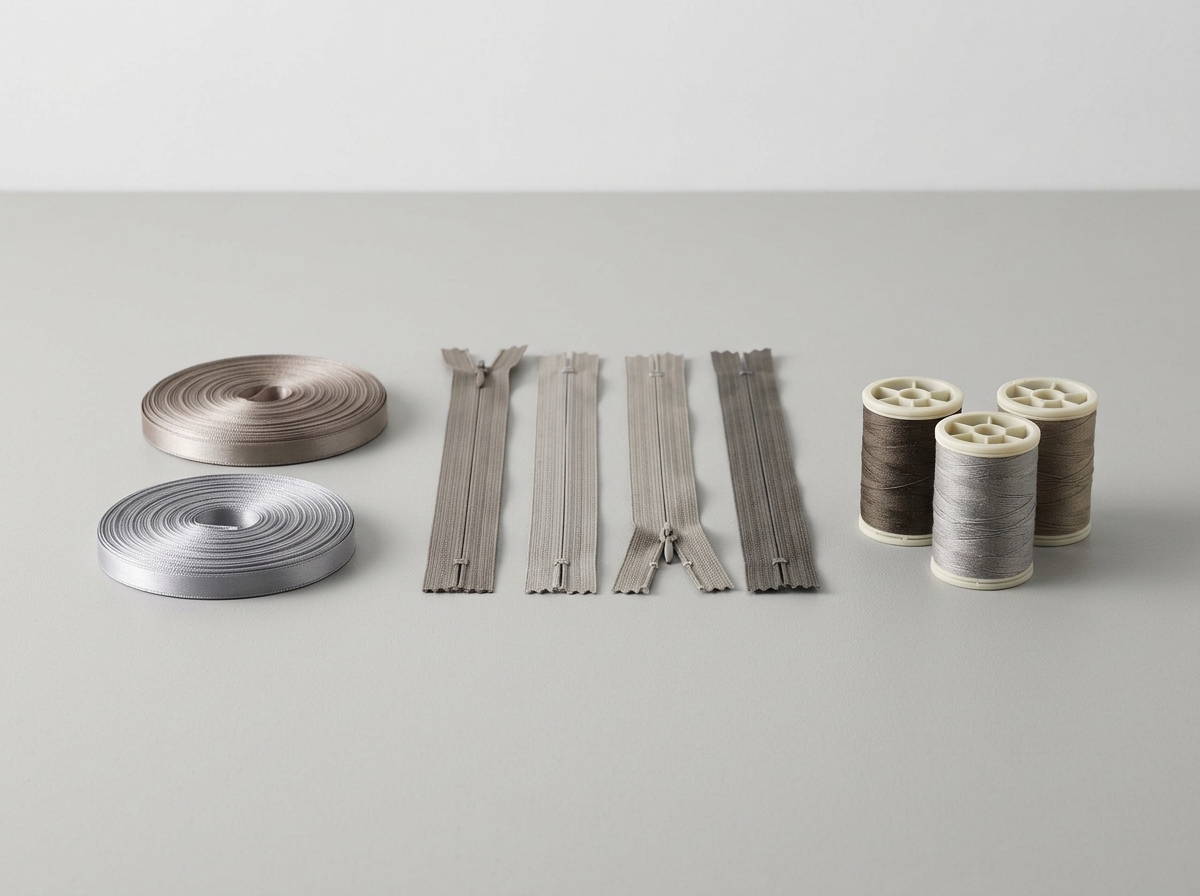
New Swell’s directory structure is relevant to export buyers because it groups accessories by use context as well as product type. That matters for buyers who purchase not only zippers but also ribbons, lace, and sewing thread for coordinated garment and craft programs. For wedding, women’s wear, and DIY markets, a supplier that can bundle accessories often simplifies sourcing, sampling, and replenishment.
That said, buyers should still evaluate each item on its own technical merits. A good catalog does not guarantee a good zipper. The real value is whether the supplier can support bulk orders with consistent specifications, clear labeling, and practical export communication.
Procurement Checklist for Invisible Sewing Zipper Orders
A strong checklist reduces risk before the first bulk shipment leaves the factory.
- Confirm zipper type, finished length, tape color, and quantity.
- Request physical samples and compare them against garment fabric.
- Check zipper function under repeated open-close cycles.
- Verify carton packing, inner packaging, and export marking.
- Ask about MOQ, lead time, and replacement policy for defects.
- Keep a signed approval sample for repeat orders.
For buyers in wedding, women’s wear, and DIY channels, this checklist is usually enough to separate a dependable wholesale source from a risky one. The cost of one failed shipment often exceeds the savings from a slightly cheaper offer.
Final Buying Logic for Export-Grade Invisible Sewing Zippers
The best invisible zipper is the one that disappears in the garment and stays consistent in production.
If you are sourcing an invisible sewing zipper for export, prioritize functional concealment, batch repeatability, and packaging discipline. Use standards such as ISO and ASTM as your comparison framework, but always confirm the real sewn-in result on your target fabric. For wedding, women’s wear, and DIY projects, the right supplier is the one that can keep the zipper invisible, the sewing line stable, and the order process predictable.
In wholesale sourcing, that combination is what turns a small accessory into a reliable production component.
FAQ
What is the main difference between an invisible sewing zipper and a regular zipper?
An invisible sewing zipper is designed to hide inside the seam, while a regular zipper remains visible and usually has a more exposed structure.
How do I know if an invisible zipper manufacturer is reliable?
A reliable manufacturer can provide samples, batch consistency, clear specifications, and test references for color fastness and zipper operation.
What length is most common for women’s dresses?
Common lengths include 18 cm and 22 cm, though the correct length depends on pattern design and opening position.
Why does zipper color matter so much in export orders?
Color mismatch is easy to see on smooth fabrics, especially in formalwear, so shade control is critical for buyer approval.
What should I ask an export zipper supplier before placing a bulk order?
Ask about MOQ, sample policy, lead time, packing method, finished length, and defect handling process.
Which standards are useful for zipper evaluation?
ISO 105-C06 is useful for color fastness, and ASTM D2061 is useful for zipper performance and strength evaluation.
Can invisible zippers be used for DIY sewing projects?
Yes, but buyers should choose clear sizing, easy-pull sliders, and packaging that helps beginner users handle installation correctly.

Post time: Sep-10-2026