- Mass production succeeds when sample approval, color matching, and packaging are standardized before the first bulk order.
- Wholesale apparel accessories work best as a category system, not as single-item purchasing decisions.
- For OEM manufacturing, measurable specs such as width, denier, zipper length, thread count, and lot consistency matter more than catalog descriptions.
- Wedding, womenswear, and DIY are the three highest-value use cases for ribbons, lace, zippers, sewing thread, and tools.
- Reliable suppliers should support sampling, MOQ planning, label customization, carton packing, and replenishment schedules.
Managing apparel accessories efficiently from sample to mass production requires more than choosing the right ribbon, zipper, or lace; it requires a procurement workflow built on traceable specifications, stable supply, and repeatable quality. In textile programs, even small deviations in color, stitching behavior, or trim width can create costly rejects, which is why many buyers align their production checks with standards such as ISO 105-C06:2010 for washing fastness and ISO 13934-1:2013 for tensile properties. For wholesale buyers, the smartest approach is to source apparel accessories as a coordinated system, using category pages such as ribbons, zippers, lace, sewing thread, and sewing tools to keep OEM manufacturing consistent across sampling, approval, and bulk delivery.
Why apparel accessories behave differently in mass production
Apparel accessories are low-unit-value items with high process impact, which means procurement mistakes are often more expensive than the accessory itself.
A ribbon, zipper, or lace trim may cost little per piece, but if it misses the garment spec, the whole production batch can be delayed or downgraded. This is why apparel accessories should be managed as production-critical inputs, not as afterthought add-ons.
In OEM manufacturing, the main issue is variability. Color, texture, stretch, and dimensional stability can shift between sample lots and bulk lots, especially when buyers source from different factories or reorder without locking standards. For products like polyester ribbon, invisible nylon zipper, polyester sewing thread, and decorative lace, the sample is only useful if it becomes a measurable production reference.
Wholesale buyers in wedding, womenswear, and DIY channels also face a portfolio problem. The same supplier may need to support a wedding trim line, a ladieswear fastening line, and a craft-oriented DIY line, each with different expectations for appearance, durability, and packaging. That is why a category-based supplier model is more efficient than buying each SKU in isolation.
From sampling to mass production: the procurement workflow for OEM manufacturing
A disciplined sample-to-mass-production workflow reduces defects more effectively than last-minute inspection.
The process should begin with a technical brief. The buyer defines width, color reference, material composition, usage scenario, and packaging requirements before requesting samples. For example, a hidden nylon zipper for a dress should state length, tape color, slider type, and concealment requirement, while a polyester ribbon for gift packaging should state width, edge finish, sheen level, and roll length.
Next comes sample approval. The buyer should test the sample against actual garment or packaging conditions, not only against a flat swatch. A lace trim that looks premium on a table may distort after sewing, and a thread that appears strong may behave differently under needle heat and seam tension.
The final stage is production lock. At this point, the approved sample becomes the control reference for bulk manufacturing, and no substitution should be allowed without written approval. That rule is especially important for repeat-order wholesale programs where color drift and trim mismatch can spread across multiple cartons.
| Stage | Main objective | Key control point | Typical failure risk |
|---|---|---|---|
| Sample request | Confirm feasibility | Material, width, color, length | Wrong specification |
| Sample testing | Check end-use behavior | Wash, stitch, stretch, fold | Unexpected shrinkage or distortion |
| Production lock | Freeze approval standard | Signed reference sample | Lot-to-lot inconsistency |
| Bulk order | Scale output | MOQ, packing, lead time | Delay, mismatch, reorder cost |
Core apparel accessories for wholesale buyers: what matters most
For mass production, buyers should evaluate apparel accessories by function, not by catalog name.
Polyester ribbon is one of the most versatile base items because it is used in gift packaging, wedding decoration, garment embellishment, and handcrafting. Its value in wholesale programs comes from repeat demand and broad end-use coverage, which makes it ideal for bulk replenishment.
Invisible nylon zippers are most important in garments where the closure should disappear visually, especially dresses, formalwear, and womenswear. In production, the main selection factors are zipper length, smoothness, tape balance, and concealed appearance after stitching.
Polyester sewing thread is a universal consumable for garment factories, home sewing, and repair applications. Because it is used continuously, thread quality affects seam performance, machine uptime, and waste control.
Lace products play a decorative and functional role in wedding, formal, womenswear, and home textile edging. The strongest subcategories are eyelash lace, wedding lace, elastic lace, TC lace, woven lace, and sewing lace, each suited to a different finish requirement.
| Product family | Typical use case | Key buying factor | Production risk if ignored |
|---|---|---|---|
| Polyester ribbon | Packaging, wedding, trim | Width, sheen, edge finish | Visual inconsistency |
| Invisible nylon zipper | Dresses, formalwear, womenswear | Hideability, length, smooth pull | Visible closure line |
| Polyester sewing thread | Garments, repair, home sewing | Strength, consistency, color | Seam breakage |
| Lace | Wedding, dress, home decor | Pattern, elasticity, hand feel | Style mismatch |
Technical specs that matter in apparel accessories wholesale
Specific numbers are more useful than generic descriptions when the goal is repeatable OEM manufacturing.
For garments and trims, buyers should insist on measurable spec sheets. A ribbon order should define width in millimeters, roll length, edge type, and color code. A zipper order should define length in centimeters, tape width, slider type, and end stop structure. A sewing thread order should define ticket size or denier, spool type, and intended stitch application. A lace order should define repeat pattern, width, stretch behavior, and edge treatment.
In textile quality control, published test methods give the procurement team a common language. ASTM D1388 covers bending length and flexural rigidity for fabrics, which is relevant when buyers compare the drape feel of lace or trim. ASTM D5034 covers grab breaking force and elongation of textile fabrics, useful for checking reinforcement behavior in accessories that must tolerate stress. The NIST SI Units guidance also supports consistent dimensional communication across international suppliers, which helps avoid inch-to-millimeter errors in global sourcing.
When factories move from sample to mass production, the most common avoidable issue is unit ambiguity. A 1/2-inch ribbon ordered without conversion discipline can create packaging or sewing mismatches when the production line works in millimeters. In OEM manufacturing, dimensional clarity saves time, especially when multiple accessory families are being ordered together.
| Specification field | How to define it | Why it matters | Example control value |
|---|---|---|---|
| Width | Millimeters or inches | Fit and appearance | 10 mm, 15 mm, 25 mm |
| Length | Centimeters or meters | Pattern matching | 22 cm, 60 cm, 1 m roll |
| Color | Pantone or approved swatch | Batch consistency | Approved lab dip |
| Strength | Test method result | Durability under use | Per ASTM D5034 |
How wedding, womenswear, and DIY shape accessory selection
Application context is the fastest way to narrow down the right apparel accessories.
For wedding programs, the buyer usually prioritizes visual refinement. Lace, ribbon, and decorative finishing products need soft hand feel, consistent color, and premium appearance under both indoor lighting and photography. Wedding buyers also tend to care more about packaging presentation and color batch uniformity than about ruggedness.
For womenswear, hidden functionality matters. Invisible zippers, clean-edged lace, and reliable sewing thread are chosen because they improve silhouette, comfort, and garment integrity. In this segment, a closure that sits well and sews cleanly is worth more than a decorative feature that looks good only in a showroom.
For DIY, ease of use becomes the leading factor. Sewing kits, scissors, crochet hooks, knitting needles, and DIY knitting machines support small-batch makers, home users, and craft sellers. Buyers in this channel often need lower MOQ, easy packaging, and fast replenishment rather than deeply customized industrial specs.
- Wedding buyers usually request elegant colors, decorative textures, and premium packaging.
- Womenswear buyers usually request hidden closures, stable seams, and consistent finishing.
- DIY buyers usually request convenience, versatility, and beginner-friendly tooling.
MOQ, samples, packaging, and lead time: the commercial logic behind bulk ordering
Wholesale efficiency depends on commercial terms as much as product quality.
Many buyers focus first on unit price, but mass production success often depends more on MOQ, sample policy, packaging format, and lead time. A lower price is not helpful if the order cannot match the garment calendar or if the packaging format creates extra labor at the factory.
MOQ should be viewed as a planning tool. In apparel accessories, MOQs help suppliers stabilize dye lots, packaging runs, and carton consolidation. For buyers, the real question is not only how low the MOQ is, but whether the MOQ supports consistent color and a stable reorder path.
Samples are also not free of risk. If a supplier cannot provide a clear sample reference, the buyer may approve a piece that cannot be reproduced in volume. That is why sample comments should be written like production instructions, not like casual feedback.
Packaging matters because many accessories are sold and stored in high quantity. Rewinding, bagging, labeling, and carton sizing can affect warehouse efficiency and damage rate. A ribbon roll packed neatly in standardized cartons is easier to count and ship than loose units with unclear labels.
Lead time should be matched to end-use calendars. Wedding and seasonal promotions are deadline-sensitive, while factory replenishment may be more flexible. A supplier with coordinated wholesale categories can usually simplify this because ribbons, lace, zippers, and thread can be planned in parallel rather than as separate one-off purchases.
- Lock the product brief before requesting samples.
- Use one approved reference sample for each SKU.
- Confirm MOQ, packaging, and carton dimensions before payment.
- Schedule bulk production with reorder windows in mind.
- Inspect random cartons for color, size, and finishing consistency.
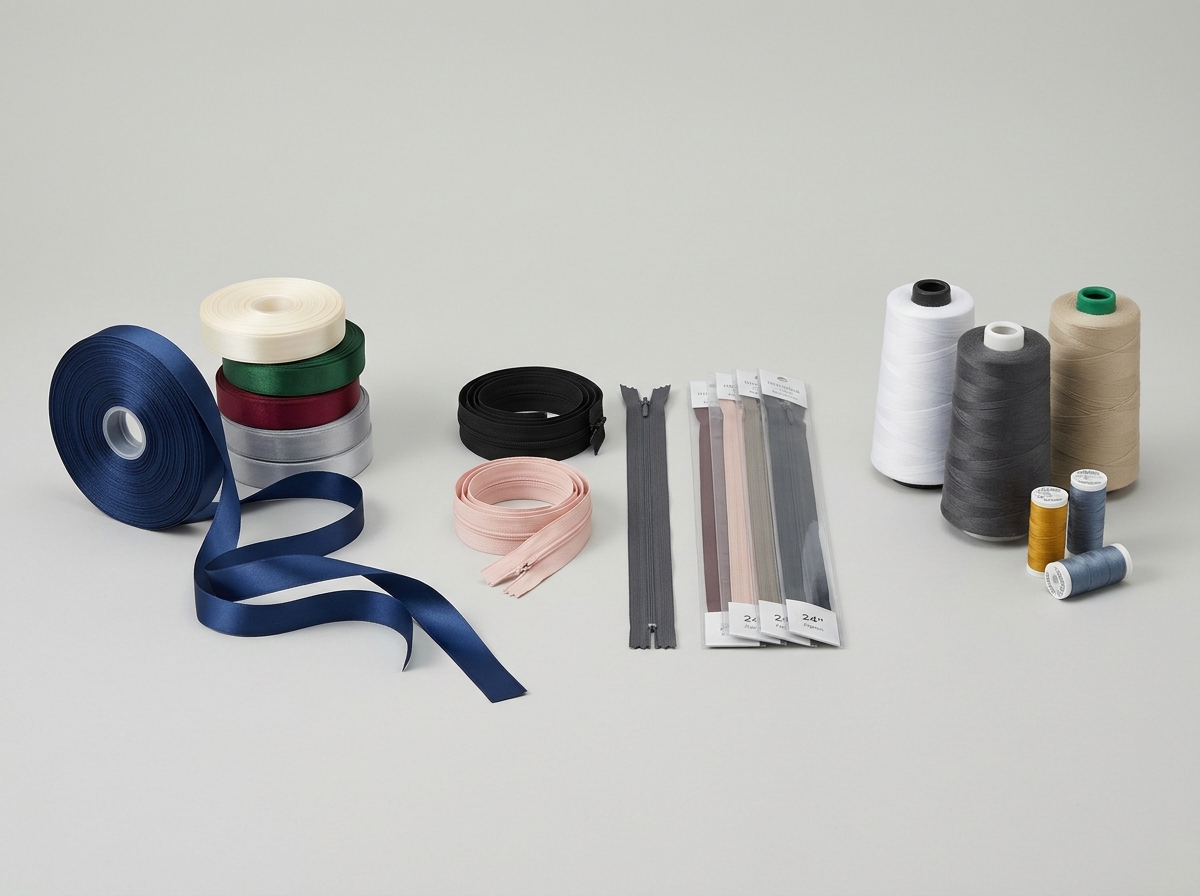 Quality control methods that reduce waste in OEM manufacturing
Quality control works best when it is built into the sourcing process instead of applied only at the end.
The first checkpoint is incoming inspection. Buyers should verify dimensions, appearance, and packaging against the approved sample. The second checkpoint is process compatibility. For sewing accessories, this means checking whether the item behaves correctly on the intended machine or garment line. The third checkpoint is end-use validation. A lace trim, zipper, or thread should survive actual sewing, washing, stretching, or handling conditions before full release.
For textile-related accessories, the most common test categories are tensile behavior, dimensional stability, colorfastness, and surface appearance. ISO methods are useful because they provide a repeatable structure across suppliers and factories. If a buyer works across multiple origins, standard methods reduce arguments over subjective terms like strong, soft, or premium.
Manufacturing waste usually comes from one of four causes: wrong material, wrong color, wrong dimension, or wrong packaging. That means the best prevention strategy is specification clarity. The more precisely the item is described in the sample stage, the less likely it is to fail in bulk production.
| QC checkpoint | What to inspect | Tool or method | Decision outcome |
|---|---|---|---|
| Incoming check | Size, color, count, packaging | Caliper, swatch, count sheet | Accept or reject lot |
| Process check | Machine behavior, stitching, feed | Trial sewing run | Adjust or continue |
| End-use check | Wash, wear, stretch, appearance | Standard test method | Approve for bulk |
| Reorder check | Lot consistency over time | Reference sample comparison | Maintain or revise spec |
How to choose a supplier for apparel accessories wholesale
The best supplier is the one that can make your repeat order look like the sample, every time.
When sourcing apparel accessories for wholesale or OEM manufacturing, buyers should evaluate supplier breadth, documentation discipline, and export readiness. A supplier with ribbons only may be useful for a narrow project, but a supplier with ribbons, zippers, sewing thread, lace, and tools can support cross-category planning and reduce coordination time.
That is especially important for New Swell style sourcing programs, where the product structure is closer to a combined accessories directory than to a single-product shop. For overseas buyers, this structure makes it easier to bundle wedding, womenswear, and DIY assortments under one supplier relationship.
A practical supplier checklist includes sample turnaround, color consistency, packaging options, custom labeling, and communication responsiveness. Buyers should also confirm that the supplier understands both export documentation and the specific needs of apparel production, because those two capabilities are not always the same.
- Ask for a production sample, not only a display sample.
- Confirm whether the supplier supports multiple category sourcing.
- Check whether packaging can be customized for retail or bulk use.
- Verify that reorder lots can match the approved reference.
What efficient apparel accessories management looks like in practice
Efficient management means fewer surprises between sample approval and mass delivery.
In practical terms, the buyer who manages apparel accessories well keeps one master spec sheet, one approved sample archive, one packaging standard, and one reorder schedule. That structure is simple, but it prevents the most expensive mistake in wholesale sourcing: assuming that a similar-looking item is the same as the approved one.
For a wedding trim line, the system might include ivory lace, soft ribbon, and decorative scissors. For womenswear, it might include invisible zippers, matching thread, and elastic lace. For DIY, it might include sewing kits, crochet hooks, knitting needles, and beginner tools. The point is not to buy everything at once, but to build a coordinated program that matches the business model.
As a result, apparel accessories become easier to forecast, easier to inspect, and easier to replenish. That is the real value of a supplier built for bulk ordering and category-based B2B procurement.
FAQ
What is the most important step when moving from samples to mass production?
The most important step is locking the approved sample into a measurable production specification. Without that control point, bulk orders can drift in color, size, or finish.
Why should apparel accessories be treated as a system?
Because ribbons, zippers, lace, thread, and tools often support the same garment or packaging program. Buying them together improves consistency and reduces sourcing time.
What should a wholesale buyer check before placing a bulk order?
The buyer should confirm MOQ, sample approval, packaging format, color reference, lead time, and whether the supplier can repeat the same lot quality.
Why are invisible zippers so important in womenswear?
They preserve the garment silhouette by hiding the closure line, which is critical in dresses, formalwear, and other fitted styles.
How do standards help in textile accessory sourcing?
Standards like ISO 105-C06 and ISO 13934-1 give buyers and suppliers a shared basis for testing durability and strength instead of relying on subjective judgment.
What makes DIY accessories different from industrial garment accessories?
DIY accessories prioritize ease of use, flexibility, and packaging convenience, while industrial garment accessories prioritize repeatability and line efficiency.
How can a supplier support both sampling and mass production efficiently?
By keeping product specifications, color references, packaging rules, and reorder records aligned so that the bulk order matches the approved sample.

Post time: Sep-06-2026