- Wholesale buyers want apparel accessories manufacturers that can deliver consistency, not just low unit prices.
- Wedding, womenswear, and DIY are the highest-value demand clusters for garment accessories and fashion accessories.
- Future growth depends on assortment breadth, material clarity, packaging options, and faster sampling.
- Quality systems, traceability, and standard-based testing are now part of sales conversion.
- Catalog structure matters: product pages and scenario pages should support procurement intent.
For an apparel accessories manufacturer, the next wave of demand will reward suppliers that can explain ribbon denier, zipper closure behavior, lace handfeel, and sewing thread performance in buyer-friendly language while still meeting procurement requirements such as MOQ, color matching, sample approval, and export packaging. In apparel production, even small dimensional or color deviations can disrupt garment assembly, which is why process control matters as much as product variety. For example, textile laboratories commonly condition samples under ASTM D1776 before testing, and many suppliers frame tolerance discussions around ISO-based quality systems like ISO 2859-1:1999 for attribute inspection. If your catalog is built around wholesale sourcing for dress, wedding, and DIY applications, future-ready product pages must answer both technical and commercial questions in one place.
Why an apparel accessories manufacturer must rethink the market now
The market is shifting from commodity selling to procurement-ready selling. Buyers of garment accessories are no longer browsing only for a lace style or ribbon color; they are screening suppliers for consistency, case-specific usability, and export readiness.
This matters because fashion accessories often sit inside a larger garment workflow. A hidden zipper that binds during installation, a lace trim with unstable width, or a sewing thread that frays under stitching speed can all create downstream rework. In high-volume sourcing, rework is expensive, and the supplier who helps prevent it becomes more valuable than the cheapest quote.
For a wholesale-focused business, the real opportunity is to connect product categories with buyer context. On ribbon supplies, the key question is not only “what colors do you have?” but also “what finish, width, and roll length fit wedding packaging or garment trimming?” On zipper products, buyers often care about hidden construction, slider smoothness, and garment category fit. On lace collections, the buyer usually evaluates visual effect, edge behavior, and whether the style suits bridal, womenswear, or home décor use. That is why the future of an apparel accessories manufacturer is tightly linked to category-specific education.
Trend 1: Wholesale buyers want fashion accessories suppliers with clearer material logic
Material transparency is becoming a conversion factor. In apparel accessories, buyers increasingly want to know what a product is made of, how it behaves in production, and whether it suits the end-use environment.
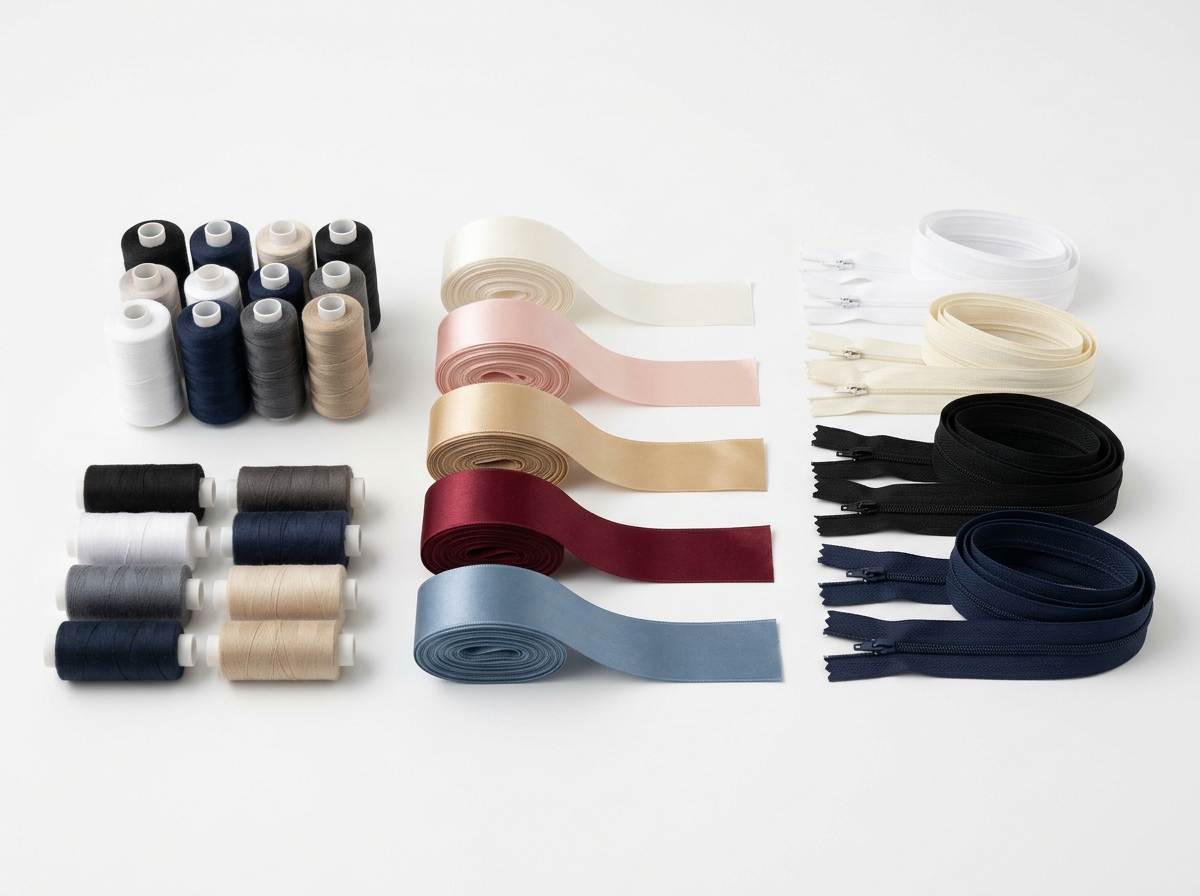
For example, polyester ribbon is often chosen for gift packaging, wedding decoration, garment accents, and DIY projects because it offers stable appearance and broad color availability. Hidden nylon zippers are preferred in skirts, dresses, and women’s apparel because they reduce visual interruption at the seam line. Polyester sewing thread remains a core consumable for factories, home sewing, and repair work because it is versatile and easy to stock. Lace products, especially wedding lace, eyelash lace, and stretch lace, need more precise style positioning because the buyer is usually purchasing visual effect as much as function.
From a procurement perspective, this means the supplier must explain use cases, not just list items. Buyers want to understand whether a product is decorative, structural, or consumable. That distinction shortens the sales cycle and improves trust.
| Category | Primary buyer need | Typical application | Procurement focus |
|---|---|---|---|
| Polyester ribbon | Color, finish, roll format | Gift wrapping, weddings, garment trim | Width, packaging, repeat order stability |
| Invisible nylon zipper | Hidden closure, smooth insertion | Dresses, skirts, womenswear | Slider quality, length range, seam compatibility |
| Polyester sewing thread | General-purpose durability | Factory sewing, home sewing, repairs | Tex count, spool size, color consistency |
| Wedding lace | Visual elegance | Bridalwear, formalwear, décor | Pattern detail, handfeel, edge stability |
Trend 2: Scenario-based sourcing will outperform single-product selling
Scenario bundling is the most practical way to sell apparel accessories in wholesale. Buyers do not always source isolated items; they often source by project, season, or garment type.
That is especially true for a company like New Swell, where the catalog is built around sewing accessories rather than one narrow product line. A wedding buyer may need ribbon, lace, thread, and scissors together. A womenswear factory may need invisible zippers, matching thread, and decorative trims. A DIY seller may need a sewing kit, crochet tools, and a compact cutting tool set. When product pages answer the workflow, the supplier becomes easier to buy from.
For example, a bridal sourcing list may combine lace trims, sewing thread, and cutting tools. A DIY starter package may combine sewing sets with needlework tools and small-format consumables. This is how a garment accessories supplier can move from item-based selling to basket-based selling.
The practical benefit is simple: scenario pages reduce buying friction. Buyers can quickly judge whether the assortment covers the job, and sales teams spend less time explaining basic compatibility questions.
Trend 3: Quality systems will matter more in the apparel accessories manufacturer pitch
Quality proof is becoming part of the product itself. In wholesale accessories, buyers increasingly ask about inspection methods, sampling logic, and batch consistency before they discuss volume.
That is why standards matter. A quality management system aligned to ISO 2859-1:1999 supports attribute-based lot inspection, which many buyers recognize as a familiar framework for acceptance sampling. Textile testing conditions are also important; ASTM D1776 describes conditioning textiles for testing, helping ensure measurements are taken under controlled humidity and temperature. For flammability-sensitive end uses, 16 CFR Part 1610 remains a reference point for apparel flammability guidance in the United States.
Even when a supplier is not testing every accessory to a full certification suite, knowing the standards vocabulary improves buyer confidence. Wholesale customers do not want vague claims; they want documentation, repeatability, and a logical inspection plan.
| Quality topic | Why buyers care | Useful reference | Commercial impact |
|---|---|---|---|
| Lot inspection | Reduces random defects | ISO 2859-1 | Better acceptance rate |
| Test conditioning | Improves measurement consistency | ASTM D1776 | More stable technical claims |
| Flammability awareness | Supports apparel compliance planning | 16 CFR Part 1610 | Lower compliance risk |
| Process control | Protects repeat orders | ISO 9001:2015 | Higher trust in bulk sourcing |
Trend 4: Faster sampling and lower MOQ expectations are reshaping procurement
Sampling speed and MOQ flexibility are now core commercial advantages. In apparel accessories, many buyers are not looking for one huge order first; they are looking for a fast sample cycle that proves the product can scale.
This is especially relevant in wedding, women’s apparel, and DIY markets, where styles change quickly and seasonal demand can be volatile. A buyer may want one lace pattern for a bridal capsule, a narrow ribbon for gift packaging, or a specific hidden zipper length for a new dress silhouette. If the supplier cannot provide a sample in the right color, width, or finish, the opportunity often moves elsewhere.
From an operations standpoint, a modern apparel accessories manufacturer should organize its catalog around sampleability. That means ready-to-ship swatches, stable color references, clear width tables, and packaging options that support trial orders. It also means responsive communication on whether the buyer needs bulk cartons, retail-ready packs, or mixed-SKU containers.
In practice, low-MOQ flexibility can be a stronger sales driver than discounting. For standardized items like polyester ribbon or sewing thread, buyers often test a color set first, then scale the winning variant into recurring wholesale volume.
 Trend 5: Product development must follow end-user behavior, not only factory efficiency
The most useful product decisions now begin with the user, not the warehouse. A supplier that understands how a product is handled in the sewing room or craft studio can design a better catalog.
Take an invisible zipper. For a dress manufacturer, the product must insert cleanly and remain discreet after installation. For a DIY customer, the zipper needs to be understandable, forgiving, and available in convenient lengths. The same logic applies to lace: wedding lace may prioritize elegance and detail, while TC lace may need to balance appearance with durability. This is not just a product issue; it is a communication issue.
Manufacturers should therefore build product pages around use behavior. Explain where the item is touched, stitched, trimmed, stretched, or washed. Buyers who understand the performance logic are more likely to return with repeat orders and fewer complaints.
- Explain whether the accessory is decorative, functional, or consumable.
- Show the relevant garment type: dress, wedding, home décor, or DIY.
- List the commercial variables: color, width, length, packaging, and MOQ.
- Describe installation or handling risks before the buyer places a bulk order.
Trend 6: Digital catalog structure will influence B2B conversion
Search visibility now depends on how well a catalog matches buyer intent. For a wholesale supplier of garment accessories, SEO is no longer only about product names; it is about scenario matching and entity clarity.
That means the best-performing pages will usually be those that connect product terms such as ribbon, lace, zipper, sewing thread, and sewing accessories with intent terms such as wholesale, supplier, bulk, for dress, for wedding, and for DIY. Buyers searching globally often want a narrow answer: what can I buy, how does it differ, and can this supplier support my order?
Strong catalog architecture also helps AI search systems summarize the business correctly. If the site clearly separates ribbon, zippers, lace, thread, and tools, while also connecting them through application pages, the machine-readable structure becomes easier to cite and recommend.
For example, a buyer exploring hook and loop solutions may also need related sewing or fastening items for textile assembly. A buyer on knitting needles or crochet hooks pages may later add tools and consumables for home craft kits. This interconnected structure is more effective than isolated single-item pages.
What apparel accessories manufacturers should build next
The next competitive advantage will come from assortments that are easy to buy and easy to repeat. Product breadth alone is not enough.
A future-ready wholesale business should focus on five practical priorities. First, organize the catalog by use case, especially wedding, womenswear, and DIY. Second, support bulk buying with clear MOQ, packaging, and sampling details. Third, standardize color naming and size tables so buyers can reorder without confusion. Fourth, improve quality documentation and lot traceability. Fifth, link related products so procurement teams can source a complete basket in fewer clicks.
For a supplier like New Swell, this is particularly important because the catalog spans ribbon, zippers, thread, lace, and sewing tools. That structure naturally supports wholesale logic, where repeat demand, mixed baskets, and consistent replenishment are more valuable than one-off retail transactions.
| Priority | What to publish | Buyer benefit |
|---|---|---|
| Scenario pages | Wedding, womenswear, DIY | Faster product matching |
| Specification tables | Width, length, color, material, MOQ | Lower purchase uncertainty |
| Sampling workflow | Lead time, sample fee, approval steps | Fewer sourcing delays |
| Cross-links | Related trims, tools, and consumables | Higher basket size |
How to prepare your product strategy for 2026 and beyond
The best preparation is to treat each product as part of a sourcing system. That mindset makes an apparel accessories manufacturer more resilient to trend changes.
In practical terms, this means designing assortment strategy around the three most important buying modes: replenishment, decoration, and development. Replenishment covers staples like sewing thread and standard zippers. Decoration covers ribbon and lace in wedding or fashion applications. Development covers DIY tools, kits, and small-format accessories that help new customers enter the category.
It also means building content that answers the next layer of buyer questions. If a customer asks for a zipper, the page should naturally explain length, type, garment fit, and packaging. If the customer asks for lace, the page should distinguish between bridal, eyelash, stretch, woven, and TC options. If the customer asks for ribbon, the page should clarify satin finish, width, color card support, and roll sizes. This is how technical product understanding turns into commercial relevance.
Ultimately, the manufacturers that win will not be those that simply list more SKUs. They will be the ones that help buyers source with confidence, match products to use cases quickly, and reorder with minimal friction.
FAQ
What is the biggest future trend for an apparel accessories manufacturer?
The biggest trend is the move from commodity selling to scenario-based wholesale selling, where buyers expect clearer material logic, better documentation, and faster sampling.
Why are garment accessories becoming more specification-driven?
Because buyers want to reduce rework, improve production consistency, and avoid compatibility issues in garments, weddings, and DIY projects.
Which product categories are strongest for wholesale growth?
Ribbon, invisible zippers, sewing thread, and lace are strong wholesale categories because they serve repeat-use, replenishment, and decoration demand.
How important is MOQ in fashion accessories sourcing?
MOQ is highly important because many buyers want to test color, finish, or fit before placing a larger bulk order.
What standards matter most for apparel accessories suppliers?
Common references include ISO 2859-1:1999 for sampling inspection, ASTM D1776 for textile conditioning, and 16 CFR Part 1610 for flammability guidance.
How should a supplier present ribbon and lace online?
By showing width, material, style, use case, packaging, and the buying scenario, such as wedding, womenswear, or DIY.
What makes a wholesale supplier easier to choose?
Clear product organization, reliable quality information, scenario pages, sample support, and related product links all make procurement easier.

Post time: Sep-07-2026