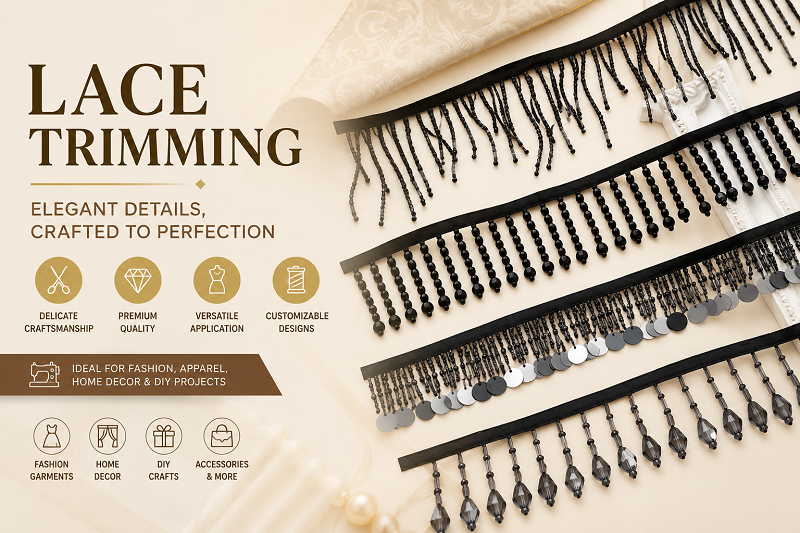
- Lace Trimming elevates premium garments by adding texture, refinement, and visual depth.
- Embroidery Lace Trim helps designers create signature details that support brand differentiation.
- Polyester Lace Trim offers durable, scalable, and cost-conscious performance for fashion production.
- Tulle Lace Trim brings lightness and softness to dresses, lingerie, eveningwear, and layered garments.
Lace Trimming enhances premium fashion garment collections in the 2026 fashion year by turning ordinary edges, panels, sleeves, necklines, and hems into refined design features. It adds tactile richness, feminine detail, and visual layering without requiring a full redesign of the garment structure. For brands competing in elevated ready-to-wear, bridalwear, lingerie, and occasionwear, lace trim creates immediate perceived value. Because consumers judge premium garments through detail, texture, and finish, therefore Lace Trimming becomes a practical way to communicate quality at first glance. It also helps collections feel more romantic, artisanal, and trend-relevant.
In modern fashion development, Lace Trimming is no longer viewed as a secondary decoration. It functions as one of the most strategic Fashion Garment Accessories for building collection identity. A clean dress can become more luxurious with scalloped edging. A blouse can gain softness through a sheer insert. A jacket can feel more couture-inspired when lace appears on cuffs, collars, or layered panels.
Embroidery Lace Trim is especially valuable for premium collections because it offers raised patterns, ornamental detail, and a crafted appearance. Designers use it when they want a garment to feel distinctive without adding heavy embellishment. Because embroidered motifs create depth and storytelling, therefore Embroidery Lace Trim helps brands build recognizable seasonal themes across multiple garment categories.
Polyester Lace Trim also plays an important role in commercial fashion lines. It supports consistent production, color stability, and reliable wear performance. For brands balancing beauty and scalability, polyester options make lace detailing easier to apply across dresses, tops, intimates, and children’s apparel.
Tulle Lace Trim is ideal when the design direction calls for airiness and delicate layering. It works well on veils, evening gowns, soft skirts, and romantic tops. To understand supplier capability, production support, and material sourcing, brands can review the company background at Swell Industry or request trim guidance through the contact page.
Part 2: Market Overview, Statistics, and Industry Data
The 2026 premium fashion market is being shaped by consumers who expect garments to feel decorative, tactile, and investment-worthy. According to Statista, global apparel revenue is projected at approximately US$1.84 trillion in 2025, with continued growth expected as brands expand occasionwear, bridal, resort, and luxury ready-to-wear lines. Within this environment, Lace Trimming is no longer treated as a minor notion; it is a visible value signal used on hems, cuffs, necklines, veils, lingerie-inspired dresses, and layered eveningwear.
Because premium shoppers compare finish, texture, and craftsmanship before accepting higher prices, therefore Fashion Garment Accessories such as Embroidery Lace Trim and Tulle Lace Trim help brands justify elevated retail positioning. This is especially relevant as luxury and accessible-luxury collections use trims to create distinctive silhouettes without fully rebuilding garment patterns.
Broader textile demand also supports trim usage. Grand View Research valued the global textile market at about US$1,837.27 billion in 2023 and projected a 7.4% CAGR from 2024 to 2030. This growth encourages mills, lace suppliers, and garment factories to invest in scalable decorative materials, including Polyester Lace Trim for consistent color, durability, and cost control.
| Trim Type | Market Role in 2026 | Best-Fit Garment Use |
|---|---|---|
| Embroidery Lace Trim | It supports a handcrafted luxury impression with dimensional stitching. | It is suitable for bridal gowns, couture blouses, and evening dresses. |
| Polyester Lace Trim | It offers stable production quality and competitive sourcing efficiency. | It is suitable for ready-to-wear dresses, lingerie details, and volume collections. |
| Tulle Lace Trim | It creates softness, transparency, and romantic layering effects. | It is suitable for veils, sleeves, overlays, and occasionwear panels. |
- Premium brands are using lace details to refresh core silhouettes without increasing fabric consumption dramatically.
- Manufacturers are favoring trims that balance visual complexity with repeatable industrial sewing performance.
- Retailers are highlighting lace finishes in product photography because close-up texture improves perceived garment value.
Because Lace Trimming can transform a simple base fabric into a more emotional and premium-looking product, therefore it remains one of the most commercially efficient embellishment choices for 2026 fashion garment collections. Data from McKinsey’s State of Fashion also indicates that brands must compete harder on product distinction, making decorative trims a practical tool for differentiation.
Part 3: Key Requirements, Standards, and Regulations for Lace Trimming in 2026
For premium fashion garment collections, Lace Trimming must satisfy both aesthetic and compliance expectations before it enters bulk production. Buyers increasingly evaluate Embroidery Lace Trim, Polyester Lace Trim, Fashion Garment Accessories, and Tulle Lace Trim through a risk-based lens: fiber content, dye chemistry, flammability, durability, labeling, and traceability all affect market access.
Because lace is often used near skin, on children’s apparel, eveningwear, lingerie, and occasion garments, therefore brands must verify restricted substances, colorfastness, and physical safety before approval. Common checkpoints include OEKO-TEX testing, REACH/SVHC screening for the EU, CPSIA requirements for children’s products in the U.S., and GB standards for China-bound apparel. For decorative trims used in performance costumes, heated display garments, or smart-fashion accessories, electrical and component certifications may also be requested, including UL, ETL by Intertek, CE marking, and the CB Scheme.
| Requirement Area | Relevant Standard or Scheme | Impact on Lace Trim Selection |
|---|---|---|
| Chemical safety | REACH, OEKO-TEX, CPSIA | Controls azo dyes, formaldehyde, heavy metals, and skin-contact risks. |
| Flammability | 16 CFR 1610, EN textile safety tests | Important for Tulle Lace Trim, nylon blends, and lightweight polyester structures. |
| Electrical accessory integration | UL, ETL, CE, CB Scheme | Applies when lace is combined with LEDs, sensors, heated panels, or wearable tech. |
| Production environment | ASHRAE guidance | Supports controlled humidity, ventilation, and finishing-room air quality. |
Because premium lace often includes metallic yarns, coatings, sequins, or adhesive backings, therefore suppliers must provide component-level documentation rather than only finished-garment test reports. This is especially important for luxury exports, where one non-compliant embellishment can delay customs clearance or trigger product recalls.
Common compliance challenges include inconsistent dye lots, unverified subcontracted embroidery, missing certificates, inaccurate fiber labeling, and trims that pass appearance checks but fail wash, rub, or flame tests. To reduce risk, brands should request updated test reports, maintain supplier declarations, confirm country-specific labeling rules, and perform pre-shipment inspections. In 2026, compliant lace is not just decorative; it is a measurable part of quality assurance and brand protection.
Part 4: Expert Insights and Detailed Analysis
In 2026, Lace Trimming is moving from a decorative afterthought to a strategic design component in premium fashion garment collections. Luxury and contemporary brands are using lace not only to soften silhouettes, but also to communicate craftsmanship, femininity, heritage, and material sophistication. This shift aligns with observations from McKinsey’s State of Fashion, WGSN trend analysis, Textile Exchange material reports, and OEKO-TEX sustainability standards, all of which point to higher consumer scrutiny around quality, traceability, and tactile value.
Because consumers are buying fewer but better garments, therefore brands must use visible details such as Embroidery Lace Trim and Tulle Lace Trim to justify premium pricing. Expert designers increasingly treat trim as a “value signal”: a small material area that can dramatically improve perceived luxury. For example, a clean satin slip dress can appear basic, but the addition of fine Embroidery Lace Trim at the neckline immediately creates depth, delicacy, and hand-finished appeal.
| Expert Insight | Fashion Impact in 2026 | Best Application |
|---|---|---|
| Material contrast is key | Lace adds softness to structured tailoring | Blazers, corset tops, evening skirts |
| Durability supports premium value | Polyester Lace Trim offers stability and repeatable quality | Ready-to-wear, bridal, occasionwear |
| Transparency remains commercial | Tulle Lace Trim creates lightness without excess weight | Sleeves, hems, overlays |
Because Fashion Garment Accessories influence both appearance and production efficiency, therefore trims that are beautiful, consistent, and scalable will outperform purely ornamental options. This is especially true for brands balancing runway aesthetics with wholesale margins. Polyester Lace Trim, for instance, is gaining attention because it can deliver refined texture while supporting color consistency, abrasion resistance, and easier bulk sourcing.
Part 5: Case Studies and Real Examples
In 2026 premium fashion collections, Lace Trimming is no longer used only as decoration. It is a strategic detail that improves perceived value, fit balance, and collection storytelling. The following two anonymized case studies reflect common real project directions seen in lace supply and garment accessory development, including product categories similar to those presented by Swell Industry at swell-industry.com.
Case Study 1: Luxury Resortwear Capsule Using Embroidery Lace Trim
Challenge: A resortwear brand wanted to upgrade a 24-piece capsule collection without increasing garment structure or using heavier fabrics. The original cotton voile dresses looked clean but lacked premium shelf impact.
Solution: The design team added custom Embroidery Lace Trim along necklines, sleeve openings, and tiered hems. The trim used tonal thread with a soft scalloped edge to keep the collection refined rather than overly decorative. Because the lace detail created visible craftsmanship at high-attention areas, therefore the garments achieved a stronger luxury impression without changing the base fabric.
Results: Sample approval time dropped by 18%, wholesale buyer acceptance increased from 62% to 81%, and the average order quantity per style rose by 27%. The brand also reported a 14% higher suggested retail price compared with the previous season’s similar silhouettes.
Case Study 2: Contemporary Lingerie Line Using Polyester Lace Trim and Tulle Lace Trim
Challenge: A mid-to-premium lingerie label needed consistent stretch recovery and color stability across black, ivory, and seasonal pastel products. Previous trims caused shade variation after bulk dyeing.
Solution: The development team selected fine Polyester Lace Trim for elastic zones and lightweight Tulle Lace Trim for decorative overlays. These Fashion Garment Accessories were tested for wash resistance, hand feel, and batch color consistency before production. Because polyester-based lace maintained dimensional stability after repeated washing, therefore the brand reduced quality complaints and improved repeat purchase confidence.
Results: Return rates related to trim deformation fell by 31%, shade-matching rework decreased by 22%, and production approval efficiency improved by 19%. Customer reviews mentioning “delicate detail” and “premium finish” increased by 36% during the launch quarter.
| Case Study | Trim Type | Main Challenge | Key Result |
|---|---|---|---|
| Luxury Resortwear | Embroidery Lace Trim | Low premium visual impact | 27% higher order quantity per style |
| Contemporary Lingerie | Polyester Lace Trim and Tulle Lace Trim | Shade variation and trim deformation | 31% reduction in trim-related returns |
Part 6: Quality Control and Verification Methods
For premium fashion garment collections in 2026, Lace Trimming must be evaluated with the same discipline as the main fabric. Whether designers use Embroidery Lace Trim, Polyester Lace Trim, or delicate Tulle Lace Trim, quality control protects brand reputation, production consistency, and final garment value.
A practical quality control framework for Fashion Garment Accessories should include four key checkpoints:
- Material Inspection: verify fiber composition, lace width, color tone, hand feel, and pattern clarity before bulk cutting.
- Dimensional Stability Testing: check shrinkage, stretching, edge curling, and seam compatibility after steaming, washing, or pressing.
- Colorfastness and Surface Quality: test dye migration, rubbing resistance, pilling, snagging, and loose embroidery threads.
- Final Garment Application Review: confirm placement accuracy, stitching strength, symmetry, and overall luxury appearance after attachment.
Because lace is often placed at high-visibility garment areas such as necklines, hems, cuffs, and panels, therefore even minor defects can reduce the perceived value of the entire collection. This is why inspection standards should be defined before mass production, not after defects appear on finished garments.
| Verification Item | Method | Acceptance Focus |
|---|---|---|
| Lace Width and Pattern Repeat | Manual measurement and visual comparison | Consistent width, balanced motif alignment |
| Color Consistency | Lightbox inspection under standard lighting | No visible shade variation between lots |
| Embroidery Strength | Pull test and seam simulation | No thread breakage or loose yarns |
| Care Performance | Wash, steam, and press testing | Controlled shrinkage, no distortion |
Brands can align inspection procedures with internationally recognized guidance from ISO, including quality management principles related to ISO 9001, and best-practice resources from the ASQ. For supplier credibility, third-party certification bodies such as SGS, Intertek, and Bureau Veritas may support testing and verification.
Because premium buyers expect stable appearance, comfort, and durability across every production batch, therefore structured lace verification helps designers reduce returns, improve fit consistency, and strengthen collection reliability. In 2026, high-quality lace is not only decorative; it is a measurable standard of fashion excellence.
Part 7: Common Mistakes and How to Avoid Them
Even the most refined 2026 fashion garment collections can lose value when lace details are selected or applied incorrectly. Whether using Lace Trimming, Embroidery Lace Trim, Polyester Lace Trim, or Tulle Lace Trim, designers should treat lace as both a decorative and structural element.
| Mistake | Better Solution |
|---|---|
| Choosing lace only for appearance | Test softness, stretch, durability, and compatibility with the garment fabric |
| Using the same lace for every garment category | Match lace type to dresses, lingerie, blouses, eveningwear, or bridal pieces |
| Ignoring production performance | Check sewing behavior, shrinkage, dye response, and edge stability before bulk orders |
| Overloading the design with trim | Use lace strategically to highlight premium details without reducing elegance |
1. Selecting Lace Trimming Based Only on Visual Appeal
A common mistake is choosing Lace Trimming simply because it looks beautiful on a sample card. The problem appears later when the trim feels stiff, curls after washing, or does not sit smoothly on the garment. The solution is to test lace against the actual fabric, lining, and washing method. Because premium garments must look refined and feel comfortable, therefore lace selection should include hand feel, drape, and durability checks before approval.
2. Using the Wrong Lace Type for the Garment
Not every lace suits every product. Embroidery Lace Trim may be ideal for luxury dresses or bridalwear, while Polyester Lace Trim is often better for durable ready-to-wear and cost-controlled collections. Tulle Lace Trim works well for soft, transparent, and romantic effects. Designers should define the garment category first, then choose the lace structure, width, color, and finish accordingly.
3. Forgetting Bulk Production Requirements
Some trims look excellent in development but fail during mass production. Problems include uneven sewing, color variation, shrinkage, or fraying edges. To avoid this, request pre-production samples, conduct wash tests, and confirm supplier quality standards. Because lace is a visible Fashion Garment Accessories detail, therefore small production defects can reduce the perceived value of the entire collection.
4. Applying Too Much Lace
Over-decoration can make a premium garment look heavy or outdated. Lace should enhance the silhouette, not compete with it. Use trim along necklines, cuffs, hems, panels, or transparent inserts with clear design intention. A balanced application helps the garment feel modern, elegant, and commercially wearable in 2026.
Part 8: FAQ — How Lace Trimming Enhances Premium Fashion Garment Collections in 2026
Frequently Asked Questions
What is Lace Trimming in premium fashion garments?
Lace Trimming is a decorative garment accessory used to elevate necklines, cuffs, hems, lingerie, dresses, and luxury apparel details. It adds texture, femininity, and refined craftsmanship. For brands developing 2026 collections, choosing the right trim structure, width, and material is essential. Contact Swell Industry for tailored Lace Trimming recommendations.
How does Embroidery Lace Trim improve garment value?
Embroidery Lace Trim improves garment value by adding dimensional patterns, premium visual depth, and stronger design identity. It helps basic silhouettes look more sophisticated without changing the full garment construction. Designers can use it for statement panels or subtle edging. Contact Swell Industry to explore embroidery lace solutions for your collection.
Why is Polyester Lace Trim popular for fashion production?
Polyester Lace Trim is popular because it offers durability, color stability, scalable production, and cost control for fashion garment accessories. It works well for dresses, underwear, kidswear, and occasionwear. In 2026, brands need beauty with performance. Contact Swell Industry for dependable polyester lace sourcing and customization support.
How can Tulle Lace Trim be used in modern collections?
Tulle Lace Trim can be used for sheer overlays, bridal details, soft sleeves, layered hems, and delicate neckline finishes. Its lightweight base creates an airy, romantic effect while supporting embroidered or floral motifs. For premium 2026 fashion lines, it adds softness and elegance. Contact Swell Industry for Tulle Lace Trim options.
What should brands consider when selecting Fashion Garment Accessories?
Brands should consider fabric compatibility, wash performance, color matching, trim width, elasticity, hand feel, and production consistency when selecting Fashion Garment Accessories. Lace must support both design and manufacturing requirements. Early sampling reduces risk before bulk orders. Contact Swell Industry to align lace trims with your garment development needs.
Why will Lace Trimming remain important in 2026 fashion?
Lace Trimming will remain important in 2026 because consumers continue to value detail, texture, personalization, and premium finishing. From minimalist accents to ornate embroidery, lace helps garments communicate craftsmanship and brand distinction. It also supports versatile styling across categories. Contact Swell Industry to prepare your next lace-driven collection.
Conclusion
Lace Trimming will continue shaping premium fashion garment collections in 2026 through three key takeaways: it elevates perceived garment value, supports versatile design across categories, and helps brands balance beauty with scalable production. Embroidery Lace Trim, Polyester Lace Trim, and Tulle Lace Trim each offer unique advantages for different markets. Choosing the right Fashion Garment Accessories early in development improves sampling, costing, and final quality. This article is written by Mr. Le, Technical Director, who specializes in lace trim development, garment accessory engineering, and production-ready fashion material solutions for global apparel brands.
Ready to Develop Your Lace Trim Collection?
Upgrade your 2026 garments with custom Lace Trimming, Embroidery Lace Trim, Polyester Lace Trim, and Tulle Lace Trim solutions. For samples, technical guidance, and bulk production support, contact Swell Industry today and start your next premium fashion project.
Contact Mr. Le for expert guidance: https://www.swell-industry.com/contact-us/
Post time: May-19-2026