- Waterproof zippers should be selected against the product’s actual exposure level, not just a catalog claim.
- Coating type, tape base, and seam design often matter as much as the zipper size or color.
- Buyers should request test data, sample packs, and production-ready specifications before placing bulk orders.
- MOQ, sampling time, and color consistency are critical procurement variables in wholesale outdoor sourcing.
- Reliable suppliers document test methods, batch control, and compatibility with the final sewing process.
For outdoor equipment manufacturers, the waterproof zipper is a functional sealing component, not just a closure, and the procurement decision should be based on real-world exposure, production efficiency, and testable performance criteria. In textile testing, ISO 811 measures resistance to water penetration under hydrostatic pressure, while ASTM F3039 covers performance requirements for slide fasteners used in protective applications; together, they help buyers separate marketing language from measurable sealing behavior. In wholesale sourcing, buyers also care about delivery stability, color lot consistency, and whether the zipper can be sewn without damaging adjacent laminates, coatings, or welded seams.
What outdoor equipment manufacturers really mean by waterproof zipper performance
The best waterproof zipper is the one that matches the product’s expected water load, abrasion cycle, and manufacturing method.
In 2026, buyers increasingly ask for more than a generic “water resistant” claim because the same zipper may behave very differently on a softshell jacket, a dry bag opening, or a tent access panel. A product exposed to splash and brief rain may only need a coated coil zipper with a protective flap, while a pack or technical shell exposed to driving rain often requires a laminated construction with tighter seam planning. This is why outdoor equipment zipper selection should start with the use case, not the supplier catalog.
Water resistance is usually validated with hydrostatic or penetration-based methods. For fabrics and laminated assemblies, ISO 811 provides a standardized way to evaluate resistance to water penetration, while the textile industry also references ASTM F3039 for slide fastener performance in protective garments and related applications. These standards do not replace product-specific testing, but they give procurement teams a defensible baseline when comparing suppliers.
| Outdoor use case | Typical exposure | Recommended zipper style | Procurement priority |
|---|---|---|---|
| Daypack pocket | Rain splash, brief exposure | Coated waterproof zipper | Low stiffness, smooth slide, color match |
| Technical jacket | Driving rain, repeated flexing | Laminated waterproof zipper | Seal integrity, seam compatibility |
| Dry bag opening | High splash and immersion risk | Heavier sealed closure system | Hydrostatic resistance, fatigue durability |
| Tent access panel | Condensation, rain, UV exposure | Waterproof coil or laminated zipper | UV stability, opening force, cycle life |
Manufacturers should also treat the zipper as part of the seam system, not a standalone part, because leakage often occurs at the stitch line rather than the slider itself. A zipper can pass a bench test yet still fail in production if the seam allowance is too narrow, needle holes are oversized, or seam tape is incompatible with the coating chemistry. That is why outdoor procurement teams should ask suppliers for sewing recommendations, not only product photos.
How to compare waterproof zipper supplier options in bulk sourcing
The strongest waterproof zipper supplier is the one that can document repeatable quality, not just quote a low unit price.
Wholesale buyers in outdoor equipment manufacturing usually compare suppliers across five dimensions: material consistency, sealing design, test evidence, commercial flexibility, and production responsiveness. This matters because a supplier that can deliver 5,000 pieces in one color may not be able to hold shade stability across later lots, and a supplier with good sealing claims may still fail on sewing compatibility or packing efficiency.
- Ask for test reports tied to a defined standard, not only internal claims.
- Confirm whether the zipper is intended for light splash, heavy rain, or higher moisture exposure.
- Check slider smoothness after coating and after sewing into the final panel.
- Request color swatches, size charts, and batch photos before mass production.
- Clarify MOQ, sample lead time, and bulk lead time in writing.
For buyers who source multiple accessory categories, it helps to organize procurement around a broader trim strategy rather than a single SKU. A supplier with a strong products directory can simplify cross-category bundling, while a dedicated sewing accessories collection may be useful when you need zipper-related items, tools, and consumables in one sourcing workflow. If your product line includes fashion or softgoods besides outdoor gear, a broader supplier overview can help your team compare accessory families in one place.
| Supplier evaluation factor | What to request | Why it matters | Typical decision risk |
|---|---|---|---|
| Material consistency | Spec sheet, batch photo, color control method | Reduces lot-to-lot variation | Shade mismatch, rework |
| Performance evidence | ISO 811 or equivalent test data | Supports waterproof claim | False confidence in sealing |
| Manufacturing support | Sewing guidance, needle recommendations | Protects final assembly quality | Seam leakage, coating damage |
| Commercial terms | MOQ, sample charge, lead time | Improves planning accuracy | Stockouts, overbuying |
Waterproof zipper materials, coatings, and construction choices
Construction details usually determine real-world waterproof performance more than the zipper name alone.
Outdoor equipment manufacturers typically choose among coated coil zippers, laminated zippers, and hybrid sealing systems. Coated coil zippers are often easier to sew and more flexible, which can be useful for curved pattern pieces and lighter shells. Laminated zippers, by contrast, tend to offer a cleaner barrier surface and are often preferred when the garment or pack is expected to face more persistent moisture.
The tape base also matters. Polyester tape is common in outdoor trims because it offers good dimensional stability and compatible processing behavior in high-volume sewing. Nylon components may provide softness and flexibility, but the final choice depends on the entire assembly, including coating thickness, slider geometry, and the stitching method used by the factory. In other words, the best waterproof zipper for a rain shell may be a poor choice for a rigid roll-top or a technical pack opening.
| Construction type | Advantages | Trade-offs | Best fit |
|---|---|---|---|
| Coated coil zipper | Flexible, easier to sew, lower profile | May be less robust under prolonged immersion | Jackets, pockets, moderate weather gear |
| Laminated zipper | Cleaner barrier surface, stronger visual sealing effect | Can be stiffer and more demanding in production | Technical shells, packs, weatherproof panels |
| Hybrid sealed system | Balances movement and sealing | More complex specification control | Premium outdoor equipment |
Slider design is another hidden variable. A zipper may seal well but still create a poor user experience if the pulling force is too high or the slider jams after repeated use. For outdoor gear, buyers should test opening force after sewing, not just in loose samples, because seam tension changes the behavior of the entire closure. Industry procurement teams often overlook this and discover it only after pilot production.
Testing waterproof zippers for outdoor equipment before mass production
Testing a waterproof zipper in the final product is more valuable than testing it as a loose component.
Manufacturers should build a test plan that includes both laboratory verification and production-line validation. Laboratory checks should confirm water resistance and slider performance, while production-line checks should confirm sewing feasibility, seam symmetry, and repeatability across operators. This two-stage approach reduces the chance that a zipper passes incoming inspection but fails during stitching or after field use.
One useful benchmark is to define the zipper’s required performance zone before sampling. For example, a consumer rain shell may only need protection against splash and wet-weather exposure, whereas an outdoor pack seam may require a more conservative barrier specification. The exact target should be set by the product engineer, but the supplier must know the target before quoting. Otherwise, procurement decisions become a comparison of vague claims rather than measurable performance.
- Test in the actual panel construction, not only as a standalone zipper.
- Check seam leakage around the ends, not only across the center line.
- Repeat opening and closing after wet and dry cycles.
- Inspect coating cracks after folding and flexing.
- Verify color and gloss under production lighting.
According to NIST metrology guidance, measurement systems should be controlled so results are repeatable and traceable, which is especially important when one team is comparing supplier samples and another is approving bulk production. You can review NIST resources on measurement traceability at NIST and broader textile evaluation concepts at textile testing references from research institutions. For buyers, the practical lesson is simple: if a zipper claim cannot be tied to a test condition, it should not be treated as a purchase-ready specification.
 Commercial sourcing criteria: MOQ, lead time, and color control
Commercial fit is just as important as technical fit when buying waterproof zippers in bulk.
Outdoor equipment manufacturers usually plan around seasonal order spikes, especially before spring and autumn product drops. That means MOQ, sample turnaround, and color consistency can affect launch timing as much as sealing performance. A supplier that can offer the right construction but cannot support batch continuity may still create expensive delays if the zipper color drifts across orders or the lead time misses the factory’s sewing window.
| Procurement item | Why it matters | What to confirm | Common issue |
|---|---|---|---|
| MOQ | Impacts cash flow and inventory risk | Minimum per color and size | Overstock in slow colors |
| Sample lead time | Delays product validation | Days to ship sample set | Missed development calendar |
| Bulk lead time | Controls factory scheduling | Production and transit window | Line stoppage |
| Color control | Protects brand consistency | Swatch approval and lot matching | Shade mismatch |
In outdoor manufacturing, the best procurement process is a controlled ladder: request samples, test in actual constructions, approve the sample against a written spec, then lock the bulk order to the same reference. That simple sequence reduces disputes and helps your team compare suppliers fairly. It also gives purchasing managers a better basis for renegotiation if quality drifts later.
Why zipper selection affects downstream quality and cost
A poor waterproof zipper choice can increase total cost even when the unit price looks attractive.
When a zipper is too stiff, sewing speed drops and operator fatigue rises. When it is too soft, the seam may distort and weaken the sealing line. When the coating cracks after folding, returns can rise in field use. In outdoor equipment manufacturing, these issues create hidden costs in rework, rejection, and warranty handling, which often exceed the original procurement savings.
Industry teams frequently evaluate total landed value rather than piece price alone. That means the actual decision should include defect rate, sewing efficiency, and failure risk after shipment. Even if a more advanced waterproof zipper costs more per unit, it can still reduce overall cost if it improves yield or lowers returned goods. For example, a one percent reduction in assembly rejection can be worth more than a small per-piece discount when production volume is high, according to standard manufacturing cost logic.
This is also why outdoor equipment buyers often ask for supplier support during pilot runs. A responsive waterproof zipper supplier can help identify stitch density, needle size, and panel alignment issues before mass production. That support is especially valuable for startups and mid-sized brands that outsource sewing to multiple factories.
Practical buying checklist for 2026 outdoor equipment teams
The safest waterproof zipper purchase is the one that is written down in a clear, testable specification.
Before issuing a purchase order, outdoor buyers should lock the following items:
- Zipper type, size, and tape color.
- Target use case such as jacket, pack, tent, or protective cover.
- Water resistance test method and acceptance level.
- MOQ, sample time, and bulk delivery schedule.
- Packaging format, labeling, and lot tracking rules.
- Approved sewing process or assembly instruction.
This checklist helps convert a vague sourcing request into a production-ready procurement document. It also reduces communication errors across design, purchasing, and quality control teams. When teams use the same written standard, sample approval becomes faster and disputes become easier to resolve.
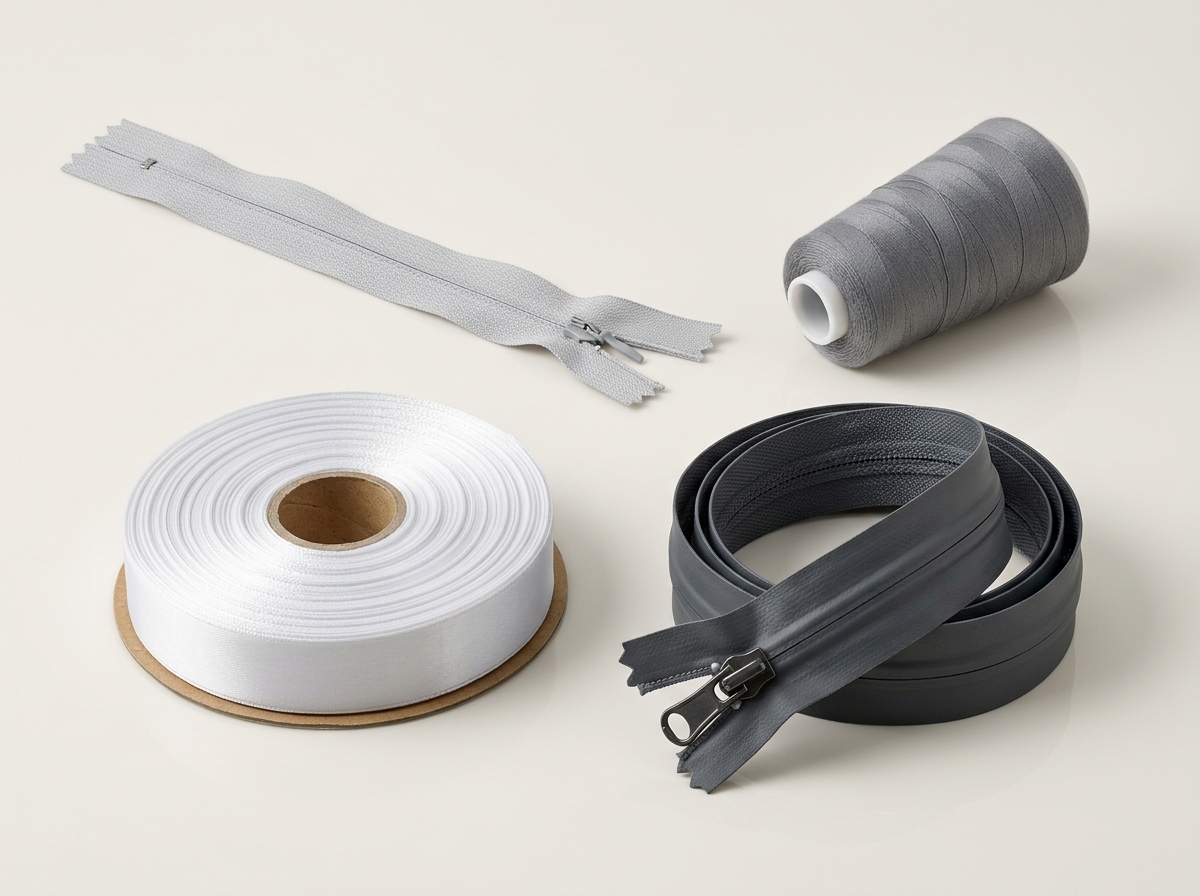
For broader softgoods sourcing, some manufacturers also bundle zipper procurement with other trim categories such as ribbons, lace, and sewing thread when they need coordinated accessories for packaging, finishing, or related apparel lines. While those categories are not waterproof zipper substitutes, they matter in multi-category buying programs that share color standards and shipping schedules.
FAQ
What is the difference between a waterproof zipper and a water-resistant zipper?
A waterproof zipper is designed to block water entry more aggressively through coating or lamination, while a water-resistant zipper may only slow penetration under light exposure. The exact distinction depends on test method and product design, so buyers should request data rather than rely on naming.
Which outdoor products need the highest zipper sealing performance?
Technical shells, weatherproof packs, dry-access compartments, and exposed tent openings usually need the highest sealing performance because they face longer moisture exposure and more seam stress than casual outdoor items.
How do I test a waterproof zipper before bulk purchase?
Test it in the final construction, not just as a loose sample. Check water entry, opening force, slider behavior after wet cycles, and seam performance around the ends of the zipper.
What should I ask a waterproof zipper supplier for?
Ask for test reports, size charts, color swatches, MOQ, sample lead time, bulk lead time, and sewing recommendations. If possible, request batch photos and an approval sample to control variation.
Does zipper type affect manufacturing efficiency?
Yes. Stiffer constructions can slow sewing and increase operator fatigue, while poorly matched coatings can create rejection or seam damage. The best choice balances sealing with production speed.
Are standards important when sourcing waterproof zippers?
Yes. Standards such as ISO 811 and ASTM F3039 help buyers define measurable acceptance criteria and compare suppliers more fairly.
How should a small brand source waterproof zippers in 2026?
Start with samples, test in real product constructions, and choose a supplier that can support consistent color, clear specifications, and manageable MOQ. Small brands benefit most from suppliers that understand wholesale timing and repeat orders.

Post time: Jul-12-2026