- Luxury trims should support the silhouette, not compete with it.
- Fabric weight, seam behavior, and color stability matter as much as decoration.
- Wholesale buyers should prioritize sampling, lead time, MOQ, and repeatability.
- Invisible zippers, lace, ribbon, and thread are chosen by use case, not by category alone.
- Reliable sourcing is a procurement decision, not just a design decision.
Professional designers choose sewing accessories for luxury collections with a strict eye on finishing quality, hand feel, and production consistency, because even a 1 mm mismatch in trim alignment can disrupt the perceived value of a garment. In premium apparel, seam appearance is often reviewed against stitch construction principles in ISO 4915, while textile labeling and maintenance expectations can affect how the final piece is presented to the customer under ASTM D5489. For wholesale buyers, the most practical route is usually a curated sourcing mix from category pages such as ribbon wholesale, lace trims, zippers, sewing thread, and sewing tools, because luxury collections depend on accessory systems rather than isolated items.
Why sewing accessories define luxury garment accessories
Luxury sewing accessories affect how a garment looks, drapes, and survives repeated wear.
In high-end fashion, apparel trims are not just decorative extras; they shape first impressions, construction quality, and perceived craftsmanship. A visible zipper pull, a rough lace edge, or thread that reflects light too aggressively can make an expensive dress feel unfinished. Designers therefore evaluate sewing accessories as part of the garment architecture, not as afterthoughts.
This matters most in bridalwear, formal dresses, and premium womenswear, where the accessory must either disappear cleanly or become a deliberate design statement. For example, an invisible nylon zipper is favored when the closure should not interrupt the line of a fitted skirt, while decorative lace is selected when edge treatment needs to add texture without increasing bulk. That distinction is why wholesale buyers often need both functional and decorative categories in the same order cycle.
| Accessory type | Typical luxury use | Design priority | Procurement note |
|---|---|---|---|
| Invisible nylon zipper | Dresses, gowns, skirts | Hidden closure line | Color match and smooth insertion are critical |
| Polyester sewing thread | Main seams, topstitching, repairs | Strength and color consistency | Check cone size and shade repeatability |
| Lace trims | Bridal, eveningwear, hems | Visual richness and hand feel | Review pattern repeat and edge finish |
| Ribbon | Packaging, bows, garment details | Surface finish and drape | Confirm width, weave, and dye lot |
How designers choose sewing accessories by garment category
The garment category determines which sewing accessories are acceptable and which are risky.
Designers rarely choose luxury garment accessories from a generic catalog mindset. Instead, they start from the garment’s structure: a wedding dress needs invisible finishing and soft tactile detailing, a cocktail dress may need more decorative contrast, and a luxury DIY capsule may prioritize easy handling and repeatable supply.
For bridalwear, the most common requirement is finesse. Lace trims must sit flat, seams should remain smooth under stress, and closures should stay hidden under body movement. For womenswear, the balance shifts toward comfort and versatility, especially if the garment must perform across day-to-evening wear. For DIY and small-batch labels, the selection logic often includes ease of sewing, packaging convenience, and supplier responsiveness.
- For bridal collections, prioritize invisible zippers, delicate lace, and low-bulk seam finishes.
- For luxury womenswear, prioritize colorfast thread, clean edging, and consistent trim widths.
- For DIY capsules, prioritize easy-to-handle accessories, ready packaging, and flexible MOQ.
- For gift or presentation sets, prioritize ribbon quality, color harmony, and visual cohesion.
Wholesale procurement teams often simplify this by building a trim matrix before sampling begins. That matrix usually records fabric type, accessory width, color code, intended placement, and wash expectations, so the design team and factory are aligned before bulk ordering.
Luxury garment accessories and the science of material selection
Material choice determines whether sewing accessories support luxury construction or undermine it.
Most premium apparel programs rely on a few core material families because they offer predictable behavior in production. Polyester sewing thread remains popular for general garment construction because it balances strength, abrasion resistance, and cost stability. Polyester ribbon works well in decoration and packaging because it holds shape better than softer materials in many presentation uses. Nylon zippers are often selected for smooth operation and lower visual weight, especially in hidden applications.
Material performance is easier to manage when teams understand technical baselines. For example, polyester is widely used in apparel because of its relatively high tensile performance and dimensional stability compared with many natural-fiber alternatives. In industrial sewing, stitch performance is often checked through seam efficiency and seam slippage testing, especially when light, medium, and delicate fabrics behave differently under tension. Those checks are part of why repeatable specification control matters in luxury sourcing.
| Material | Common luxury use | Why designers choose it | Buying check |
|---|---|---|---|
| Polyester | Thread, ribbon, lace bases | Stable, durable, scalable | Color consistency and lot repeatability |
| Nylon | Invisible zippers | Smooth closure and low profile | Teeth alignment and slider motion |
| Blend constructions | TC lace, mixed trims | Balance of texture and durability | Hand feel and edge stability |
| Cotton-rich structures | Craft and heritage looks | Natural appearance | Dimensional stability and care behavior |
At the procurement stage, the key question is not only what the accessory looks like, but how it behaves after cutting, sewing, pressing, and transport. A luxury buyer should always request samples that reflect the actual fabric weight and finish of the target collection, because a trim that works on satin may fail visually on matte crepe.
How invisible zippers and lace trims shape premium silhouettes
Hidden closures and delicate edge details are two of the strongest signals of luxury finishing.
Invisible zippers are essential when a designer wants the garment line to remain uninterrupted. This is especially true for fitted dresses, formal skirts, and bridal gowns, where any visible closure can break the visual flow. The goal is not only concealment, but also ease of use, smooth insertion, and reliable alignment after repeated wear.
Lace trims play a different role. They introduce texture, romance, and pattern hierarchy. In bridal and eveningwear, lace can define hems, sleeves, necklines, and overlays. The best lace does not overwhelm the garment; it creates controlled detail that supports the silhouette.
Because both product types are highly visible, sourcing consistency becomes a design issue. A slight shade drift between batches can create visible mismatch under studio lighting. A poorly calibrated zipper tape can pucker at the seam. That is why many designers request multi-round samples before approving bulk production.
| Decision factor | Invisible zipper | Lace trim | Why it matters |
|---|---|---|---|
| Visibility | Minimal | High | Luxury pieces need controlled visibility |
| Functional role | Closure | Decoration and edging | Use case determines technical spec |
| Common risk | Puckering | Pattern mismatch | Both can reduce perceived quality |
| Procurement focus | Slider smoothness | Edge finish and repeat | Sample testing reduces rejection |
Wholesale buying criteria for sewing accessories in luxury collections
Wholesale buyers should evaluate sewing accessories on production readiness, not only on appearance.
For B2B sourcing, luxury garment accessories must be judged by five procurement variables: MOQ, sample timing, color consistency, packaging quality, and delivery reliability. These variables directly affect whether the design team can launch on schedule and whether the factory can maintain the intended finish across a full production run.
In practice, many buyers reduce risk by ordering a sample set that includes multiple widths, shades, and material finishes. This is especially important for ribbon, lace, and thread because the same visual category can behave very differently across fabric types. A ribbon that looks elegant in a gift box may feel too stiff on a garment bow. A lace that appears refined in isolation may become visually heavy once applied to a lightweight dress.
- Confirm the target garment category before selecting trims.
- Request actual swatches against the main fabric, not just catalog images.
- Check color tolerance across batch samples and reorders.
- Verify packaging format for export and warehouse handling.
- Review lead time, MOQ, and replenishment capability together.
For luxury collections, the sourcing process works best when the supplier can provide stable specification records and quick sample turnaround. That is why category pages such as lace trims and zippers are often reviewed alongside ribbon wholesale and sewing thread instead of in isolation.
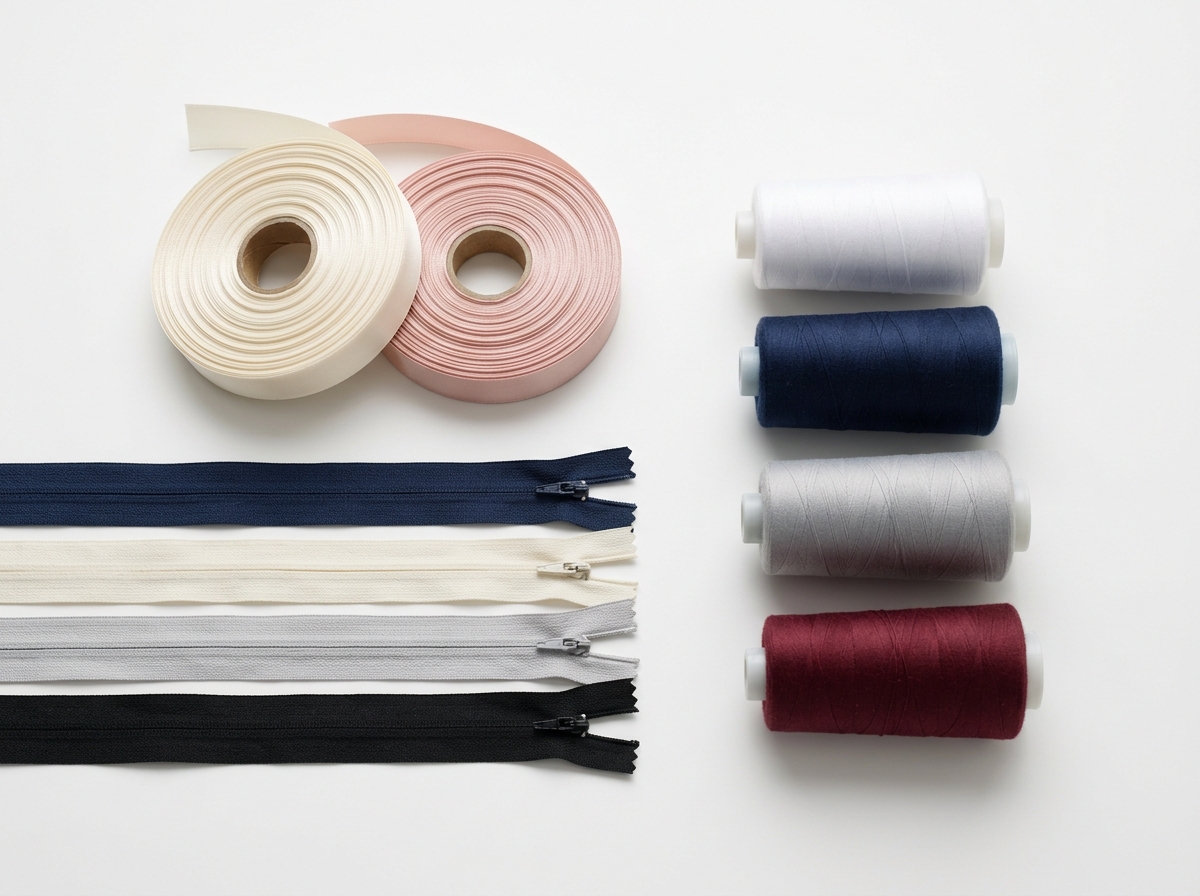 Recommended specification checks before bulk order
Specification checks protect luxury collections from visible quality loss.
Before bulk approval, designers and buyers should verify at least the following points: width, hand feel, color code, edge finish, and compatibility with the base fabric. For sewing thread, that means checking spool size, twist stability, and whether the thread supports both seam construction and topstitch visibility. For zippers, it means checking tape flexibility, slider action, and how the closure sits after pressing. For lace and ribbon, it means checking repeat consistency and edge stability after cutting.
The most effective luxury sourcing teams use a simple approval protocol. They compare samples under daylight-equivalent lighting, sew test pieces on target fabric, and inspect the result after pressing. That process helps reveal whether the accessory supports the garment’s final form or introduces unwanted bulk, sheen, or stiffness.
| Check point | Thread | Ribbon | Lace | Zipper |
|---|---|---|---|---|
| Color match | Essential | Essential | Essential | Important |
| Functional test | Seam tension | Drape and fold | Cut edge and stretch | Slide and closure |
| Aesthetic test | Stitch visibility | Surface sheen | Pattern clarity | Hidden placement |
| Production risk | Thread breakage | Warp distortion | Edge fray | Puckering |
How designers manage risk in luxury sewing accessories sourcing
Risk management is the difference between a beautiful prototype and a successful collection launch.
Luxury sourcing often fails when teams assume that a sample approval equals bulk stability. In reality, trims and accessories are vulnerable to dye lot variation, handling damage, and carton compression during export. This is especially true for decorative items such as lace and ribbon, where subtle visual variation is easy to spot in a premium garment.
Professional teams reduce risk by setting a simple control system: approved reference sample, documented size spec, recorded color code, and incoming inspection rules. If a collection spans multiple styles, the buyer should also define which trims are interchangeable and which are style-specific. That avoids last-minute substitution that weakens the design language.
- Keep one master approval sample per accessory type.
- Record width, finish, and color code in the tech pack.
- Test sewing accessories on the actual base fabric.
- Inspect incoming goods for lot consistency before cutting.
- Reserve premium trims for visible zones and use stable basics elsewhere.
For buyers sourcing from a wholesale supplier, this discipline is especially valuable because it turns a broad catalog into a controlled product system. New Swell is better understood as a sourcing partner for accessories and tools than as a single-item seller, which matters when a collection needs coordinated categories rather than isolated trims.
Practical buying framework for wedding, womenswear, and DIY lines
The best sewing accessories strategy changes with the intended user and sales channel.
Wedding collections require the highest visual precision, so designers often choose lace, invisible zippers, and soft-edged ribbon that can support photography, fitting, and long wear. Womenswear lines usually need a more balanced mix of appearance and durability, especially when garments move from showroom to retail floor. DIY lines, by contrast, need flexibility, clear packaging, and easy-to-handle accessories that do not intimidate beginner makers.
That means the same wholesale catalog can serve three different markets if the buyer segments correctly. A wedding buyer may prioritize ornate lace and hidden closures. A womenswear buyer may prioritize consistent thread and clean finishing. A DIY buyer may prioritize bundled sewing kits and easy retail presentation.
- Wedding: prioritize beauty, concealment, and fabric harmony.
- Womenswear: prioritize durability, repeatability, and production speed.
- DIY: prioritize accessibility, packaging, and simple instructions.
For this reason, category pages such as sewing tools and ribbon wholesale often become strategic references during collection planning, not just after design completion.
What quality standards and test methods help in accessory evaluation
Formal test methods make luxury accessory selection more objective.
While fashion decisions are visual, the approval process should still include measurable checks. Thread and seam performance are commonly evaluated through stitch and seam construction practices referenced in ISO 4915. Textile care labeling and aftercare planning can also affect customer expectations, which is why ASTM D5489 is useful when building product documentation. For broader textile compliance and testing frameworks, buyers often review U.S. Consumer Product Safety Commission textile guidance and the NIST publication database for measurement and material references.
These references do not replace design judgment, but they help teams align on verifiable criteria. If a luxury label wants fewer production surprises, it should define acceptable tolerances in the tech pack and then test samples against those expectations before bulk approval.
| Reference | What it supports | Why it matters in luxury sourcing |
|---|---|---|
| ISO 4915 | Stitch and seam construction | Helps standardize sewing quality review |
| ASTM D5489 | Care labeling planning | Supports customer-facing product information |
| CPSC textile guidance | Compliance awareness | Useful for market-entry checks |
| NIST publications | Measurement and material references | Helpful for technical documentation |
Frequently asked questions about sewing accessories for luxury collections
What are the most important sewing accessories for luxury garments?
The most important sewing accessories for luxury garments are invisible zippers, premium sewing thread, lace trims, and ribbon, because they influence both finish quality and visual identity.
How do designers choose between lace and ribbon for luxury apparel trims?
Designers choose lace when they need texture and pattern complexity, and ribbon when they need controlled surface detail, bows, edges, or packaging coordination.
Why are invisible zippers preferred in dressmaking?
Invisible zippers are preferred in dressmaking because they preserve the garment line and reduce visual interruption on fitted silhouettes.
What should wholesale buyers check before ordering luxury garment accessories?
Wholesale buyers should check MOQ, sample quality, color consistency, packaging, lead time, and compatibility with the base fabric before ordering bulk quantities.
Are polyester sewing threads suitable for premium apparel?
Yes, polyester sewing thread is widely used in premium apparel because it offers reliable strength, stable color, and broad production compatibility.
How can a buyer reduce risk when sourcing apparel trims overseas?
A buyer can reduce risk by approving samples on actual fabric, documenting exact specifications, and requiring consistent lot control for repeat orders.
Which sewing accessories are most relevant for wedding collections?
Wedding collections usually rely most on lace trims, invisible zippers, ribbon details, and fine sewing thread for clean finishing and visual refinement.

Post time: Sep-09-2026