- Polyester sewing thread is the most versatile choice for garments because it balances strength, stretch recovery, and wash resistance.
- Thread selection should follow fabric structure, seam load, needle size, and finish quality, not only color matching.
- For B2B sourcing, the right thread is also a procurement decision: cone count, MOQ, shade consistency, and lead time matter as much as technical performance.
- Standards and measurable specs help buyers compare suppliers more reliably than marketing claims.
Polyester sewing thread is the default workhorse for apparel manufacturing, home sewing, and repair because it performs well across many fabric types, from lightweight woven cotton to moderately stretchy knits, and its strength and durability fit everyday laundering and seam stress; for comparison, textile testing and sewing quality control often reference objective methods such as ISO 13934-1 for tensile properties and ASTM D1683 for seam strength, making the thread choice easier to evaluate in measurable terms. For wholesale buyers, this matters even more because the same polyester thread may be used across dress production, wedding garments, DIY kits, and repair programs, so the best selection is the one that fits both fabric behavior and sourcing requirements.
How to choose polyester sewing thread by fabric type
The right polyester sewing thread is the one that matches fabric thickness, surface smoothness, and seam movement.
Lightweight fabrics need a finer, smoother thread to avoid visible puckering, while heavier fabrics need a stronger thread that can withstand higher seam tension. Stretch fabrics usually benefit from polyester because it keeps better recovery than many cotton alternatives, but the needle, stitch density, and seam construction still need to support the fabric’s movement. For buyers sourcing sewing thread, the practical question is not only whether the thread is polyester, but whether its construction suits the end use.
| Fabric type | Recommended thread approach | Typical use case | Buying note |
|---|---|---|---|
| Sheer or lightweight woven | Fine polyester sewing thread | Blouses, lining, delicate dresses | Prioritize smooth finish and low seam bulk |
| Medium-weight woven | All-purpose polyester thread | Shirts, skirts, casual wear | Balanced strength and stitch appearance |
| Knit and stretch fabric | Flexible polyester sewing thread | T-shirts, athleisure, children’s wear | Check seam recovery and stretch compatibility |
| Heavy woven | Higher tensile polyester thread | Denim, workwear, bags | Confirm needle size and seam abrasion resistance |
For lightweight garments, the most common mistake is using a thread that is too bulky for the fabric. That choice can create seam tunneling, puckering, and visible stitch lines, especially on smooth finishes like chiffon, voile, and fine poplin. A finer polyester sewing thread reduces that risk because it sits deeper in the seam without overpowering the cloth surface.
For medium-weight apparel, all-purpose polyester thread usually gives the best balance of versatility and availability. This is where wholesale buyers often standardize a single thread spec across many SKUs to simplify inventory and reduce color management complexity. If your catalog includes both everyday fashion and basic repair kits, a general-purpose polyester thread can cover a surprisingly wide range of production needs.
For knits, stretch recovery is more important than many beginners realize. A seam that looks clean on the machine can still fail after repeated body movement if the thread or stitch structure cannot flex with the fabric. Polyester is widely chosen because it provides stronger elongation behavior than cotton thread in many garment applications, but the final result depends on the stitch type, needle point, and seam allowance.
Polyester thread strength, seam performance, and what the numbers mean
Thread selection becomes more reliable when buyers compare measurable performance rather than vague “strong” or “durable” claims.
Textile testing standards give a common language for evaluating thread-related seam performance. ISO 13934-1 covers tensile properties of fabrics, which helps explain how seam loads transfer into the surrounding material, while ASTM D1683 focuses on seam strength in sewn fabrics. In practical sourcing, that means the same polyester sewing thread can perform very differently depending on the fabric, stitch density, and needle choice.
| Performance factor | Why it matters | What buyers should ask suppliers | Typical evaluation method |
|---|---|---|---|
| Tensile strength | Controls break resistance under load | What is the thread construction and test basis? | Laboratory tensile testing |
| Evenness | Reduces skipped stitches and weak spots | How consistent is diameter across the cone? | Visual inspection and yarn quality control |
| Colorfastness | Protects appearance after washing | What dyeing and wash tests are used? | Wash and light exposure testing |
| Seam abrasion resistance | Prevents failure in high-friction areas | Can it withstand repeated wear at pocket and crotch seams? | Seam abrasion or wear simulation |
A useful sourcing habit is to request the supplier’s test basis, not just the final result. A tensile value alone is less informative if you do not know the filament count, twist level, or test standard used. In many garment programs, consistency matters more than a single peak number because production efficiency depends on whether the thread behaves the same across multiple lots.
For buyers working with dresses, uniforms, and everyday apparel, seam quality is often judged by appearance before failure. A thread that is too thick can telegraph through the fabric, while a thread that is too weak may break during trimming, washing, or finishing. The best polyester sewing thread is the one that preserves both seam integrity and surface aesthetics.
Best polyester sewing thread choices for cotton, knits, denim, and synthetics
Different fabrics demand different thread behavior even when the base material is polyester.
Cotton fabrics usually accept polyester sewing thread very well because polyester provides better wash stability and lower shrink mismatch than cotton thread in many apparel use cases. For smooth cotton shirting, the thread should be fine enough to avoid visible stitch marks. For denim, the thread should be stronger and more abrasion resistant because seams face more friction and higher load.
Knits and stretch fabrics are where many sourcing mistakes happen. If the thread is too rigid, the seam can pop under movement even if the fabric itself is high quality. For these applications, a flexible polyester sewing thread paired with the correct needle and stitch type gives better long-term performance than a generic one-size-fits-all option.
Synthetics such as polyester fabric, blended sportswear, and some fashion fabrics need thread that remains stable under repeated wash cycles and heat exposure. This is one reason polyester sewing thread is commonly used in commercial production: it stays dimensionally more stable than many natural-fiber alternatives in the environments garments actually face.
- For cotton shirts and blouses: choose smooth, fine polyester sewing thread.
- For knits and casual wear: choose flexible polyester thread with good recovery.
- For denim and workwear: choose a stronger thread with better abrasion resistance.
- For synthetic blends: choose a thread with consistent dye matching and wash durability.
 Wholesale buying guide: MOQ, packaging, color matching, and lead time
Wholesale buyers should evaluate polyester sewing thread as a supply chain item, not just a sewing consumable.
When sourcing from sewing accessories suppliers, the key commercial variables are MOQ, color assortment, cone size, labeling, carton packing, and delivery schedule. A thread that works technically but arrives with inconsistent color lots can still create costly production delays. For factory buyers, keeping shade continuity across repeat orders is often as important as tensile performance.
| Procurement factor | Why it matters | Typical buyer question | Risk if ignored |
|---|---|---|---|
| MOQ | Controls inventory pressure | Can I test before bulk purchase? | Overstock of slow-moving colors |
| Shade consistency | Ensures repeat production match | Will the next lot match the first lot? | Visible color variation in garments |
| Packaging | Protects cones in transit | Is the carton suitable for export? | Damage, contamination, rework |
| Lead time | Affects production schedules | How fast can replenishment arrive? | Line stoppage or missed shipment |
For wedding and formalwear buyers, color matching is especially important because seams, topstitching, and finishing details are often visible. For DIY and home sewing, packaging clarity matters more because the buyer may not have an in-house QC team to check lot compatibility before use. In both cases, a clear product spec sheet reduces order risk.
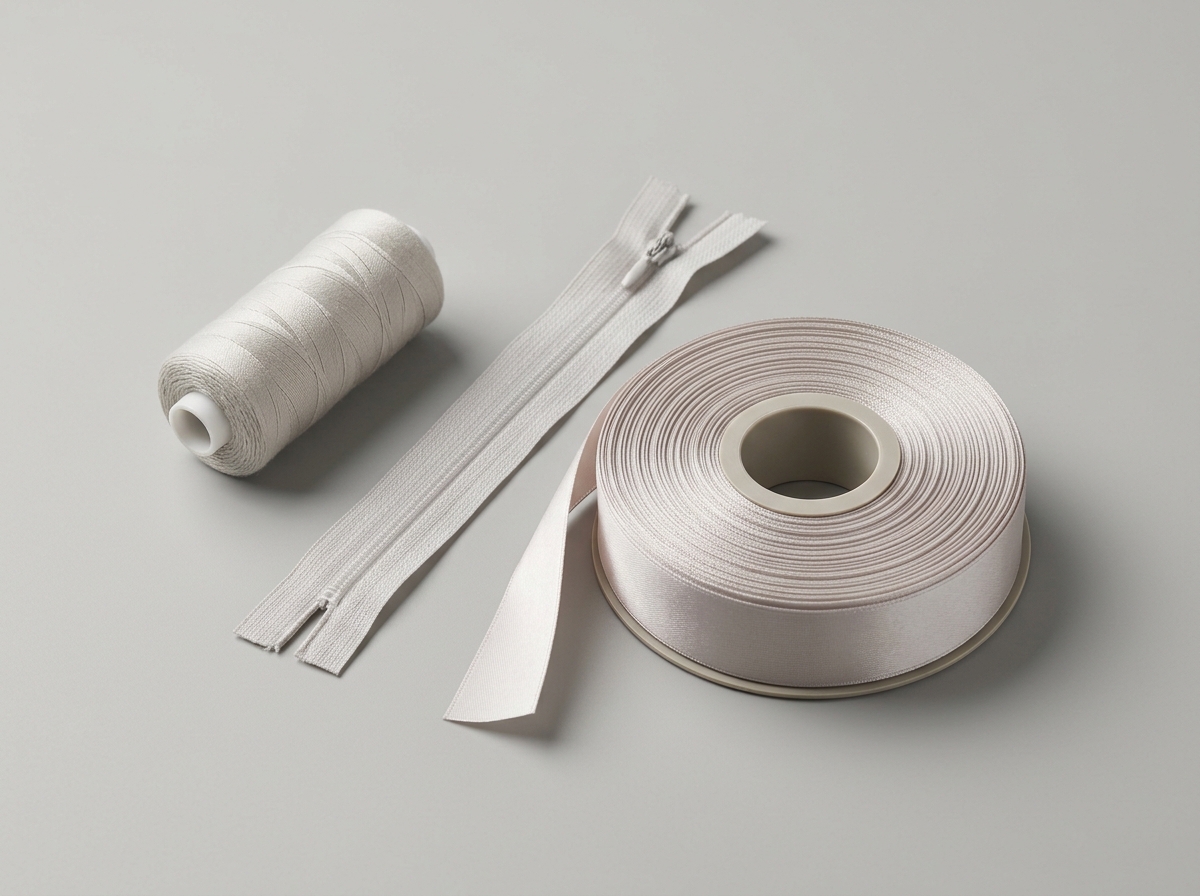
If you are building a wholesale catalog, it is also useful to group thread by application rather than only by raw material. That means organizing products into categories such as everyday apparel thread, heavy-duty thread, stretch-friendly thread, and matching kits for repair or DIY. This approach helps customers choose faster and improves cross-sell with other categories such as ribbons, lace, and zippers.
How to test polyester sewing thread before bulk order
Sampling is the lowest-cost way to avoid expensive production mistakes.
A practical pre-buy test should check stitch appearance, break behavior, wash response, and compatibility with the intended fabric. Even if a thread looks similar on paper, it can behave differently once it is run through a specific machine, needle system, and fabric construction. Buyers who serve wedding, women’s apparel, and DIY markets should test against at least one representative fabric from each category.
- Sew a straight seam and inspect stitch balance on the face and back.
- Check for puckering, skipped stitches, and thread fraying.
- Run a wash or steam test if the garment will be laundered.
- Test seam stress on high-movement areas such as waist, armhole, and side seam.
- Compare color under daylight and indoor lighting before approving the lot.
This type of validation is especially valuable for B2B orders because the lowest unit price is not always the lowest total cost. A slightly better polyester sewing thread can reduce rework, machine downtime, and customer complaints, which often matters more than a small price difference per cone.
For home sewing and repair users, the same logic applies in simpler form. If the thread snarls, breaks frequently, or makes the seam look rough, it is the wrong thread for that fabric. The user experience is better when the thread choice matches the project instead of forcing one universal spool to do everything.
Common polyester sewing thread mistakes and how to avoid them
Most thread problems come from mismatch, not from polyester itself.
- Using a thread that is too thick for delicate fabric.
- Choosing a low-quality cone with poor evenness or inconsistent twist.
- Ignoring needle size, which can damage the thread and fabric together.
- Skipping color tests under the actual lighting conditions of the garment.
- Ordering bulk without confirming wash and seam performance on the real fabric.
The easiest way to reduce these problems is to start from the fabric, not from the thread shelf. Ask what the seam must do, how much it will stretch, how often it will be washed, and how visible the stitching will be. After that, select the thread construction that supports those demands.
Why polyester sewing thread is a strong fit for wholesale apparel sourcing
Polyester sewing thread is the most practical general-purpose choice for modern apparel sourcing because it balances technical reliability with procurement flexibility.
For wholesalers and exporters, polyester thread also fits broad catalog strategies. It serves factories, alteration shops, home sewing customers, and DIY buyers without needing completely different supply chains for each segment. That is why it pairs naturally with a mixed product structure like DIY tools and sewing sets: the buyer can source multiple project essentials from one supplier while keeping the material logic consistent.
From a quality standpoint, the right thread is the one that preserves seam integrity, appearance, and processing efficiency across the fabric types you actually sell. From a commercial standpoint, the right thread is the one that can be reordered in stable colors, predictable packaging, and usable MOQ levels. When those two goals align, polyester sewing thread becomes more than a consumable; it becomes a dependable part of your product system.
FAQ: polyester sewing thread selection
What is the best polyester sewing thread for everyday clothing?
An all-purpose polyester sewing thread is usually the best option for everyday clothing because it balances strength, appearance, and wash resistance across common woven and knit fabrics.
Is polyester thread better than cotton thread?
Polyester thread is often better for general apparel because it usually offers stronger durability, better wash performance, and more consistent recovery in many garment applications.
What polyester thread should I use for stretch fabric?
Use a flexible polyester sewing thread and confirm stitch compatibility with the fabric stretch level, because seam recovery matters as much as raw thread strength.
How do I choose thread for denim?
Choose a stronger polyester sewing thread with good abrasion resistance, and test it on the exact denim weight before approving bulk production.
Why does my polyester thread keep breaking?
Thread breakage usually comes from wrong needle size, poor tension setup, low thread quality, or mismatch between thread thickness and fabric density.
What should wholesale buyers check before ordering sewing thread in bulk?
Wholesale buyers should confirm MOQ, shade consistency, cone size, packaging, test basis, and lead time before placing a bulk order.
Can polyester sewing thread be used for dresses and wedding wear?
Yes, polyester sewing thread is commonly used for dresses and wedding wear, especially when the chosen thread is fine enough to stay discreet and stable enough to handle seam stress.
For technical validation and fabric-performance benchmarking, buyers can also review general textile and garment testing references such as the U.S. government’s NIST resources and the ISO 105-C06 wash-fastness standard, which helps explain why laundering performance matters for thread and fabric systems.

Post time: Jul-22-2026