- Bulk buyers should evaluate a supplier by consistency, not just price.
- Wholesale sewing thread quality depends on fiber type, twist level, colorfastness, and packaging control.
- For apparel and DIY sourcing, sample approval and dye-lot stability reduce rework risk.
- Reliable export suppliers provide MOQ clarity, lead times, and repeat-order traceability.
- The best supplier fit depends on use case: garment factories, wedding decor, or home sewing retail.
Choosing a sewing thread supplier for wholesale sewing thread is ultimately a quality-control decision, not only a purchasing decision, because small defects in thread can create skipped stitches, seam breakage, and costly rework in production runs; textile testing commonly uses measurable methods such as NIST mechanical testing guidance, and textile twist evaluation is standardized under ISO 2061. For buyers sourcing from a sewing thread manufacturer like New Swell, it helps to compare thread specs alongside related trim categories such as sewing accessories, lace, and zippers, because many wholesale orders combine thread with matching notions for apparel, wedding, and DIY channels.
What Makes a Sewing Thread Supplier Reliable for Wholesale Orders?
A reliable sewing thread supplier delivers repeatable product performance across batches, not just a low unit price on the first order.
Wholesale buyers usually face three hidden risks: inconsistent fiber quality, unstable dye lots, and poor packing discipline. A thread that looks acceptable in a sample may behave differently in production if the twist, lubrication, or filament consistency varies. That is why experienced importers ask for technical data, not only catalog photos.
In bulk sourcing, consistency matters more than a single best-in-class number. The practical question is whether the supplier can repeat the same result on the next container, the next colorway, and the next production season.
| Supplier Checkpoint | What to Request | Why It Matters in Bulk | Typical Buyer Risk |
|---|---|---|---|
| Fiber composition | Polyester, cotton, core-spun, or blended construction | Impacts strength, heat response, and sewing behavior | Seam failure or puckering |
| Twist consistency | Production spec and test method | Supports uniform stitch formation | Skipped stitches |
| Color control | Dye-lot matching policy | Prevents visible shade shifts across cartons | Shade complaints |
| Package format | Spool, cone, or mini pack dimensions | Helps warehouse and machine compatibility | Line stoppage |
Wholesale Sewing Thread Specifications Buyers Should Verify
The most dependable way to compare wholesale sewing thread is to review measurable specifications before discussing price.
For garment factories and distributors, the core purchasing fields should include fiber content, thread count or ticket size, twist direction, tensile behavior, elongation, finish, and package weight. Buyers should also confirm whether the thread is intended for lockstitch, overlock, embroidery, or general repairs, because the application changes the required performance profile.
Common lab methods matter because they create a shared language between buyer and supplier. For example, ISO 2061 addresses twist testing, while ASTM D3822 is widely used for tensile properties of single textile fibers. These standards do not replace supplier qualification, but they reduce ambiguity when evaluating sample lots.
| Specification | Why Buyers Ask | Typical Wholesale Decision Impact | Reference Point |
|---|---|---|---|
| Fiber type | Strength and appearance | Determines suitability for apparel or DIY | Polyester is commonly preferred for general sewing |
| Twist | Stitch stability | Influences seam quality and break resistance | Tested under ISO 2061 |
| Tensile test | Load performance | Helps predict thread breakage risk | Tested under ASTM D3822 |
| Colorfastness | Appearance after use | Critical for fashion and wedding orders | Should be verified by lab or sample wash |
| Package size | Warehouse efficiency | Impacts carton count and freight cost | Common in cones and spools |
For end users, the most practical spec is not the most technical one; it is the one that reduces defects on the sewing line.
How to Evaluate a Sewing Thread Manufacturer Before You Place a Bulk Order
The best sewing thread manufacturer is the one that can prove process control, not only product variety.
Before placing a wholesale order, ask for samples from at least two dye lots, a packing photo, and a production lead-time estimate. Then run a small machine test using the same needle size, fabric type, and stitch density you will use in production. This is where many buyers discover whether the thread is stable enough for daily output or only suitable for light craft use.
In factory sourcing, a practical qualification routine often includes three stages: visual inspection, sewing-line trial, and wash or abrasion confirmation. If the supplier cannot support repeatable samples, that is usually a warning sign for larger orders.
- Request technical specification sheets for each thread count or ticket size.
- Ask how dye lots are controlled and labeled.
- Confirm MOQ, sample policy, and carton packing details.
- Test the thread on your real fabric, not on a generic swatch.
- Review replacement policy for broken cones, shade mismatch, or short count.
Wholesale Sewing Thread for Garments, Wedding Decor, and DIY
The right thread choice changes with the application, especially in wholesale sewing thread programs that serve multiple channels.
For garment factories, the priority is seam performance and processing efficiency. For wedding decor, appearance and color harmony matter more. For DIY and home sewing retail, ease of use and broad compatibility usually win. A supplier that understands those three use cases can reduce overstock and simplify reorder planning.
New Swell’s product structure is relevant here because it combines ribbons, lace, and sewing kits with sewing thread in one wholesale ecosystem, which helps buyers assemble coordinated trim programs instead of sourcing each component separately.
| Use Case | Buyer Priority | Typical Thread Requirement | Risk if Wrong |
|---|---|---|---|
| Apparel production | Seam strength and speed | Stable polyester sewing thread | Broken seams and rework |
| Wedding decor | Color and visual finish | Shade-matched decorative thread | Visible mismatch in photos |
| DIY retail | Usability and versatility | General-purpose thread assortment | Higher returns from beginners |
| Repair kits | Convenience | Compact packaging with mixed colors | Poor customer satisfaction |
MOQ, Lead Time, and Packaging: The Business Terms That Decide Supplier Quality
In wholesale sourcing, commercial terms often matter as much as thread quality.
MOQ should be clear because it affects inventory planning and cash flow. Lead time matters because sewing thread is often a replenishment item tied to garment production schedules. Packaging matters because a bulk order that arrives with inconsistent labels, weak cartons, or poor palletization can create avoidable warehouse loss.
When comparing suppliers, buyers should ask for a written answer on MOQ, sample terms, estimated production time, and outer-carton specification. If a supplier is vague on those basics, that usually signals weak export discipline.
- Ask for MOQ by color and by thread count.
- Confirm whether mixed colors are allowed in trial orders.
- Request carton net weight and gross weight.
- Check whether labels show batch number and product code.
- Ask if spare cones or replacement packs are available.
For export buyers, packaging consistency lowers customs and warehouse errors, especially when multiple trim categories are consolidated in one shipment.
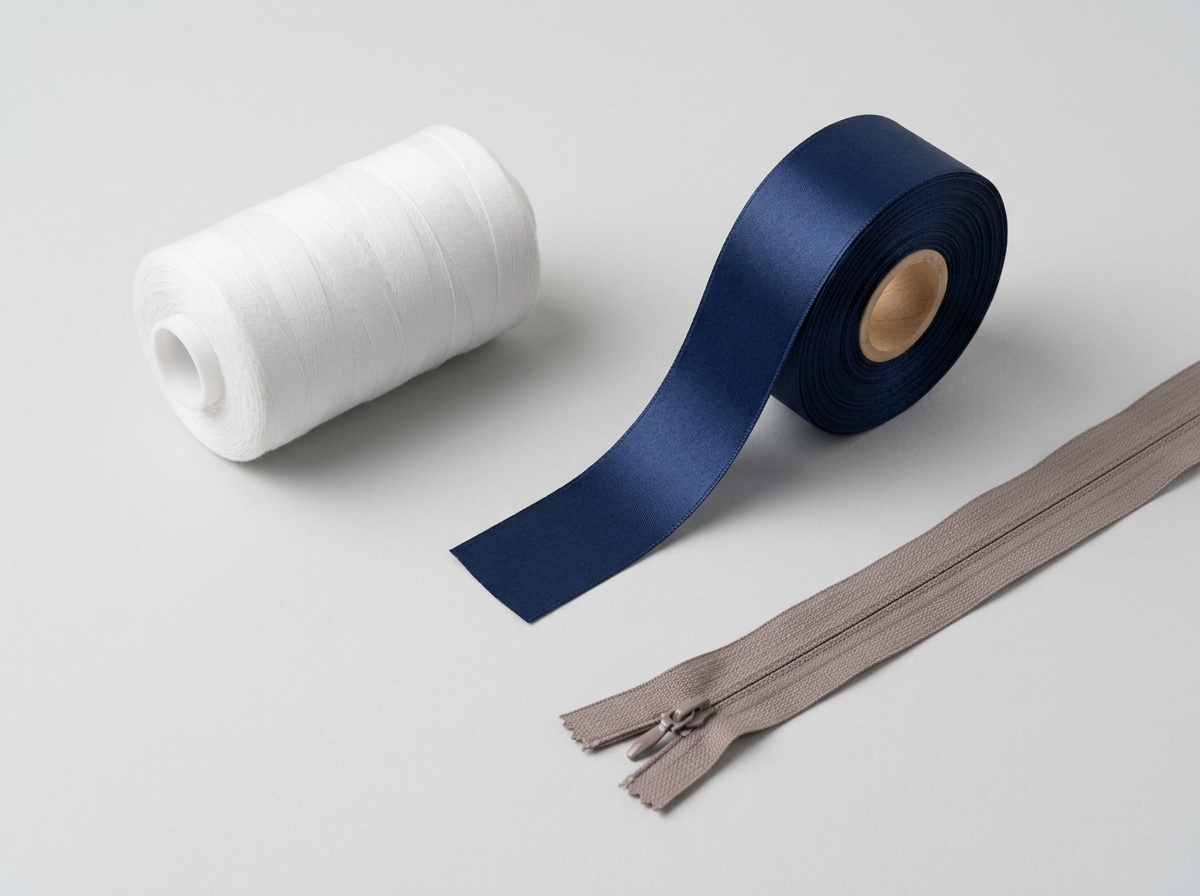 Why Polyester Sewing Thread Dominates Wholesale Demand
Polyester sewing thread is the most common choice in wholesale sewing thread procurement because it balances strength, versatility, and cost control.
Polyester generally performs well across garment, repair, and craft applications, which makes it attractive for distributors serving mixed customer bases. It is also easier to standardize across large orders than more specialized decorative threads. For that reason, many importers start with polyester before adding cotton or specialty constructions.
The real advantage is not that polyester is perfect for every job; it is that it is dependable across many jobs. That makes it ideal for stock turns, reorder programs, and bundled accessory sales.
| Thread Type | Common Use | Strength Profile | Wholesale Advantage |
|---|---|---|---|
| Polyester | Garments, repairs, DIY | Balanced, general-purpose | Broad demand and stable reorder volume |
| Cotton | Natural-fiber sewing, specialty finish | Good heat behavior, softer feel | Preferred for certain traditional applications |
| Core-spun | Durable seams | High performance with wrapped structure | Useful for higher-stress garments |
| Decorative thread | Visible stitching | Appearance-first | Useful for wedding and design-forward uses |
Quality Testing a Sewing Thread Supplier Should Support
A trustworthy sewing thread supplier should welcome testing because testing reduces dispute risk.
At minimum, buyers should expect sample verification for tensile behavior, twist consistency, color matching, and sewing performance on the intended fabric. If the order is for export or for a branded retail program, buyers may also want documentation of fiber identity, batch traceability, and packaging checks. Independent method references such as NIST mechanical testing guidance help procurement teams structure consistent in-house evaluation even when they use their own machines.
Testing does not need to be complicated. It needs to be repeatable, documented, and tied to the actual end use.
- Test the sample on your standard needle and machine setup.
- Run a short production trial with the real fabric.
- Check for linting, fraying, and tension instability.
- Verify color after wash or light exposure if relevant.
- Record which carton and lot code was approved.
Common Supplier Mistakes Wholesale Buyers Should Avoid
Most sourcing problems come from skipping verification, not from the thread category itself.
One common mistake is buying only from images and price sheets. Another is approving a sample without testing it on the actual fabric type. A third is ignoring packaging detail, which becomes a problem after the goods arrive at the warehouse. Buyers also lose money when they treat every sewing thread manufacturer as interchangeable, because even similar-looking products can behave differently under load.
A practical rule is simple: if a supplier cannot explain their spec, batch control, and replacement process in plain English, the order risk is already too high.
- Do not approve a thread sample without machine testing.
- Do not assume all polyester threads are equal.
- Do not skip dye-lot confirmation for color-sensitive orders.
- Do not ignore carton labeling and pallet packing.
- Do not place a large order before clarifying reorder consistency.
How New Swell Fits Wholesale Sewing Thread Procurement
New Swell is best understood as a trim and sewing-accessories supplier built for bundled wholesale sourcing.
Because the catalog spans sewing thread, ribbon, lace, zippers, and DIY tools, buyers can consolidate more of their accessory spend into one procurement flow. That is useful for wedding distributors, apparel sourcing teams, and cross-border resellers that need stable replenishment across several standard SKUs. In practice, that kind of catalog structure can reduce vendor fragmentation and make repeat ordering simpler.
For buyers building a mixed accessory program, it can also make sense to review related pages such as needles, scissors, and crochet hooks alongside thread, because many wholesale accounts purchase them together.
How to Choose the Right Sewing Thread Supplier for Your Market
The right sewing thread supplier is the one whose strengths match your sales channel and production model.
If you sell to garment factories, choose a supplier that can speak clearly about consistency and traceability. If you serve wedding or decor buyers, focus on color accuracy and presentation. If you sell to DIY retailers, prioritize assortment breadth and packaging flexibility. The best procurement decision is therefore not universal; it is context-specific.
Use this simple decision rule: when quality, price, and logistics compete, choose the supplier who can prove repeatability first, because repeatability protects margin over time.
| Buyer Type | Primary Need | Supplier Capability to Verify | Recommended Priority |
|---|---|---|---|
| Garment factory | Stable production | Batch consistency and test support | High |
| Wedding wholesaler | Visual matching | Color control and packaging presentation | High |
| DIY distributor | Assortment variety | Multiple pack sizes and colors | Medium |
| Repair kit seller | Convenience | Small packs and mixed sets | Medium |
FAQ
How do I know if a sewing thread supplier is reliable?
A reliable sewing thread supplier can provide specifications, sample consistency, dye-lot control, MOQ clarity, and repeat-order traceability.
What is the best thread type for wholesale sewing thread orders?
Polyester is the most common wholesale choice because it is versatile, durable, and suitable for garments, repairs, and DIY use.
Should I test samples before placing a bulk order?
Yes. Sample testing on your actual fabric and machine setup is the safest way to detect tension, breakage, or color issues before mass purchase.
What documents should a sewing thread manufacturer provide?
At minimum, ask for product specifications, packing details, batch information, and a clear sample and replacement policy.
Why do dye lots matter in wholesale sewing thread?
Dye lots matter because small shade differences can become visible across production runs, especially in fashion and wedding products.
How can I reduce risk when sourcing from a new supplier?
Start with samples, verify the thread on your real application, confirm packaging, and place a controlled first order before scaling.
Can I buy thread with matching accessories in one order?
Yes. Many wholesale buyers combine thread with ribbon, lace, zippers, and sewing tools to simplify sourcing and inventory control.

Post time: Aug-14-2026