- Needle size should be matched to thread thickness, fabric weight, and stitch type.
- Polyester sewing thread is the most common all-purpose choice for garment sewing and wholesale production.
- Skipped stitches, thread breakage, and seam puckering are usually symptoms of a poor thread-to-needle match.
- For buying decisions, thread count, ticket size, needle system, and end use matter more than color alone.
- Wholesale buyers should also confirm cone size, MOQ, sample availability, and packaging before placing bulk orders.
Sewing thread thickness and needle size are closely linked, and the wrong pairing can disrupt stitch formation even when the machine is set correctly. In industrial sewing, needle systems and size ranges are standardized, such as needle size guidance from the Organ Needle Company, while textile seam quality is often evaluated through standardized test methods like ISO 13935-2 for seam tensile properties. For wholesale buyers and sewing users, the practical question is not only which sewing thread to buy, but which sewing thread thickness will run reliably through a given needle size, fabric type, and machine speed.
Why sewing thread thickness and needle size must be matched together
The first rule is that thread and needle are a paired system, not independent choices. If the thread is too thick for the needle eye, friction rises, heat builds up, and the thread may fuzz or snap before a clean lockstitch forms.
If the needle is too large for the fabric, the hole becomes oversized and the seam may pucker, especially on lightweight woven fabrics. This matters in garment work, where even a small mismatch can affect appearance, seam strength, and production efficiency.
For this reason, many sewing lines use a standard setup for routine apparel work and only switch when the fabric or seam requirement changes. That is why a wholesale buyer comparing sewing thread options should always think in terms of thread thickness, fiber type, and end-use fabric rather than thread color alone.
How to read sewing thread thickness in practical buying terms
Sewing thread thickness is usually described by ticket number, tex, denier, or commercial size, depending on the market and supplier. The important point is that a smaller ticket number often indicates a thicker thread in some systems, while a higher tex number usually indicates more mass per 1000 meters. Because different suppliers label thread differently, buyers should always confirm the actual linear density and recommended needle size range.
In bulk sourcing, this is especially important for polyester sewing thread because one supplier’s 40/2 may not feel identical to another supplier’s 40/2. Ask for the thread construction, twist direction, lubrication finish, and recommended needle range before placing a wholesale order.
| Thread description | Typical use case | Practical needle range | Buying note |
|---|---|---|---|
| Fine sewing thread | Lightweight blouses, lining, delicate seams | 60/8 to 70/10 | Reduces visible stitch bulk |
| Standard sewing thread | Shirts, dresses, general apparel | 70/10 to 90/14 | Most common garment choice |
| Heavy topstitch thread | Decorative seams, topstitching | 90/14 to 100/16 | May need slower speed |
| Upholstery or heavy-duty thread | Denim, bags, structured seams | 100/16 to 110/18 | Check machine tension and needle eye |
These ranges are practical starting points, not rigid laws. The final match depends on fiber type, fabric thickness, and machine condition.
Needle size explained for sewing thread thickness and fabric type
Needle size is the easiest place to start when troubleshooting thread issues. In most home and light industrial sewing, smaller needle numbers are used for finer fabrics, while larger needle numbers are used for thicker fabrics and heavier threads.
For example, a 70/10 needle is generally suited to lightweight woven fabrics and fine to medium thread. A 90/14 needle is often a better fit for standard garment sewing with medium polyester sewing thread. When the thread gets heavier, many sewists move to a 100/16 or 110/18 needle to maintain a smooth thread path through the eye.
| Needle size | Common fabric weight | Best thread thickness | Typical risk if mismatched |
|---|---|---|---|
| 60/8 | Sheer and ultra-light fabrics | Very fine thread | Puckering if thread is too thick |
| 70/10 | Light cotton, voile, lining | Fine to medium thread | Skipped stitches if thread is too bulky |
| 80/12 | Medium shirting and dress fabrics | Medium thread | Needle heat if speed is too high |
| 90/14 | Denser woven fabrics, general apparel | Medium thread | Thread abrasion if eye is too small |
| 100/16 | Heavy twill, denim, canvas | Heavy thread | Fabric damage if point type is wrong |
Needle point type also matters. A sharp needle works well on tightly woven fabrics, while a ballpoint needle helps avoid yarn breakage on knits. If the point type is wrong, even the correct needle size may still produce imperfect seams.
What happens when sewing thread thickness is too large or too small
The wrong thread-to-needle match usually shows up in the seam before it shows up in the machine settings. Most problems are visible, measurable, and preventable.
- Too thick for the needle: thread fraying, skipped stitches, needle heat, audible rubbing at the needle eye.
- Too thin for the needle: weak seam appearance, oversized needle holes, visible puckering on light fabrics.
- Too heavy for the fabric: stiff seam feel, poor drape, seam distortion in fashion garments.
- Too fine for the seam duty: reduced strength in stress zones such as side seams and crotch seams.
In production, these issues waste time because operators often adjust tension first, even though the root cause is thread and needle mismatch. A correct match reduces the need for trial-and-error tension changes.
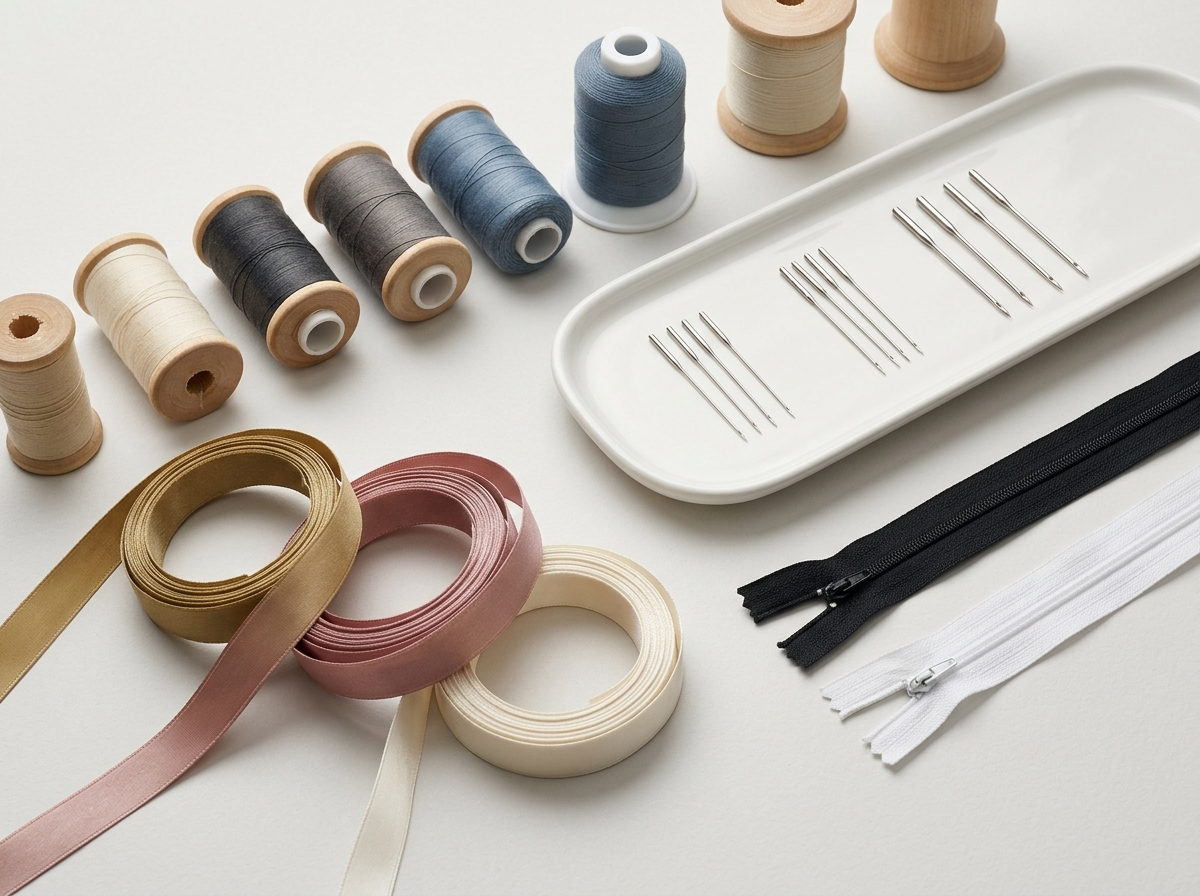
This is also why buyers looking at sewing accessories should treat needles, thread, scissors, and kits as a system. A well-matched accessory set is easier to sell, easier to use, and easier to standardize in wholesale programs.
How to choose sewing thread thickness for garments, wedding wear, and DIY
The best thread choice changes with the use case. Wedding garments, womenswear, and DIY projects do not ask the same thing from a seam, so a universal thread spec is rarely the best answer.
For fashion garments: medium polyester sewing thread is usually the most versatile option because it balances strength, stitch appearance, and machine compatibility.
For wedding and formalwear: finer thread often creates cleaner seams and less stitch visibility on delicate fabrics such as chiffon, tulle, and satin.
For DIY and craft work: buyers may prioritize ease of use over extreme tensile strength, especially when sewing by hand or on entry-level machines.
| Scenario | Recommended thread approach | Suggested needle range | Key concern |
|---|---|---|---|
| Everyday apparel | Medium polyester sewing thread | 80/12 to 90/14 | Balanced seam quality |
| Wedding dress details | Fine thread for low visibility | 60/8 to 70/10 | Stitch discreetness |
| DIY home sewing | General-purpose thread | 70/10 to 90/14 | Ease of handling |
| Heavy craft or bag work | Heavier thread with stronger core | 100/16 to 110/18 | Seam durability |
If the project involves elastic fabric, bonded seams, or decorative topstitching, the thread may need to be adjusted even within the same fabric category. That is why a knowledgeable supplier of garment trims and craft materials is valuable for wholesale buyers who need more than one specification.
Technical standards and measurable quality checks that buyers should know
Quality control should be based on measurable seam behavior, not only on visual inspection. A common way to evaluate seam strength is to test tensile performance using standards such as ISO 13935-2, which covers seam tensile properties by the grab method.
For sewing thread itself, tensile and elongation behavior can be measured under standard textile test frameworks, and seam performance can then be compared against the end fabric. In practical terms, this means the buyer can ask for thread data such as breaking force, elongation, twist level, and linear density before approving bulk production.
Needle systems also follow standardized sizing logic. In many sewing applications, the size designation helps operators move from a fine setup for lightweight cloth to a heavier setup for denim or canvas. This standardization reduces confusion in production and helps when sourcing from multiple factories or export suppliers.
| Quality check | What to measure | Why it matters | Typical buyer action |
|---|---|---|---|
| Thread thickness | Tex, denier, ticket size | Predicts friction and seam bulk | Request spec sheet |
| Needle compatibility | Needle size and point type | Controls stitch formation | Test on target fabric |
| Seam strength | Tensile failure behavior | Confirms end-use durability | Ask for lab results |
| Seam appearance | Puckering and stitch balance | Impacts garment quality | Inspect sample run |
For larger programs, buyers should also request a sample run before confirming MOQ. A sample that sews cleanly at the planned speed is more valuable than a spec sheet alone.
Wholesale buying tips for sewing thread, needles, and accessories
Wholesale buyers should evaluate sewing thread thickness in the same way they evaluate fabric: by use case, machine compatibility, and supply stability.
- Confirm the thread construction, fiber, and linear density before asking for price.
- Match the thread to the needle size you plan to use in production.
- Test at least one sample seam on the actual fabric, not on scrap of a different fabric.
- Check spool size, cone weight, carton packing, and color consistency across lots.
- Ask about MOQ, lead time, and whether mixed colors are available for trial orders.
For buyers building a broader sourcing list, zippers and lace trims often need to be specified alongside thread because seam visibility and closure structure affect the final garment outcome. In that sense, thread selection is part of the full trim package, not a separate decision.
Common mistakes when matching sewing thread thickness with needle size
Most thread problems come from a few avoidable errors. The good news is that they are easy to prevent once the logic is understood.
- Using a heavy thread with a small general-purpose needle.
- Changing thread brand without checking actual thickness and construction.
- Adjusting tension before checking thread and needle compatibility.
- Ignoring fabric type, especially with knits and delicate synthetics.
- Choosing a needle only by size number and not by point type.
Another frequent mistake is assuming that a stronger seam always needs the thickest thread. In reality, seam strength depends on thread, fabric, stitch density, and needle penetration quality together. Overly thick thread can actually reduce seam quality if it distorts the fabric or weakens the stitch formation.
How to build a reliable thread and needle selection workflow
A simple workflow prevents most production errors and makes procurement easier for wholesale buyers. The best workflow starts with the fabric, then the seam function, then the thread thickness, and finally the needle size.
- Identify the fabric weight and structure.
- Decide whether the seam is structural, decorative, or hidden.
- Select a thread thickness that suits both appearance and strength.
- Choose a needle size large enough for smooth thread passage, but not so large that it damages the fabric.
- Run a sample seam and inspect stitch balance, seam flatness, and thread wear.
This workflow works well for garment factories, home sewists, and DIY sellers because it reduces guesswork. It also supports repeat orders, which is important for bulk purchasing and export supply consistency.
Frequently asked questions about sewing thread thickness and needle size
What is the best needle size for standard sewing thread?
For most general garment sewing, 80/12 or 90/14 is a practical starting point for standard sewing thread. The final choice depends on fabric weight and machine condition.
Can a thread be too thick for a needle?
Yes. If sewing thread thickness is too large for the needle eye, friction increases and the thread may fray, break, or create skipped stitches.
Is thicker thread always stronger?
No. Thread strength depends on fiber, construction, and finish, not thickness alone. A poorly matched thick thread can still perform worse than a well-matched medium thread.
Should I change needle size when changing thread brand?
Often yes. Different brands may label thread sizes similarly but behave differently in actual diameter and surface finish.
What needle size is best for polyester sewing thread?
Medium polyester sewing thread commonly works well with 80/12 to 90/14 needles for apparel, but heavier polyester thread may require 100/16 or larger.
How do I know if the thread and needle are mismatched?
Typical signs include thread shredding, needle heat, skipped stitches, seam puckering, and visible friction marks near the needle eye.
What should wholesale buyers ask before ordering sewing thread in bulk?
Ask for ticket size or tex, fiber type, recommended needle size, sample availability, MOQ, cone weight, lead time, and color consistency across lots.

Post time: Jul-28-2026