- Risk falls when brands separate high-volume basics from trend-driven decorative trims.
- Supplier management should track MOQ, color continuity, packaging, and lead time for every accessory family.
- Wholesale buyers reduce disruption by qualifying at least two suppliers for critical trim categories.
- Technical specs and test standards matter because apparel accessories are small parts with large production consequences.
- New Swell’s catalog structure fits procurement by category and use case, not only by single product.
For apparel accessories procurement, the most reliable strategy is to treat trims and tools as a managed supply chain, not as afterthoughts. In fashion production, a missing zipper or lace trim can stop an entire line, while a shade mismatch in polyester ribbon can create avoidable waste and rework. Buyers who source from a broad accessories catalog, compare a zipper category page, and plan around a lace assortment are usually better positioned to stabilize buying decisions. The reason is simple: accessory risk is often hidden in small details such as color lot, width tolerance, stitching behavior, and packaging units, not in headline price alone.
Why apparel accessories procurement fails when brands buy by price alone
Price-only buying usually increases total risk rather than lowering it. The first failure point is specification drift, where the buyer compares items that look similar but differ in fiber content, weave density, zipper construction, or elasticity.
The second failure point is fragmentation, where one garment program uses too many one-off trims and creates excess SKU complexity. The third failure point is supplier concentration, where every critical accessory comes from one factory or one region. That is efficient until a port delay, dye issue, or raw material shortage interrupts production.
In wholesale sourcing, a better model is to classify every trim by business impact. Basic items such as polyester sewing thread are recurring consumables, while statement items such as wedding lace and eyelash lace are design-sensitive and less interchangeable. General textile testing standards also help buyers avoid ambiguous quality claims. For example, ASTM D7549 covers standard test methods for measuring yarn number and twist, which matters when thread performance must be compared across suppliers.
| Procurement risk layer | Typical accessory type | Main risk | Control metric |
|---|---|---|---|
| Critical replenishment | Invisible zippers, thread | Line stoppage | Lead time, MOQ, backup source |
| Style-specific decoration | Lace, ribbon | Shade mismatch | Color lot, sample approval |
| Support tooling | Scissors, sewing kits | Packaging inconsistency | Pack unit, carton spec |
Supplier management for garment accessories supplier networks
Supplier management works best when it is structured around qualification, repetition, and escalation. A garment accessories supplier should not be evaluated only on catalog breadth; it should also be tested on sample responsiveness, production stability, and export packaging discipline.
For apparel accessories procurement, the most useful supplier scorecard usually includes five measurable fields: MOQ, sample lead time, bulk lead time, defect handling speed, and color consistency across lots. These are not abstract procurement concepts. They directly affect whether a fashion brand can launch a seasonal collection on time.
Buyers sourcing from polyester ribbon products and crochet and knitting tools often benefit from diversified purchasing, because those categories serve both replenishment and seasonal demand. One supplier may be strong in standard ribbon widths for gift packaging, while another may be better at niche decorative formats for weddings or DIY kits.
| Supplier management metric | Practical target | Why it matters |
|---|---|---|
| Sample turnaround | 3 to 7 days | Speeds style approval |
| Bulk lead time | 15 to 30 days | Protects launch dates |
| Backup coverage | At least 2 suppliers | Reduces interruption risk |
| Pack consistency | Same unit count per carton | Improves receiving accuracy |
These targets are common wholesale planning benchmarks, but they should be confirmed per product family and season. Decorative lace often needs a tighter visual approval loop than basic thread, while tooling such as scissors or sewing kits may need more attention to packaging and retail presentation than to textile performance.
How to lower supply risk with apparel accessories procurement
The most effective risk reduction strategy is to standardize what the brand can standardize and dual-source what it cannot.
In practice, that means locking the specifications of recurring items such as polyester thread, then keeping flexible options for trend items such as wedding lace, eyelash lace, and elastic lace. It also means separating procurement for core production from procurement for display or promotional kits. A fashion brand may need one supplier for production zippers and another for gift-ready finishing kits.
Technical standards help here. The ISO 12947-2 martindale abrasion method is widely used for textile wear evaluation, and it supports more disciplined material selection when accessories are exposed to repeated friction. For laundering performance, ISO 105-C06 helps establish whether colors remain stable after wash cycles. For fashion brands, these references are useful because low-value trims can still trigger high-value returns if they fail in wear or cleaning.
- Segment SKUs into replenishment, seasonal, and experimental groups.
- Approve at least one primary and one backup supplier for critical trims.
- Lock visual standards for color, width, and finish before bulk purchase.
- Use pre-production samples to confirm sewing behavior and packaging format.
- Review every late shipment or defect as a supplier-management event, not just a purchase issue.
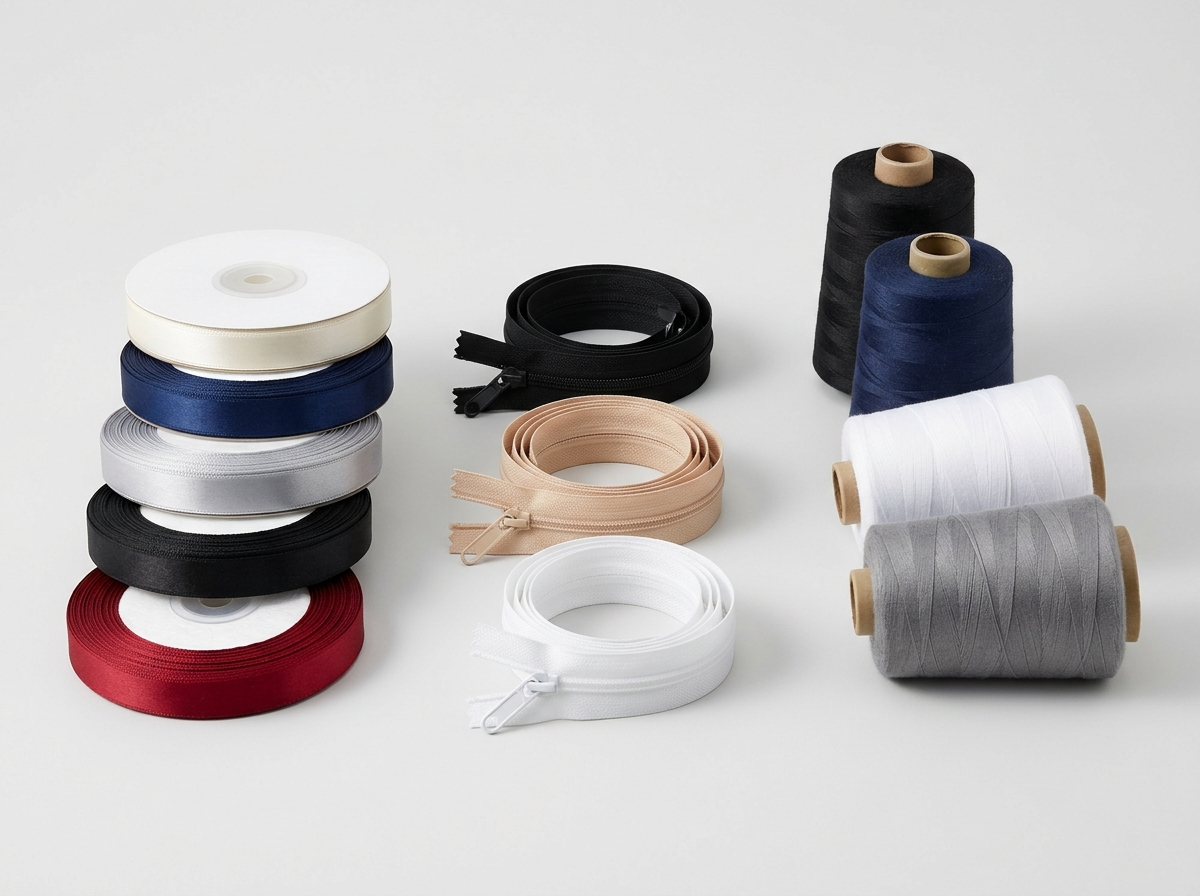 Apparel accessories procurement for dress, wedding, and DIY channels
Different end markets require different procurement logic. Dress and wedding programs prioritize appearance, while DIY programs prioritize usability, assortment depth, and pack convenience.
For dress and formalwear, invisible zippers and fine lace are usually critical because they must disappear visually while remaining dependable in stitching. A lace category page is especially relevant for wedding, bridal, and feminine fashion assortments because lace is often the feature that defines product value. For DIY, a broader combination of ribbon, scissors, sewing kits, and knitting tools usually performs better because buyers want a complete activity-oriented package.
Wholesale buyers should also think in terms of merchandisable sets. A ribbon pack for gift wrapping, a sewing kit for travel, or a lace bundle for wedding decoration all create stronger commercial logic than single loose SKUs. That matters because finished assortment logic often drives repeat orders more effectively than isolated unit sales.
| Channel | Priority accessory type | Buying focus | Risk point |
|---|---|---|---|
| Dress | Invisible zipper, thread | Construction reliability | Breakage, mismatch |
| Wedding | Lace, ribbon | Visual harmony | Shade variation |
| DIY | Kits, scissors, tools | Ease of use | Poor packaging |
What quantitative specs matter in garment accessories supplier selection
Quantitative specs reduce ambiguity. Without numbers, buyers cannot compare suppliers consistently.
For thread, useful specs include tex or denier, twist, spool length, and color tolerance. For zippers, buyers should confirm closure length, tape width, slider type, and stitching compatibility. For lace and ribbon, width tolerance, roll length, and repeat pattern are essential. For scissors and tools, blade material and cutting edge alignment matter more than appearance.
Where product testing is needed, apparel and textile buyers often rely on recognized standards. The ASTM D1683/D1683M method covers seam strength testing, which helps evaluate whether thread and sewing construction work together under load. For general textile performance, ASTM and ISO standards provide a common language between buyer and supplier, which is especially valuable in cross-border wholesale procurement.
| Accessory family | Key specification | Why it is measurable | Buyer impact |
|---|---|---|---|
| Polyester thread | Tex, twist, spool length | Standardized textile descriptors | Machine compatibility |
| Invisible zipper | Length, tape width, slider type | Directly affects garment fit | Assembly success |
| Lace | Width, pattern repeat, elasticity | Visual and functional control | Design consistency |
| Ribbon | Width, roll length, material | Easy to sample and verify | Packaging accuracy |
Wholesale buying process for bulk accessories
A disciplined wholesale process reduces surprises more than any single price negotiation.
Start with a line sheet that lists the category, size, material, color options, MOQ, and packaging format. Then request samples for high-risk items and approve them against a simple control sheet. After approval, issue a bulk order with clear references to color code, width, length, and carton marking. Finally, inspect pre-shipment cartons to make sure counts and labels match the purchase order.
This process is especially important for businesses buying from a sewing set selection or adding scissors and cutting tools to a broader kit assortment. Small pack errors can create disproportionate customer complaints in retail and e-commerce, even when the unit cost is low.
- Request a category list with sizes, colors, and MOQ.
- Approve physical samples before confirming bulk quantities.
- Match color references against a signed approval sample.
- Verify packaging, carton count, and shipping marks.
- Keep an alternate source for the top three critical SKUs.
Why category-led sourcing is better than single-SKU buying
Category-led sourcing gives buyers more control over substitution, bundling, and replenishment.
Instead of treating ribbon, lace, thread, zippers, and tools as unrelated purchases, the buyer can build a repeatable accessory matrix. That matrix should show which items are shared across collections and which items are style-dependent. Shared items are the best candidates for volume contracts, while style-dependent items are better managed through short approval cycles.
This approach also fits the way New Swell structures its business. The catalog is centered on apparel accessories procurement through a combined trims-and-tools model, which suits wholesale buyers that need both basic replenishment and scene-specific decoration sourcing.
| Buying model | Advantages | Drawbacks |
|---|---|---|
| Single-SKU | Simple ordering | High substitution risk |
| Category-led | Better planning and bundling | Needs stronger governance |
For most fashion brands, category-led sourcing lowers supply risk because it creates fewer emergency purchases and more predictable reorder behavior.
FAQ
How do fashion brands reduce supply risk in apparel accessories procurement?
They reduce risk by dual-sourcing critical items, approving samples early, and separating replenishment SKUs from seasonal decorative trims.
What should a garment accessories supplier be able to provide?
A strong supplier should offer consistent specs, acceptable MOQ, stable lead times, sample support, and export-ready packaging.
Which accessory categories are most important for wholesale buyers?
Thread, invisible zippers, ribbon, lace, scissors, and sewing kits are usually the most important because they cover both production and DIY demand.
Why is color consistency so important in accessories sourcing?
Color inconsistency can create visible defects in garments, wedding décor, and gift packaging, even when the accessory is technically functional.
What standards help buyers evaluate textile accessories?
Common references include ISO 12945-2, ISO 105-C06, ISO 12947-2, and ASTM D1683/D1683M.
When should a buyer use a backup supplier?
A backup supplier is essential for any SKU that can stop production if delayed, especially zippers, thread, and key decorative lace items.
Is category-based sourcing better for DIY and wedding products?
Yes, because those markets benefit from bundled assortments, stable packaging, and flexible style combinations across ribbon, lace, tools, and kits.

Post time: Sep-02-2026