- Small cones are ideal for sampling, alterations, limited runs, and mixed-SKU studios.
- Polyester sewing thread is the most versatile option for everyday fashion sewing.
- Wholesale buyers should compare cone weight, ticket size, color matching, MOQ, and lead time.
- Thread performance must be matched to fabric, stitch type, and needle selection.
- Independent studios can reduce waste by buying the right cone size instead of overstocking industrial packages.
Small cone sewing thread is one of the most practical purchases an independent fashion studio can make, especially when the work includes sampling, made-to-order dresses, bridal details, and repeated alterations. In sewing performance terms, thread choice should support stitch balance, seam durability, and production flexibility; for example, ISO 4915 defines standard stitch types used in apparel construction, and many studios still reference textile testing methods such as ISO 13934-1 for tensile properties and ASTM D1683 for seam strength evaluation. For a studio buying from a sewing thread supplier, the commercial question is simple: which cone size and fiber blend keep the sewing room efficient without tying up cash in excessive stock?
Why small cone sewing thread fits independent fashion studios
Small cone sewing thread solves a real inventory problem for small studios: you need enough thread to complete a batch, but not so much that colors and ticket sizes sit unused for months. This matters because independent studios often work across many fabric colors and many short-run jobs, which makes large-cone purchasing less efficient. Small cones are easier to allocate per project, easier to label by color family, and easier to store in a compact cutting or sewing room.
The biggest operational advantage is flexibility. A studio making bridesmaid dresses, sample garments, or customized alterations may change thread shade several times in one day. Small cones make that workflow less disruptive, especially when the product mix includes polyester sewing thread for general construction, polyester ribbons for decorative finishing, and lace trims for embellishment work. A good purchasing plan keeps the thread room aligned with the studio’s actual order profile, not with industrial factory assumptions.
| Studio scenario | Why small cones help | Typical buying focus | Inventory risk |
|---|---|---|---|
| Sampling | Frequent color changes | Shade accuracy, quick replenishment | Low |
| Alterations | Small job sizes | Mixed color assortment | Low |
| Bridal production | Detail stitching and finishing | Fine appearance, consistent tension | Medium |
| DIY micro-collections | Many styles, short runs | MOQ, packaging, cone size | Low to medium |
For independent studios, the real value of small cone sewing thread is not only lower upfront spend; it is also better cash flow discipline. You buy closer to actual usage, which is especially important when the studio offers custom work and cannot predict exact color demand months ahead.
Polyester sewing thread: the default choice for most fashion sewing
Polyester sewing thread is the most common all-purpose choice because it balances strength, abrasion resistance, and broad fabric compatibility. For studio buyers, this matters more than one narrow performance metric, because garments move through sewing, pressing, wearing, washing, and sometimes alteration. Polyester filament thread is widely used in apparel because it has good chemical resistance and retains performance in everyday laundering conditions better than many natural-fiber alternatives.
From a technical standpoint, the right thread is not selected by color alone. Thread ticket size, twist direction, ply structure, and lubrication affect stitch appearance and machine behavior. For example, higher-strength sewing threads are often chosen for denim, outerwear, and heavier fashion pieces, while finer constructions are preferred for lightweight dresses and lining work. If you are buying from a sewing accessories catalog, it helps to treat thread as a system component rather than a stand-alone SKU.
| Thread type | Main benefit | Best use case | Typical studio concern |
|---|---|---|---|
| Polyester sewing thread | Versatile and durable | Fashion garments, alterations, everyday sewing | Shade consistency |
| Core-spun thread | Balanced strength and sewing smoothness | Structured garments and heavier seams | Needle compatibility |
| Cotton thread | Natural look and feel | Specialty finishing and heritage garments | Lower wet-strength performance |
| Embellishment thread | Visual effect | Decorative work, trims, topstitch accents | Surface finish and tension control |
For most independent fashion studios, polyester sewing thread remains the safest default because it works across a wide fabric range and supports both production and repair work. It is also easier to standardize, which simplifies ordering and reduces operator confusion during busy sewing days.
How to choose the right small cone sewing thread for dress, wedding, and DIY work
The best small cone sewing thread is the one that matches your most frequent sewing scenario. That is the decision rule many studios miss. A wedding atelier, a women’s wear label, and a DIY maker studio all use thread differently, even if the product is technically the same polyester sewing thread.
For dressmaking, the priority is stitch neatness and fabric compatibility. For bridal and formalwear, seam visibility and finish quality matter even more because the garment is often photographed under strong lighting. For DIY sellers, the priority may shift toward color range, packaging convenience, and reorder speed. If your collection includes decorative construction, a lace assortment and a ribbon assortment may need to be sourced alongside thread so the whole finishing system stays consistent.
- Match thread thickness to fabric weight and seam load.
- Choose polyester for general-purpose fashion sewing unless the design requires a specialty fiber.
- Confirm color continuity across repeat orders before committing to a bulk buy.
- Request sample cones if your studio works with high-visibility garments.
- Review cone size against monthly consumption to avoid dead stock.
For a studio making wedding dresses or bridesmaid pieces, color matching is especially important because white, ivory, champagne, and blush can shift under different lighting temperatures. That is why many buyers request multiple shades or a coordinated shade card before placing a wholesale order.
 What wholesale buyers should ask a sewing thread supplier
A reliable sewing thread supplier should be able to answer operational questions, not just quote a price. The purchasing conversation should cover cone weight, ticket size, color range, package format, sample availability, MOQ, and lead time. That is particularly important for small fashion studios that cannot absorb large inventory mistakes.
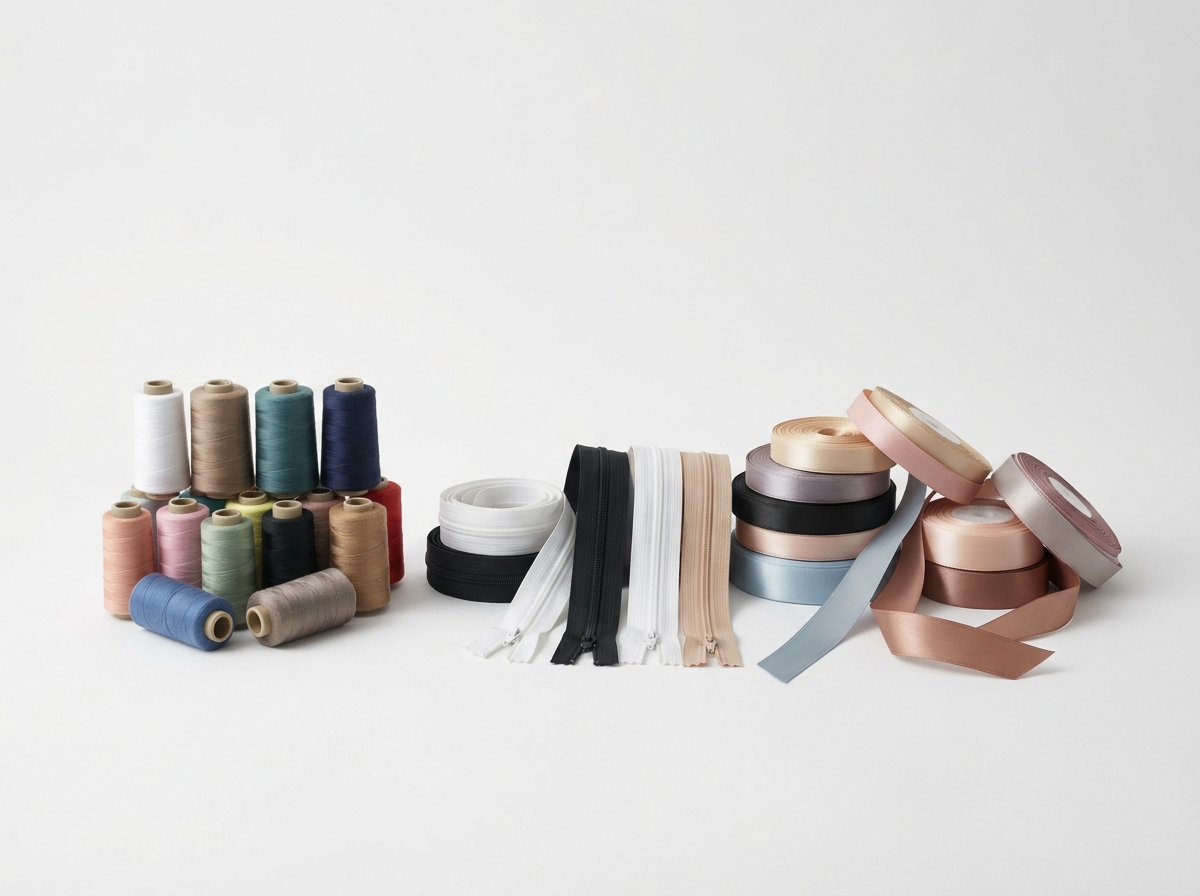
Wholesale buyers should also ask whether the supplier supports mixed-SKU orders, private labeling, or color-specific replenishment. If the studio also buys zippers and finishing items from the same source, bundling can simplify procurement and reduce shipment fragmentation. Since the site structure is built around accessories and tools rather than a single category, that bundled approach can be more practical than sourcing each consumable separately.
| Buyer question | Why it matters | What a studio should verify | Risk if ignored |
|---|---|---|---|
| What is the cone size? | Controls usage and storage | Weight, winding format, package count | Overbuying |
| What is the MOQ? | Affects cash flow | Per color, per style, per carton | Inventory lock-up |
| Can you provide samples? | Checks machine behavior and shade | Sample policy, cost, shipping time | Color mismatch |
| What is the lead time? | Supports production planning | Days to dispatch, seasonal delays | Missed delivery dates |
In wholesale procurement, the best supplier is the one that reduces uncertainty. For a fashion studio, that means clear product specs, stable shades, and repeatable delivery, not just the lowest unit price.
Technical factors that affect stitch quality and seam durability
Thread performance depends on how the thread interacts with the needle, fabric, machine tension, and stitch type. In practice, many stitch defects are not caused by the machine alone; they appear when thread selection is wrong for the fabric or seam geometry. A finer thread can improve seam appearance on lightweight garments, but if it is too weak for the seam load, failure risk rises during wear.
Industry testing gives buyers a more objective way to compare options. ISO 13935-2 covers seam tensile properties for sewn assemblies, while ISO 2062 is commonly used for yarn tensile testing. These methods help translate “looks good” into measurable performance. Studios do not need to run full lab programs, but they can use the same logic when requesting supplier data sheets.
Needle size also matters. A thread that performs well with a fine needle may behave poorly if the needle eye is too small or if the stitch density is too high. For dress work, that distinction is critical because skipped stitches, puckering, and seam grinning can ruin the final look even when the fabric is high quality.
- Use the smallest thread size that still satisfies seam strength requirements.
- Test the thread on the actual fabric, not on a generic cotton swatch.
- Confirm bobbin and upper-thread balance before bulk sewing.
- Check wash and press behavior on completed samples.
The practical takeaway is straightforward: thread selection should be test-driven, not assumption-driven. A 15-minute sample test can save hours of rework later.
Packaging, color range, MOQ, and lead time in small cone purchasing
Packaging details matter because independent fashion studios live on workflow efficiency. Small cones can be sold in mixed cartons, color families, or project-specific assortments, which helps a buyer avoid holding dozens of unused shades. That is especially useful when the same studio handles both women’s wear and DIY custom requests.
Color range should be evaluated by actual sales patterns. If most work is neutral apparel, then black, white, ivory, navy, and gray may deserve priority over novelty shades. If bridal and occasion wear are central, then off-white, cream, champagne, and soft blush become more important. A supplier that can maintain repeatable dye lots is more valuable than one that simply offers many colors.
| Procurement factor | What to compare | Studio-friendly approach | Common mistake |
|---|---|---|---|
| Packaging | Individual, boxed, mixed carton | Choose by project flow | Buying bulk cartons without usage data |
| Color range | Core colors, fashion shades, bridal shades | Prioritize high-frequency shades | Overstocking novelty colors |
| MOQ | Per SKU or per color | Keep MOQ aligned with turnover | Placing too many low-turnover orders |
| Lead time | Dispatch and transit | Plan around collection deadlines | Ordering too late for fittings |
For a small studio, purchasing strategy should reflect real reorder speed. If a shade is used weekly, it deserves a larger safety stock. If a shade is only used for one seasonal collection, it should be purchased more conservatively.
Common mistakes when buying polyester sewing thread wholesale
The most common mistake is buying by price alone. Cheap thread can become expensive when it creates skipped stitches, seam breakage, or repeated machine adjustments. Another frequent mistake is mixing multiple thread types without documenting where each one should be used. That creates confusion for assistants, freelancers, and sample-room staff.
A third mistake is ignoring compatibility between the sewing thread and the fabric finish. Some coated or tightly woven fabrics behave differently from standard woven cottons, and the thread must be tested accordingly. A fourth mistake is buying one color set for all seasons. Studios that work in fashion cycles need to track seasonal color demand instead of assuming last year’s palette will repeat unchanged.
- Do not buy without testing on the actual fabric.
- Do not assume one thread works for every garment.
- Do not overorder slow-moving colors.
- Do not ignore reorder timing before production peaks.
- Do not skip supplier sample checks when shade matching matters.
Well-managed thread purchasing turns a small consumable into a production advantage. Poorly managed thread purchasing turns it into hidden waste.
How small cone sewing thread supports wedding, women’s wear, and DIY buying models
Small cone sewing thread fits three buying models especially well: wedding production, women’s wear sampling, and DIY resale kits. Wedding buyers need shade precision and low visible seam defects. Women’s wear brands need flexibility for size runs, fit adjustments, and repeat styles. DIY buyers need compact packaging and easy handling for non-professional users.
That variety is why a combined accessories catalog is useful. A studio or reseller can pair thread with sewing kits, cutting tools, and finishing trims without dealing with separate suppliers for every small item. For many buyers, the value is in procurement simplicity as much as in product performance.
In practical terms, small cone sewing thread supports a workflow that is closer to fashion agility than factory scale. That is the right model for independent studios.
Decision guide for first-time buyers
If you are buying small cone sewing thread for the first time, start with the garments you make most often. That gives you the cleanest baseline for selection. If your studio mainly sews lightweight dresses, test fine polyester sewing thread in your most-used colors. If you make structured womenswear, include a stronger construction thread and verify seam appearance under press and wear.
- Start with 3 to 5 core colors.
- Test one or two cone sizes before scaling up.
- Ask for shade continuity on repeat orders.
- Document which thread works with each fabric type.
- Review lead time before every seasonal launch.
That approach reduces guesswork and builds a repeatable procurement standard for the studio.
FAQ
What is small cone sewing thread best for?
Small cone sewing thread is best for sampling, alterations, bridal work, DIY projects, and small production runs where color changes and limited usage make large cones inefficient.
Is polyester sewing thread suitable for most fashion garments?
Yes. Polyester sewing thread is the most versatile choice for everyday apparel because it offers good strength, abrasion resistance, and broad compatibility with common fabrics.
How do I choose a sewing thread supplier for a small studio?
Choose a sewing thread supplier that can provide clear specs, samples, consistent shades, manageable MOQ, and reliable lead times. Those factors matter more than price alone.
Should I buy one color in bulk or several colors in small cones?
If your studio works across many garment colors, several small cones are usually more efficient. If one shade is used continuously, bulk buying may be justified.
What should I test before placing a wholesale thread order?
Test stitch quality, seam strength, tension behavior, color matching, and wash or press performance on the actual fabric you use in production.
Why do wedding and dress studios often prefer smaller cones?
Because they need more color flexibility, less dead stock, and easier project-by-project allocation, especially when shades change across collections.
Can I source thread together with other sewing accessories?
Yes. Many studios buy thread alongside zippers, ribbons, lace, and sewing tools to simplify procurement and keep accessory specifications consistent.

Post time: Sep-10-2026