- Apparel companies judge suppliers with a scorecard, not a single quote.
- For garment accessories, repeatability matters more than one-off product claims.
- MOQ, color control, sample approval, and lead time can decide whether a supplier becomes approved.
- International buyers expect proof of compliance, traceability, and defect control.
- Wholesale suppliers for dress, wedding, and DIY channels need both catalog depth and process discipline.
Supplier evaluation for apparel supplier selection is a risk management exercise, especially when the products are standardized wholesale items such as ribbon, invisible nylon zippers, sewing thread, lace, and sewing accessories. In textile quality control, measurement systems matter: ISO 12947-2:2016 defines the Martindale abrasion test, while ISO 105-C06:2010 covers color fastness to domestic and commercial laundering. Buyers also look for dimensional accuracy under NIST SI guidance because bulk apparel accessories must stay consistent across production lots. For a category-focused supplier like New Swell, the evaluation lens should center on wholesale continuity, scene fit for wedding, women’s wear, and DIY, and the ability to supply stable catalog items at scale.
How International Apparel Companies Evaluate an Apparel Supplier
The best supplier scorecards start with repeatability, not promises.
Global apparel buyers usually split supplier evaluation into five practical layers: product quality, factory capability, compliance, service, and commercial fit. The commercial fit matters because a supplier may make a good sample yet still fail at bulk replenishment, packaging consistency, or documentation. For wholesale garment accessories, this is especially important: a lace SKU that looks correct once can still fail if color lots drift, rolls are wound unevenly, or carton labeling breaks the buyer’s warehouse process.
One common mistake is to treat every supplier the same. A garment accessories manufacturer supplying ribbon, zippers, thread, and lace is not judged like a fashion garment factory. Accessories are often standardized, high-repeat, and margin-sensitive, so international buyers prioritize lot-to-lot stability, sample accuracy, and the ability to maintain the same color, width, and finish across reorder cycles. That is why a clear supplier evaluation framework is essential for wholesale sourcing.
Supplier Evaluation Criteria for Apparel and Garment Accessories
Quality, delivery, and documentation are the three evaluation pillars that decide most sourcing outcomes.
| Evaluation Area | What Buyers Check | Typical Evidence | Why It Matters |
|---|---|---|---|
| Product quality | Defect rate, size tolerance, color consistency | Inspection report, approved sample, test data | Reduces returns and line stoppages |
| Lead time | Sample time, bulk time, reorder speed | Production schedule, shipping history | Supports replenishment planning |
| MOQ and flexibility | Minimum order quantity by SKU and color | Catalog terms, quotation sheet | Controls inventory risk |
| Packaging control | Inner pack, carton size, labeling accuracy | Packaging spec sheet, carton mark proof | Prevents warehouse errors |
| Compliance | Audit readiness, restricted substances, traceability | Test reports, declarations, factory records | Protects the buyer’s brand and market access |
For wholesale buying, measurable thresholds matter more than subjective approval. For example, color difference is often checked with a spectrophotometer using ASTM E308 for standard practice in calculating color coordinates. In textile programs, buyers may also request laundering or rubbing performance references through standards such as ISO 105-X12:2016 for color fastness to rubbing. These tests help compare one supplier against another using a repeatable method rather than visual guesswork.
Why Apparel Buyers Care About ISO and Test Standards
Standards turn supplier claims into verifiable evidence.
International apparel companies rely on standards because buying decisions must survive audits, customer complaints, and repeat orders. A supplier saying “high quality” is not enough; a buyer wants proof that the material performs consistently under defined conditions. That is especially relevant for supplier evaluation in accessories, where the product may be simple but the risk of mismatch is high. A zipper that closes smoothly in the sample but jams in bulk can trigger costly rework.
The most useful standards are the ones that align with the product’s risk profile. For lace, buyers often care about abrasion, appearance retention, and color fastness. For ribbon, edge fray, width consistency, and dye stability matter. For sewing thread, tensile strength and evenness are critical. For DIY tools, handle durability and finish quality can influence returns. When a supplier can point to recognized standards and show lot-level testing, the sourcing conversation becomes faster and more credible.
| Product Type | Key Risk | Relevant Standard or Method | Buyer Focus |
|---|---|---|---|
| Ribbon | Color drift | ASTM E308 / ISO color methods | Shade repeatability |
| Invisible zipper | Functional failure | Internal pull-cycle and opening checks | Smooth operation |
| Sewing thread | Breakage | Tensile and twist testing | Strength and evenness |
| Lace | Surface wear | ISO 12947-2 abrasion | Appearance retention |
| DIY tools | Safety and durability | Material and finish inspection | Reliability in use |
For buyers comparing factories, a supplier who understands these standards will usually move through qualification faster than one who only offers a low quote. That is one reason product-category suppliers with strong catalog discipline often perform well in international sourcing programs.
What Buyers Expect from a Wholesale Apparel Supplier
Wholesale buyers evaluate operational reliability as much as product quality.
In apparel sourcing, operational reliability means the supplier can support repeated orders with stable communication, clean packaging, and acceptable production timing. A good apparel supplier answers technical questions clearly, sends accurate samples, and follows approval instructions without extra back-and-forth. For buyers sourcing wedding lace, women’s wear trims, or DIY sewing kits, this reliability directly affects launch timing.
International buyers usually look for six commercial signals. First, the supplier should confirm MOQ by SKU, color, and package format. Second, sample lead time should be realistic and consistent. Third, the supplier should explain whether custom packaging is available. Fourth, the supplier should show how quality checks are done before shipment. Fifth, the supplier should provide honest freight and incoterm discussion. Sixth, the supplier should be able to support reorders without redesigning the product each time.
- Confirm whether MOQ changes by material, size, or color.
- Ask for approved samples before bulk production.
- Check whether carton and inner pack labeling can be customized.
- Verify lead time for both sample and bulk orders.
- Request defect handling rules before payment.
For a category-focused business like New Swell, these buying signals are especially important because its catalog is built around wholesale ribbon, zippers, sewing thread, and lace. That structure fits B2B procurement better than a single-SKU selling model.
Supplier Evaluation Standards for Dress, Wedding, and DIY Scenarios
Scenario fit is a major part of supplier selection for apparel accessories.
International apparel companies often buy the same product family for different end uses, and each use case changes the evaluation standard. A ribbon for wedding decoration is not judged the same way as a ribbon for gift packaging. A lace trim for a bridal dress requires more aesthetic stability than a lace edge for home sewing. A sewing kit for travel needs compact packaging, while a DIY bundle for a hobby store needs shelf-ready presentation.
| Scenario | Primary Buyer Concern | Supplier Evaluation Focus | Typical Commercial Requirement |
|---|---|---|---|
| Wedding | Appearance and consistency | Shade control, delicate finish, packaging | Low visual defect tolerance |
| Women’s wear | Fit and functional integration | Invisible zipper performance, trim compatibility | Stable reorder quality |
| DIY | Ease of use | Assortment depth, clear instructions, bundle design | Retail-friendly packaging |
| Factory replenishment | Volume continuity | MOQ, production planning, delivery reliability | Bulk lead-time control |
Because these use cases differ, buyers may score the same supplier differently by category. A factory might be excellent for wedding lace but only average for sewing accessories if packaging and assortment control are weak. That is why category-level evaluation is often more effective than a generic vendor review.
Quantitative Checks Used in Supplier Evaluation
Numbers make supplier comparison clearer and reduce bias.
Many international buyers use quantitative gates before approving a supplier. Although thresholds vary by brand and product, the logic is the same: measure what can fail. For example, textile buyers may request color difference data, width checks, or inspection sampling records. In apparel accessories, these checks often combine with a visual inspection standard such as AQL sampling. A common reference in inspection practice is ANSI/ASQ Z1.4, which supports attribute sampling plans for lot inspection.
Packaging and labeling are also measurable. Carton dimensions, inner pack counts, and barcode readability can be verified before shipment. For repeat items, some buyers track reorder accuracy by lot. A supplier that can maintain stable specifications across multiple production runs often receives stronger long-term status than a supplier that only wins on first-order pricing.
| Metric | Typical Buyer Check | What Good Looks Like | Impact on Approval |
|---|---|---|---|
| Color difference | Instrument comparison | Consistent shade by lot | High |
| Width or length | Measured sample audit | Matches approved spec | High |
| Defect rate | Incoming and pre-shipment inspection | Stable, low rejection | High |
| Lead time | Sample and bulk schedule | Predictable and documented | High |
| Label accuracy | Carton check | No SKU mismatch | Medium to high |
For garment accessories, a supplier’s ability to manage these numbers is often more important than having a large product list. A focused catalog with controlled specifications usually outperforms a broad catalog with inconsistent execution.
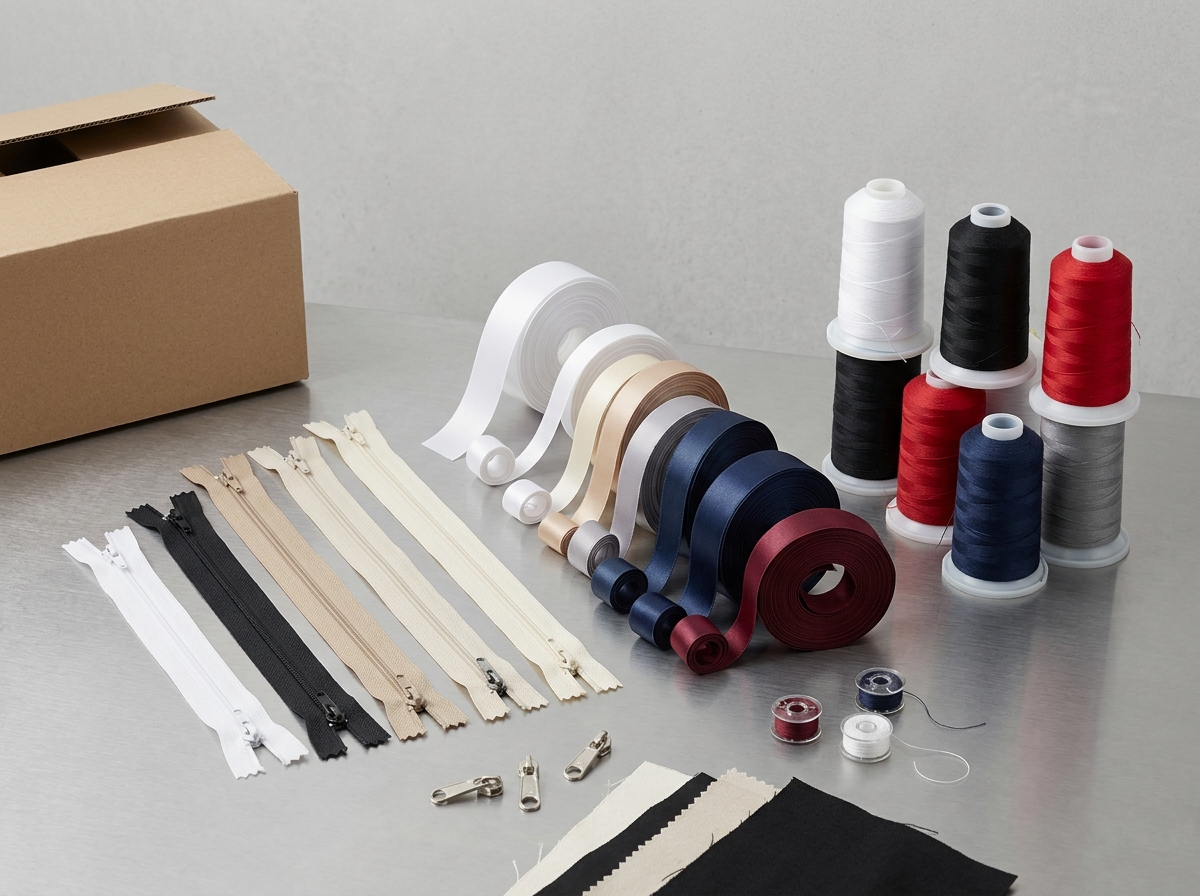 How to Compare a Garment Accessories Manufacturer Before Approval
The most efficient comparison method is a weighted scorecard.
Buyers can shorten sourcing cycles by using a scorecard with weighted categories. A practical model is to assign 30 percent to quality, 25 percent to delivery reliability, 20 percent to commercial terms, 15 percent to compliance, and 10 percent to communication. The weights can shift depending on the program, but the structure helps teams avoid overvaluing price alone.
When comparing two suppliers, ask the same questions in the same order. Request product specs, sample confirmation, MOQ, lead time, package format, and quality process. Then verify whether answers are consistent across sales, production, and logistics contacts. Gaps between departments are often a warning sign.
- Check whether the sample matches the written spec.
- Confirm whether the MOQ is realistic for your channel.
- Review whether packaging can protect the product in transit.
- Ask how the supplier handles shade variation or part mismatch.
- Verify whether reorders will be made from the same standard.
A reliable garment accessories manufacturer will usually welcome this process because it clarifies expectations and reduces disputes later. For wholesale buyers, that clarity is valuable.
Where New Swell Fits in Supplier Evaluation for Wholesale Buyers
A category-based supplier can be a strong fit when the buyer wants breadth and repeatability.
New Swell’s catalog structure is built around wholesale accessories rather than one narrow product line, which can be useful for international apparel buyers who need consolidated sourcing. That matters because many teams prefer fewer vendors when procurement involves ribbon, zippers, thread, lace, and basic DIY tools. A combined catalog can reduce administrative time and simplify sample coordination.
For buyers sourcing through a wholesale channel, the most relevant question is not whether the supplier has a large showroom. It is whether the supplier can consistently support wedding, women’s wear, and DIY programs with the right MOQ, packaging, and product stability. In that context, the internal product organization of ribbon, sewing thread, lace, and sewing accessories can help buyers build a more efficient approved-vendor list.
For businesses that need assortment depth and scene-based sourcing, this kind of directory-style supplier structure is often more practical than isolated single-item purchasing. It supports procurement at the category level, which is how many international apparel companies actually buy.
Supplier Evaluation Mistakes That Cause Sourcing Failures
Most sourcing failures come from incomplete evaluation, not from one bad order.
The first common mistake is accepting a low price before checking sample consistency. The second is ignoring packaging and labeling, even though they determine warehouse efficiency. The third is approving a supplier without clarifying reorder rules. The fourth is assuming that one strong product means the entire catalog is equally controlled. The fifth is skipping document review for compliance and traceability.
These mistakes are costly because apparel supply chains are time-sensitive. If a wedding program misses a window, the issue is not only quality but also lost sales timing. If a women’s wear zipper arrives late, the production line can stop. If a DIY kit is packed incorrectly, customer reviews can fall. Good supplier evaluation prevents these downstream issues.
Practical Supplier Evaluation Checklist for Apparel Companies
A short checklist can expose most supplier risks before the first bulk order.
- Request a written product specification for every SKU.
- Approve a physical sample before mass production.
- Confirm MOQ, lead time, and reorder conditions.
- Check whether packaging can match your sales channel.
- Ask for test methods or inspection records.
- Verify whether the supplier can support multiple categories.
If the supplier passes these six checks, the risk profile is usually manageable for wholesale accessories. If several checks fail, the buyer should either renegotiate terms or keep the supplier on a backup list.
FAQ About Supplier Evaluation Standards Used by International Apparel Companies
What do international apparel companies look for first in a supplier?
They usually look for quality consistency, lead time reliability, and proof that the supplier can meet the required specification in bulk.
How is an apparel supplier different from a general trader?
An apparel supplier is expected to understand product specifications, repeat orders, quality control, and packaging in the context of garment sourcing.
Why are standards important in supplier evaluation?
Standards create a common basis for comparing suppliers using measurable tests rather than opinion.
What matters most for garment accessories manufacturers?
Repeatability matters most, especially for color, size, finish, and packaging consistency across production lots.
How do buyers evaluate wholesale lace or ribbon suppliers?
They check shade control, width stability, packaging, MOQ, sample quality, and whether the supplier can support the same spec again later.
What is a realistic supplier evaluation process for small and mid-size buyers?
A practical process is sample review, spec confirmation, MOQ check, quality documentation review, and a small pilot order before scaling up.
Can one supplier cover wedding, women’s wear, and DIY needs?
Yes, if the supplier has a structured catalog, clear category control, and the operational discipline to manage different packaging and quality expectations.

Post time: Sep-06-2026