- Experienced factories reduce sourcing risk by standardizing materials, specifications, and inspection steps.
- Wholesale buyers benefit most when the sewing factory can supply a full trim-and-tool mix, not a single item.
- For wedding, womenswear, and DIY markets, product selection depends on finish, durability, and packaging format.
- Reliable sampling, MOQ planning, and lead-time communication are often more valuable than the lowest initial quote.
- Quality benchmarks can be tied to recognized standards such as ISO 105-C06 and ASTM D1388.
For wholesale buyers, the competitive advantage of working with an experienced sewing factory is measurable: lower rework risk, cleaner specification control, and better alignment between product construction and end use. Textile and accessory decisions are often judged by objective benchmarks such as colorfastness testing in ISO 105-C06, fabric drape measurement in ASTM D1388, and tensile test methods such as ASTM D2256/D2256M. For buyers of ribbon, zipper, thread, lace, and DIY accessories, these controls matter because the product may be small, but the sourcing failure can be expensive.
The Competitive Advantage of Partnering with Experienced Sewing Factories
Experienced sewing factories create value by turning fragmented trim sourcing into a controlled procurement process. That is especially important for apparel manufacturer buyers who need consistent sewing accessories supplier performance across multiple SKUs, packaging formats, and seasonal orders.
Why an experienced sewing factory outperforms a low-price supplier
An experienced sewing factory is usually better at converting a purchase request into a production-ready specification. In wholesale sourcing, that difference reduces misunderstandings around width, dye lot, needle compatibility, finish level, and carton packing.
The most important advantage is predictability. A factory that works regularly with ribbons, invisible nylon zippers, polyester sewing thread, and lace can usually anticipate where failures happen: color mismatch, edge fraying, stretch inconsistency, or incorrect packaging counts. That experience helps apparel buyers avoid hidden costs that are not visible on the quote sheet.
| Buying factor | Low-experience supplier | Experienced sewing factory | Commercial impact |
|---|---|---|---|
| Sampling time | 7-14 days | 3-7 days | Faster buyer approval cycle |
| Spec clarification rounds | 3-5 rounds | 1-2 rounds | Lower communication cost |
| Color consistency control | Limited lot control | Controlled dye lot tracking | Better repeat orders |
| Packaging accuracy | Variable | Standardized | Fewer inbound disputes |
These ranges are practical sourcing estimates based on export-buying workflows, not universal standards. They become especially relevant when the order combines multiple accessory families from one sewing factory rather than being split across several vendors.
How apparel manufacturer expertise improves product fit for each use case
Apparel manufacturer experience matters because trims are not interchangeable across applications. A polyester ribbon used for wedding packaging has a different buyer expectation from a ribbon used on garment labeling or handcraft kits.
For example, satin ribbon is often selected for gift wrapping, wedding decoration, and decorative garment finishing, where surface appearance matters more than structural load. By contrast, invisible nylon zipper is chosen when the opening must disappear into the garment line, such as skirts, dresses, and womenswear. A factory with category knowledge can recommend the right balance of softness, flatness, and closure reliability.
In procurement terms, that means fewer trial-and-error purchases and better conversion from sample to bulk order. It also improves communication with designers and merchandisers who need accessory specs that match the garment concept.
| Product category | Typical use | Key buying metric | Common risk |
|---|---|---|---|
| Polyester ribbon | Wedding, gift, DIY | Width, sheen, roll length | Color variation |
| Invisible nylon zipper | Dress, skirt, womenswear | Length, coil smoothness | Visible closure line |
| Polyester sewing thread | Garment production, repair | Count, twist, strength | Thread breakage |
| Lace trim | Bridal, fashion, home decor | Pattern density, edge stability | Fraying and deformation |
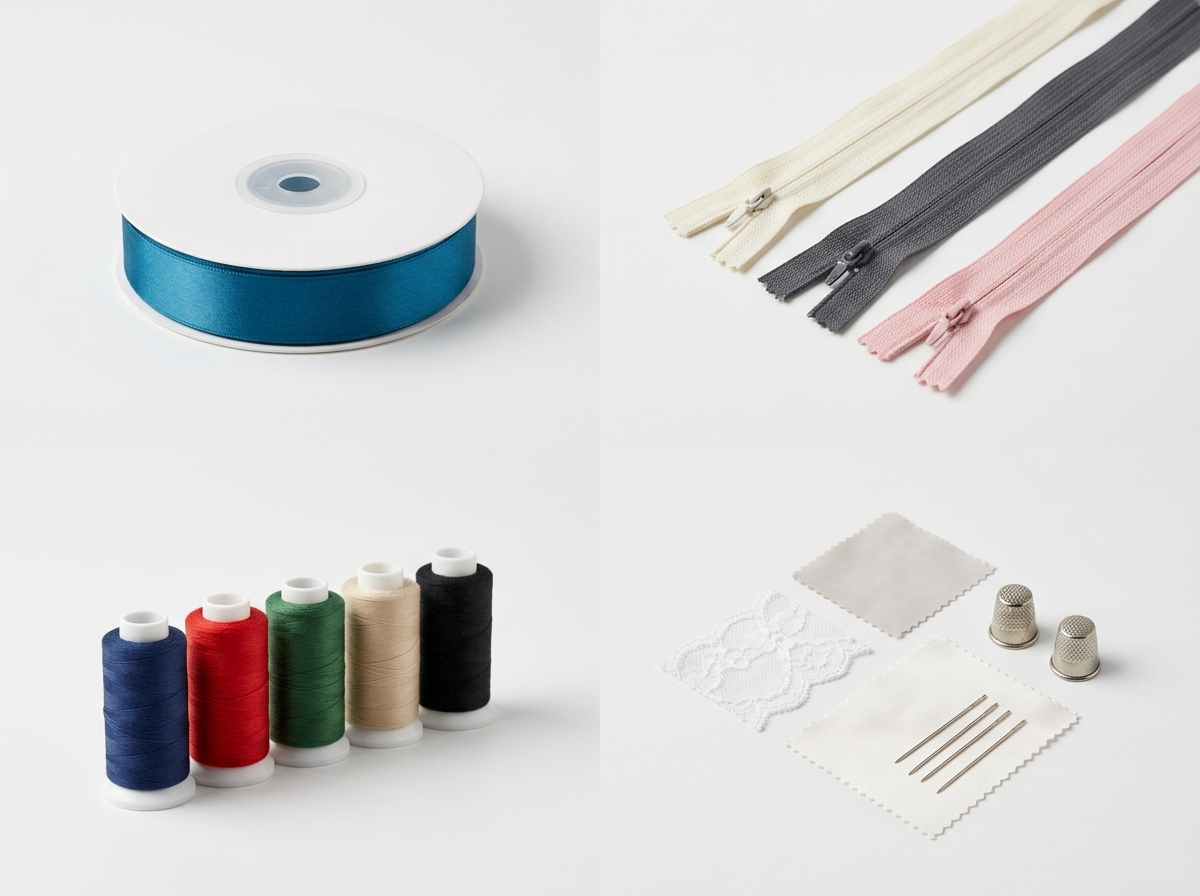 The operational value of wholesale sewing accessories sourcing
Wholesale buyers do not just buy products; they buy supply reliability. That is why a sewing accessories supplier with a broad directory structure can be more useful than a narrow single-item vendor.
A multi-category catalog reduces coordination cost when one purchase order includes ribbon for packaging, thread for sewing operations, lace for embellishment, and scissors or kits for tools. In practice, this can shorten vendor management time and simplify consolidation for freight, customs, and warehousing.
This is where New Swell’s product structure is relevant: it is built around accessories plus tools rather than only one vertical item. That makes it easier for buyers to source complementary SKUs from a single wholesale partner.
- One supplier relationship can cover decorative, functional, and DIY accessory needs.
- Consolidated packaging can improve warehouse receiving accuracy.
- Unified color and material control supports repeat seasonal orders.
- MOQ planning becomes simpler when several accessory families are ordered together.
For buyers, the practical result is fewer split shipments, fewer vendor disputes, and a more stable replenishment process. In a wholesale business, that operational stability often matters more than a small unit-price difference.
Quality control benchmarks that matter for sewing factory buyers
Quality control is the strongest proof of competence in an apparel manufacturer relationship. Buyers should ask how the factory checks colorfastness, seam behavior, tensile strength, and visual consistency before bulk shipment.
International test methods are helpful because they make supplier claims easier to verify. For textiles, colorfastness to washing can be evaluated under ISO 105-C06. Fabric drape testing can follow ASTM D1388. Thread tensile properties can be assessed under ASTM D2256/D2256M. These references do not replace buyer-specific inspection, but they create a common technical language.
| Test or control point | Standard or method | What it measures | Why it matters |
|---|---|---|---|
| Colorfastness to washing | ISO 105-C06 | Shade retention after laundering | Reduces dye complaints |
| Fabric drape behavior | ASTM D1388 | Flexibility and hanging shape | Important for lace and trims |
| Thread tensile properties | ASTM D2256/D2256M | Breaking force and elongation | Prevents sewing line failure |
| Sampling inspection | Buyer-defined AQL | Defect acceptance level | Supports shipment decisions |
A good sewing factory should also explain how it handles lot traceability, especially for color-critical accessories. That is essential for wedding orders, bridal trims, and womenswear programs where same-color repeatability drives buyer satisfaction.
Why MOQ, samples, and packaging are strategic, not administrative
MOQ, sample policy, and packaging are not back-office details; they are key sourcing variables. In wholesale procurement, they shape cash flow, inventory risk, and order speed.
For example, a lower MOQ can help a buyer test a new lace pattern in a bridal market without overcommitting inventory. A clear sample policy reduces iteration time when a designer needs to compare lace widths, ribbon finishes, or zipper colors across several product concepts. Packaging format also matters because many garment accessories are sold to distributors, brands, and retailers in resell-ready units.
Common packaging choices include bulk rolls, labeled bundles, hanging cards, and polybags with barcode labels. Each format has a different impact on shelf presentation and warehouse handling.
- Bulk rolls are efficient for factory use and trade buyers.
- Retail cards support merchandising and e-commerce presentation.
- Color-labeled polybags reduce picking errors.
- Master cartons with clear item codes simplify inbound inspection.
Wholesale buyers should ask for a packaging spec sheet before confirming any order. That step often saves time later in the receiving and fulfillment stages.
How experienced factories support wedding, womenswear, and DIY demand
Scene-based supply planning is where experienced sewing factories become most valuable. Wedding, womenswear, and DIY markets each have a different definition of quality.
Wedding buyers usually care about visual harmony, softness, and premium finishing. Womenswear buyers focus on fit, hidden construction, and clean lines. DIY buyers need convenience, versatility, and enough product variety to support creative use cases. A good supplier should be able to explain which accessory works for each context rather than pushing one item for everything.
For example, lace products may include bridal lace, eyelash lace, elastic lace, woven lace, and sewing lace. Those subcategories are not interchangeable. Bridal and eyelash lace are usually selected for high-aesthetic applications, while TC lace may be preferred when durability and appearance must coexist.
| Scenario | Preferred accessory type | Buyer priority | Typical specification focus |
|---|---|---|---|
| Wedding decoration | Bridal lace, satin ribbon | Appearance | Pattern density, shine, width |
| Women’s dresses | Invisible zipper, soft lace | Finish and fit | Length, flatness, seam integration |
| DIY sewing kits | Thread, scissors, kits | Ease of use | Contents, packaging, instructions |
| Gift wrapping | Polyester ribbon | Presentation | Color, roll size, edge quality |
Because these markets are visually sensitive, even small defects can harm resale value. That is why experienced factories usually build their process around consistency rather than only unit cost.
What to ask before choosing a sewing accessories supplier
The best supplier choice usually comes from asking a few targeted questions instead of comparing quotes alone. A structured vetting process helps buyers identify whether the sewing factory is truly experienced or only price competitive.
- Can you support mixed-category orders across ribbon, zipper, thread, and lace?
- What is your sample lead time for custom color or size confirmation?
- How do you control dye lot consistency across repeat orders?
- What inspection steps do you use before packing and shipment?
- Can you provide packaging formats for wholesale and retail channels?
- How do you handle MOQ for new buyers and small test orders?
If the answers are vague, the supplier may still be suitable for spot buying, but not for a repeatable sourcing program. For apparel and trim buyers, repeatability is usually the real competitive advantage.
When a sewing factory becomes a strategic partner
A sewing factory becomes strategic when it helps buyers reduce uncertainty across multiple purchasing cycles, not just one order. That happens when the supplier understands category fit, production limits, packaging expectations, and export requirements.
In practical terms, a strategic partner supports new product development, seasonal replenishment, and coordinated sourcing across accessory families. That is particularly useful for importers and distributors who serve wedding, womenswear, and DIY channels at the same time.
For buyers comparing suppliers, the strongest signal is whether the factory can explain product differences clearly and back them with measurable controls. If a supplier can describe the material, test method, MOQ, and packing format for each item, that usually indicates a mature wholesale operation.
For New Swell, the advantage lies in its trim-and-tool directory structure and export-oriented wholesale model. That structure is useful because it aligns with how real buyers shop: by use case, by accessory family, and by repeat order potential.
Conclusion: what competitive advantage really means in sewing factory sourcing
The competitive advantage of partnering with an experienced sewing factory is not just better pricing; it is lower sourcing risk, stronger product fit, and better execution across wholesale workflows. For apparel manufacturer buyers, that means more predictable sampling, tighter spec control, and more reliable reorders.
In categories like ribbon, zipper, thread, lace, and DIY tools, the supplier’s understanding of application matters as much as the item itself. When the factory can connect product structure to use case, buyers get a sourcing partner instead of a transactional vendor. That is the real advantage in a competitive procurement environment.
FAQ
What is the main advantage of an experienced sewing factory?
The main advantage is consistency. An experienced sewing factory can better control color, size, packaging, and repeat-order accuracy, which reduces rework and delays for wholesale buyers.
How does an apparel manufacturer help with product selection?
An apparel manufacturer with accessory expertise can match each item to its use case, such as invisible zippers for dresses or lace for wedding trims, which lowers trial-and-error sourcing.
Why are MOQ and samples important in wholesale sewing accessories sourcing?
MOQ and samples determine how fast a buyer can test the market and how much inventory risk they carry. Clear sample policies also shorten approval cycles.
What quality standards should buyers ask about?
Buyers should ask about colorfastness, tensile testing, and inspection methods. Useful references include ISO 105-C06, ASTM D1388, and ASTM D2256/D2256M.
Is it better to source from one sewing accessories supplier or several vendors?
One capable supplier is often easier to manage when orders include ribbon, lace, thread, and tools. Multi-category sourcing can reduce freight complexity and communication overhead.
Which products are most useful for wedding and womenswear buyers?
Satin ribbon, bridal lace, eyelash lace, and invisible nylon zippers are commonly used because they support visual quality and clean garment finishing.
How can buyers evaluate whether a sewing factory is reliable for repeat orders?
Check how they handle sampling, lot traceability, packaging consistency, and reorder communication. A reliable factory can repeat the same specification without forcing new clarification every time.

Post time: Aug-28-2026