- Colorfast polyester sewing thread helps garments keep a clean, professional look after repeated washing and wear.
- Polyester thread is widely used in apparel because it combines seam durability, abrasion resistance, and stable color performance.
- For wholesale buyers, thread selection should consider fabric type, stitch type, needle size, wash conditions, and MOQ requirements.
- Testing against recognized standards such as ISO and ASTM improves procurement confidence and reduces quality disputes.
Colorfast polyester sewing thread is a small material choice with a large impact on garment life, because seams often fail or discolor before the fabric itself does. In apparel engineering, seam performance is typically evaluated with tensile and seam-strength methods, while color stability is assessed under light and washing conditions; for example, ISO 105 covers color-fastness testing across multiple exposure routes, and ASTM D5034 specifies grab tensile testing for textiles. For buyers sourcing bulk polyester thread for uniforms, dresses, and DIY garment programs, the most important question is simple: will the thread still look and perform well after repeated laundering, handling, and retail use?
Why colorfast polyester sewing thread is critical for long-lasting garments
Colorfast polyester sewing thread protects both durability and appearance, which is why it is a default choice in many apparel categories. A garment may be cut from premium fabric, but if the thread bleeds, fades, or weakens, the final product can still look cheap or fail early. Polyester is a synthetic fiber known for low moisture absorption and good dimensional stability, which helps it maintain shape and shade better than many traditional thread options in everyday wear.
For garment makers, the practical benefit is fewer complaints about seam mismatch, fewer returns caused by visible stitching changes, and better consistency across production lots. That matters in categories such as dresses, blouses, school uniforms, workwear, and home sewing projects where the thread is part of the visual design, not just the hidden structure.
How polyester thread compares in real garment use
Polyester thread is usually selected when a buyer wants a balance of strength, elasticity, and color stability. In contrast, cotton thread may be preferred for a matte, natural look in some heritage or breathable garments, but it can be more vulnerable to shrinkage and long-term color change depending on finish and dyeing. Nylon thread can offer high strength and stretch, yet it is often chosen for specific technical uses rather than broad apparel sourcing.
The decision is not about one thread being universally better. It is about matching the thread to the fabric, garment category, and wash profile. For example, a wedding dress lining seam, a casual woven shirt, and a stretch DIY project do not demand the same thread behavior. In wholesale sourcing, that is why a supplier’s product range and specification clarity matter as much as the thread material itself.
| Thread Type | Typical Apparel Strength Profile | Color Stability | Common Use Case | Buyer Risk if Misused |
|---|---|---|---|---|
| Polyester sewing thread | High | Good | General apparel, uniforms, DIY clothing | Low if fabric-match is correct |
| Cotton sewing thread | Moderate | Moderate | Natural-fiber garments, decorative stitching | Possible shrinkage and lower wash stability |
| Nylon thread | High | Good | Technical seams, stretch-related applications | May be over-specified for standard apparel |
What “colorfast” actually means in sewing thread
Colorfast means the thread resists color loss or color transfer under expected use conditions, especially washing, rubbing, perspiration, and light exposure. That does not mean a thread is immune to all fading; it means the color performance is strong enough for the intended use environment. In apparel procurement, the relevant question is not whether a thread is perfectly permanent, but whether it performs within an acceptable fastness grade for the garment’s life cycle.
Industry color-fastness testing is commonly referenced through the ISO 105 series. For example, ISO 105-C06 addresses color fastness to domestic and commercial laundering, while ISO 105-B02 covers color fastness to artificial light. Buyers do not need to become test engineers, but they should ask suppliers which fastness tests were performed and what result level was achieved for the shade range they plan to order. For formal sourcing, documentation is more trustworthy than vague claims.
Useful reference: ISO 105-C06: Color fastness to domestic and commercial laundering, ISO 105-B02: Color fastness to artificial light, and ASTM D5034: Grab tensile properties of textiles.
Key technical factors that affect colorfast polyester sewing thread performance
Colorfast polyester sewing thread performs well when the fiber, dyeing method, twist level, and finishing process are aligned with the end use. If any one of those is weak, the thread can lose shade consistency or seam integrity sooner than expected. For buyers, the smartest approach is to review thread construction rather than looking only at color names or cone appearance.
- Fiber quality: Stable polyester raw material supports consistent dye uptake and better shade repeatability.
- Dye process: Well-controlled dyeing improves resistance to wash and light exposure.
- Twist and ply: Proper twist helps balance strength, smooth feeding, and stitch appearance.
- Lubrication and finish: Surface finish affects needle heat, sewing speed, and thread breakage.
- Shade consistency: Lot-to-lot control matters in bulk apparel production and reorders.
In practical terms, a thread with good colorfastness but poor sewing behavior can still create problems, such as skipped stitches, needle heat buildup, or seam puckering. That is why thread specifications should be reviewed together with fabric density, needle system, and machine speed. A garment is a system, not a single material.
 Colorfast polyester sewing thread in wholesale sourcing and bulk production
Wholesale buyers usually care about more than thread color. They also need predictable MOQ, packaging options, lead time, and the ability to reorder the same shade without visible lot variation. For bulk apparel programs, those commercial details can matter as much as the physical thread specification because production continuity reduces downtime and waste.
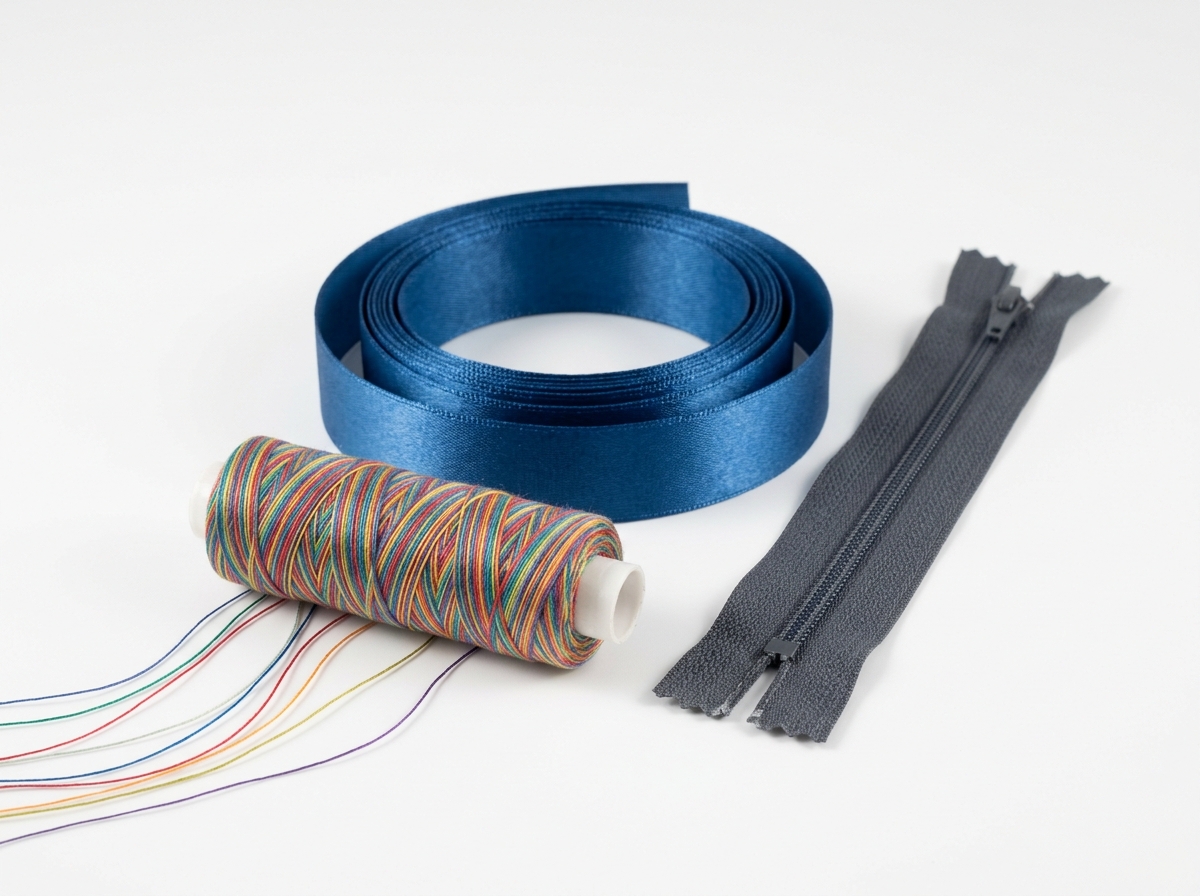
New Swell’s catalog structure is suited to this buying pattern because it groups consumable apparel components and accessories for repeat procurement. If you are sourcing for large garment runs, it helps to compare ribbon, zipper, and lace categories alongside thread, since final garment quality depends on the full trim set, not one item in isolation.
| Wholesale Buying Factor | Why It Matters | Typical Procurement Question |
|---|---|---|
| MOQ | Controls inventory risk and cash flow | Can the supplier support small test orders and repeat bulk orders? |
| Shade consistency | Prevents visible mismatch across batches | Can the same color be reordered with stable lot control? |
| Packaging | Affects storage, handling, and line feeding | Is the thread packed for factory, retail, or mixed use? |
| Lead time | Impacts production schedule reliability | How quickly can the supplier replenish stock? |
How to choose polyester thread for dresses, uniforms, and DIY sewing
The best polyester sewing thread is the one that matches the garment’s fabric weight, stitch type, and end-use stress. A lightweight dress needs a different balance than a work uniform or a repair seam on a handbag lining. Choosing by application is more reliable than choosing by marketing description.
- Identify the fabric type: woven, knit, stretch, sheer, or heavy-duty.
- Match thread thickness to the seam visibility and machine capability.
- Check the wash environment: home laundering, industrial wash, or occasional dry cleaning.
- Review needle size and stitch formation to reduce thread breakage.
- Confirm shade consistency if the seam is decorative or visible.
For DIY users, the decision is usually simpler: choose a versatile polyester thread that feeds smoothly, resists breakage, and stays visually stable across common home washing conditions. For garment factories, the choice should be validated with sampling before full-scale production, especially when the seam is visible on the outside of the garment.
Testing methods buyers should ask for before placing a bulk order
Testing is the most reliable way to separate a good thread claim from a real production-grade product. A supplier should ideally be able to explain which performance tests were run and provide a result summary for the actual shade and construction being purchased. This is especially important when buying for export, because fabric performance expectations vary by market and garment category.
At minimum, apparel buyers should ask about color fastness to laundering, color fastness to light, tensile behavior, and sewing performance under intended machine conditions. If the thread is destined for a premium garment line, sample testing should include the exact fabric, needle, and stitch construction used in production.
| Test Area | Common Standard Reference | What It Reveals | Why Buyers Care |
|---|---|---|---|
| Laundering fastness | ISO 105-C06 | Color loss and transfer after wash | Prevents fading complaints |
| Light fastness | ISO 105-B02 | Resistance to light exposure | Important for retail display and sun exposure |
| Grab tensile strength | ASTM D5034 | Fabric strength behavior under load | Helps assess seam and fabric compatibility |
For product development teams, a simple pass/fail approach is often not enough. Look for the actual test grade, the test conditions, and whether the test was completed on the finished dyed thread or only on raw material. That distinction can change sourcing decisions.
Why seam quality and color quality should be evaluated together
Colorfastness alone does not guarantee garment quality, and strength alone does not guarantee visual stability. The best sewing thread performs well in both categories because a seam is both structural and aesthetic. In visible areas such as neckline stitching, topstitching, and dress hems, any color shift can reduce the perceived value of the garment even if the seam remains intact.
This is especially true in wedding, fashion, and premium DIY segments, where customers notice stitching detail. A thread that keeps its tone under repeated washing and daylight exposure protects the garment’s finished appearance, which is a major part of its resale and wear value.
If your product mix includes decorative trims as well as thread, it is worth aligning thread color selection with the rest of the trim set. Coordinated sourcing across eyelash lace and wedding lace can improve visual harmony in formalwear and event garments.
Common mistakes when sourcing polyester sewing thread
Most thread problems are procurement problems that only show up on the sewing line. That is why buyers should avoid treating thread as a generic commodity. A small difference in finish, shade, or construction can produce large downstream losses in production speed and appearance.
- Buying by color only and ignoring stitch performance.
- Skipping sample testing on the actual garment fabric.
- Assuming all polyester threads behave the same under wash and light exposure.
- Mixing lots without checking shade consistency.
- Ignoring packaging and storage conditions before factory use.
These errors often create more cost than the thread itself. Rework, rejected panels, delayed shipments, and complaint handling can quickly outweigh any savings from choosing the cheapest option.
What long-lasting garments really need from thread
Long-lasting garments need thread that stays strong, stays visible when it should, and stays stable after repeated real-world use. Colorfast polyester sewing thread is valuable because it supports all three goals at once in many mainstream apparel categories. For factories and wholesale buyers, the best procurement strategy is to treat thread as a functional material with measurable performance, not as a small afterthought.
When thread is selected with attention to fabric weight, stitch application, and fastness requirements, garments look better for longer and perform more reliably. That is the core reason polyester sewing thread remains a standard choice in apparel production, repair, and DIY clothing projects.
FAQ about colorfast polyester sewing thread
1. Why is colorfast polyester sewing thread better for everyday garments?
It is often better because it balances color stability, strength, and general sewing reliability for garments that will be washed and worn repeatedly.
2. Does polyester thread fade in the wash?
It can fade if the dyeing or finish quality is poor, but properly made colorfast polyester sewing thread is designed to resist laundering-related color loss.
3. Is polyester sewing thread suitable for dresses and fashion apparel?
Yes, it is widely used in dresses and fashion garments because it gives good seam durability and stable appearance in visible stitching.
4. What standards should I check for thread colorfastness?
Ask for test references such as ISO 105-C06 for laundering and ISO 105-B02 for light exposure, plus tensile data where relevant.
5. How do I choose the right thread for bulk garment production?
Match the thread to the fabric, stitch type, and wash condition, then confirm shade consistency and test samples before full order release.
6. Can polyester thread be used with home sewing machines?
Yes, it is commonly used in home machines because it feeds well and works for many everyday sewing and repair tasks.
7. What should wholesale buyers ask a supplier before ordering?
Ask about MOQ, packaging, sample availability, color consistency, lead time, and which test standards were used for the thread.

Post time: Jul-29-2026