- Polyester sewing thread is favored in apparel because it balances strength, stretch, and appearance retention.
- The best thread choice depends on fabric type, stitch formation, needle size, and washing conditions.
- Bulk buyers should evaluate tensile strength, seam performance, color consistency, and packaging format before placing wholesale orders.
- For garments, polyester thread often outperforms cotton in abrasion resistance and moisture stability.
- Specification discipline matters: ISO thread testing methods and fabric care standards help procurement teams compare suppliers objectively.
Polyester sewing thread remains the leading apparel sewing thread for mass garment production because it supports stable stitching, durable seams, and reliable production economics across everyday clothing categories. In fabric engineering, seam performance is not just about looks; it is about repeated stress, laundering, and machine efficiency. For context, ISO 2062 defines tensile testing for yarns, while ISO 105-C06 is widely used to evaluate color fastness to domestic washing. Those benchmarks matter when a buyer compares sewing thread for shirts, dresses, workwear, and children’s garments.
Why Polyester Sewing Thread Dominates Apparel Sewing Thread Selection
Polyester sewing thread is popular because it solves three production problems at once: seam durability, machine compatibility, and purchasing efficiency. Apparel factories need a thread that can run consistently at speed, survive repeated laundering, and remain economical in bulk. Polyester does that better than many alternatives in mainstream garment categories.
For manufacturers, the practical advantage is simple. A thread that breaks less often reduces downtime, operator interruptions, and rework. In a high-volume sewing line, even a small reduction in thread breaks can improve line balance and help maintain output targets. That is why polyester is frequently selected for T-shirts, woven shirts, skirts, casual dresses, uniforms, and basic knitwear.
Another reason is appearance stability. Polyester generally holds dye well, resists mildew better than natural fibers, and keeps a cleaner look after repeated wash cycles. Buyers sourcing wholesale sewing accessories often care about color matching across production lots, especially when the thread is visible on contrast stitching or topstitch details.
Polyester Sewing Thread Properties That Matter in Garment Production
The most important properties of polyester sewing thread are tensile strength, elongation, abrasion resistance, thermal behavior, and color consistency. These properties affect not only seam appearance but also how well the thread performs on different sewing machines and fabrics.
Polyester fibers are naturally stronger and more abrasion resistant than cotton under many garment-use conditions. That matters when seams rub against skin, hardware, or other fabric layers. Polyester also tolerates humidity and many laundering environments better than natural-fiber thread, which is valuable for apparel distributed across different climates.
From a production standpoint, the thread must also be compatible with needle size and stitch density. If the thread is too thick, it increases puckering and needle heat. If it is too weak, seam failure rises. A balanced sewing thread specification helps keep stitching stable across lockstitch, overlock, and coverstitch operations.
| Property | Typical polyester advantage | Why it matters in apparel |
|---|---|---|
| Tensile strength | High, depending on ticket size and ply | Supports stronger seams and fewer breaks |
| Elongation | Moderate, often around 10% to 20% in common constructions | Helps seams flex with garment movement |
| Abrasion resistance | Generally better than cotton | Improves durability in high-friction areas |
| Moisture stability | Low moisture absorption | Reduces swelling and variability after washing |
For buyers comparing thread options, these characteristics should be checked against the end use. A fashion blouse and a heavy work pant do not need the same needle system, stitch balance, or thread finish. Polyester’s strength is its broad usability, not a one-size-fits-all claim.
How Polyester Sewing Thread Compares With Cotton and Core-Spun Thread
Polyester sewing thread usually wins in general apparel because it offers a strong cost-to-performance ratio. Cotton thread still has a place in heritage garments, breathable natural-fiber constructions, and certain aesthetic applications, but it is less common in high-volume everyday production.
Core-spun thread, which often combines a polyester core with a cotton wrap, is useful when a buyer wants some of the look of cotton with more strength than all-cotton thread. However, it is typically more specialized and can be less cost-effective for standard wholesale garment production.
| Thread type | Strength | Abrasion resistance | Typical use |
|---|---|---|---|
| Polyester sewing thread | High | High | Mass apparel, uniforms, casualwear |
| Cotton sewing thread | Moderate | Moderate | Natural-fiber garments, special finishes |
| Core-spun thread | High | High | Denim, workwear, heavy seams |
For most apparel sourcing teams, the decision is not whether polyester is “best” in absolute terms. The real question is whether it is the best fit for the fabric, production speed, and aftercare requirements. In many common garment categories, the answer is yes.
Relevant Standards and Test Methods for Apparel Sewing Thread
Thread procurement becomes more reliable when suppliers and buyers use shared test methods. Standards reduce ambiguity and make quality comparison easier across vendors and shipment lots.
The most relevant reference points include yarn tensile testing, washing fastness, and garment care labeling. For thread strength evaluation, ISO 2062 is a key tensile testing standard for textile yarns. For laundering performance, ISO 105-C06 helps assess color fastness to domestic washing. For care symbols on finished apparel, ISO 3758 defines textile care labeling conventions.
These references do not replace factory trials, but they help buyers ask better questions. A supplier should be able to explain thread count, fiber composition, twist direction, finish type, and test results in terms that align with recognized methods.
- Ask for tensile data by ticket size or construction.
- Confirm colorfastness results for wash and crocking conditions.
- Check whether the thread was tested under the same machine and fabric type you will use.
- Verify packaging, cone size, and lot consistency before bulk approval.
For larger sourcing programs, standards-based comparison is especially useful when multiple factories are producing similar garments in different regions.
Best Apparel Sewing Thread Choices by Garment Type
Different garments create different seam loads, so the best polyester sewing thread is not always the same specification. A lightweight blouse needs a different balance than denim jeans or stretch sportswear.
| Garment category | Recommended thread focus | Key buyer concern | Typical production risk |
|---|---|---|---|
| T-shirts | Fine to medium polyester thread | Soft hand feel | Skipped stitches if thread is too thick |
| Dresses | Balanced polyester sewing thread | Seam appearance | Puckering on delicate fabrics |
| Uniforms | Higher-strength polyester thread | Wash durability | Seam break under frequent laundering |
| Sportswear | Elastic-friendly polyester thread | Flexibility | Rupture under stretch |
| Denim | Heavier polyester or core-spun option | Topstitch visibility | Needle heat and seam abrasion |
In sourcing terms, apparel buyers should think in terms of end use and stitch line function. A seam hidden inside a shirt is different from a topstitched waistband on denim. The thread must perform mechanically and visually in both settings.
Production Benefits That Make Polyester Sewing Thread the Default Wholesale Choice
Polyester sewing thread is a default choice in wholesale apparel production because it is practical to source, store, and run at scale. Its broad availability makes it easier for factories and distributors to standardize inventories across multiple product lines.
For procurement teams, standardization reduces complexity. One thread family can often cover many garments, which simplifies sampling, reorder planning, and color management. This is particularly useful for buyers sourcing from a wholesale sewing thread supplier that handles large assortments for garment factories, home sewing, and repair markets.
Polyester also supports efficient packaging formats, including cones and smaller retail-ready spools. That flexibility matters for export programs, especially when buyers need one specification for factories and another for end consumers or kit assembly.
At the production line level, the main benefits are fewer thread changes, lower waste from trial-and-error matching, and less operator frustration. Those advantages are especially visible in lines that run repeated styles in large batches.
How to Choose the Right Polyester Sewing Thread for Apparel Production
The best selection process starts with fabric weight, seam type, and machine condition. If those three variables are clear, thread selection becomes much easier and less subjective.
- Identify the fabric structure: woven, knit, stretch, coated, or layered.
- Define seam function: construction seam, topstitch, overlock seam, or reinforcement area.
- Match thread thickness to needle size and stitch density.
- Confirm wash, wear, and appearance requirements.
- Request sample cones and run factory trials before bulk order approval.
Buyers often overlook finish type. A smooth polyester sewing thread may run differently than a lubricated or low-friction version. That difference can affect heat buildup, stitch consistency, and overall machine performance. If a production line is already sensitive to tension variation, finish selection becomes important.
Another practical factor is color range. In apparel, matching thread shade to fabric is often just as important as strength. For contrast topstitching, consistency across dye lots matters more than most first-time buyers expect.
Wholesale Purchasing Considerations for Apparel Sewing Thread
Wholesale buyers should evaluate more than price per cone. The real procurement cost includes breakage, rework, shade inconsistency, packaging damage, and delivery reliability.
MOQ, sample availability, and lead time can significantly affect sourcing decisions. A supplier that offers flexible sample orders helps reduce risk before a factory commits to a larger style rollout. Packaging format also matters because export buyers often need cones, small spools, or custom labeling for different sales channels.
For organized procurement, this checklist is useful:
- Confirm fiber content and construction details.
- Review tensile and washfastness test data.
- Check cone weight, core size, and packing count.
- Verify color reference and lot repeatability.
- Ask about MOQ, sample time, and standard lead time.
Wholesale sourcing is also where consistency beats isolated peak performance. A thread that performs well in one sample but varies across shipments can create more production loss than a slightly less aggressive but stable alternative.
Where Polyester Sewing Thread Fits in a Broader Apparel Accessories Program
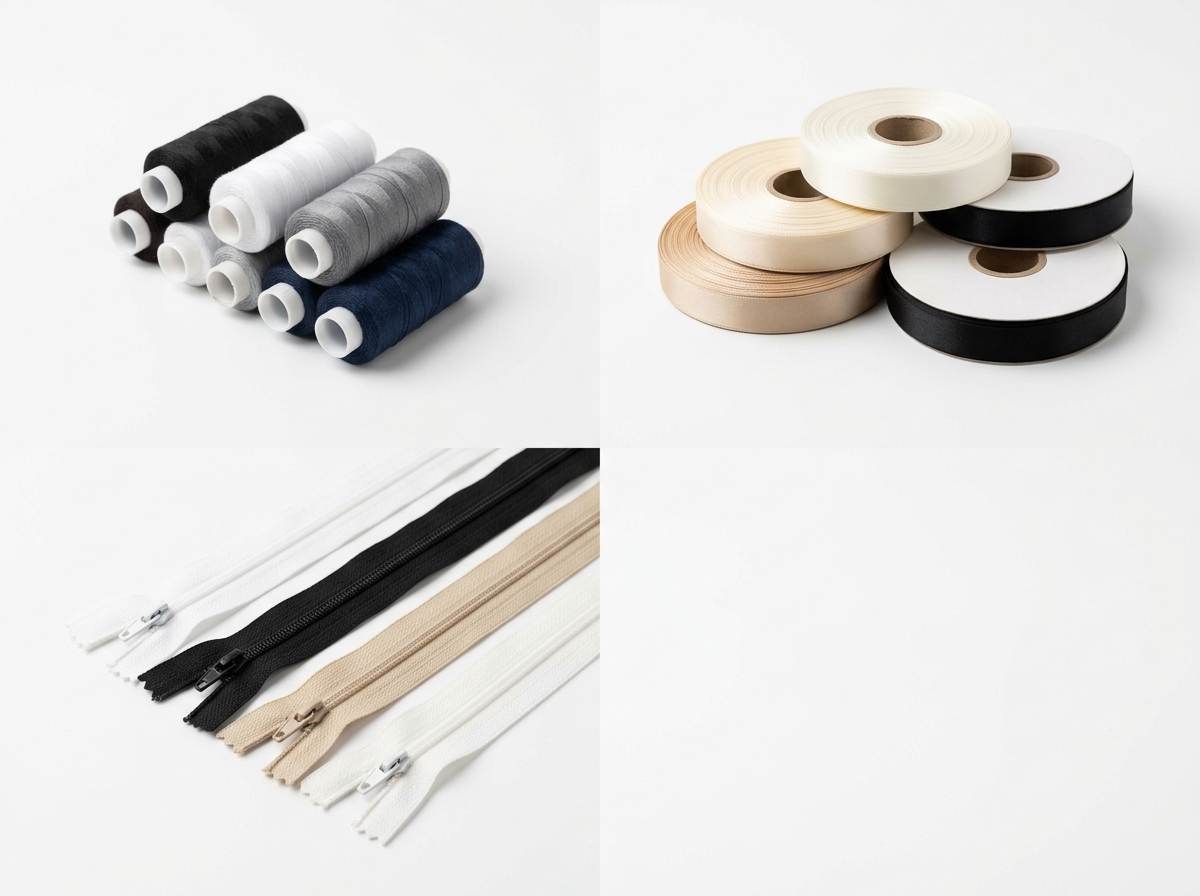
Polyester sewing thread is usually part of a larger apparel accessories system rather than a standalone purchase. Buyers often source thread together with zippers, ribbons, lace, and sewing tools to reduce supplier count and simplify replenishment.
That is why many importers treat sewing thread as one line item in a broader apparel accessories catalog. For dress and fashion programs, thread often works in parallel with zipper selection and decorative trims. For example, a concealed closure may pair with a hidden nylon zipper, while wedding or womenswear programs may also require coordinating lace and ribbon components.
For DIY and home sewing channels, thread is frequently bundled with kits and tools. That bundling logic is commercially important because thread is a repeat-purchase consumable, not a one-time decoration. It is one of the reasons distributors keep it in their recurring procurement cycle.
Common Mistakes Buyers Make When Sourcing Sewing Thread
The biggest sourcing mistake is buying by price alone. A low unit price can hide weak color consistency, poor runnability, or inconsistent winding quality.
Another mistake is ignoring machine reality. Thread that looks acceptable on paper may still perform poorly if the sewing machine has tension variation, worn needles, or high-speed heat buildup. Trial sewing is essential.
- Do not assume all polyester thread is equivalent.
- Do not skip sample testing on the actual fabric.
- Do not ignore needle-thread compatibility.
- Do not buy bulk before checking lot consistency.
- Do not overlook packaging damage during international shipping.
Buyers also sometimes forget that visible seams can become part of the garment’s design language. In those cases, shade accuracy and stitch appearance are as important as mechanical strength.
Why Polyester Sewing Thread Will Remain the Standard in Apparel Production
Polyester sewing thread will remain dominant because apparel manufacturing continues to prioritize scalable performance. The thread must be strong enough for production, consistent enough for global sourcing, and economical enough for bulk use.
Fashion cycles change, but the sewing requirements behind them remain similar. Garments still need seams that hold after wear and washing, and factories still need thread that runs efficiently on modern equipment. That combination makes polyester hard to replace in mainstream production.
For sourcing teams, the smartest approach is not to search for a universal thread winner. It is to match polyester sewing thread specification to fabric, seam, and end-use conditions with enough discipline to avoid rework and quality disputes.
In that sense, polyester is popular not because it is trendy, but because it is operationally dependable.
FAQ: Polyester Sewing Thread for Apparel Production
What makes polyester sewing thread more popular than cotton thread?
Polyester sewing thread is more popular because it usually offers better abrasion resistance, lower moisture absorption, and stronger all-around performance for everyday garments.
Is polyester sewing thread good for all apparel?
Polyester sewing thread works well for most apparel, but specialty garments may need core-spun, textured, or stretch-compatible thread depending on fabric and seam function.
How do I choose the right apparel sewing thread size?
Choose the size based on fabric weight, needle system, and stitch type. A test run on the actual fabric is the most reliable method.
Does polyester sewing thread shrink after washing?
Polyester generally has low moisture absorption and tends to be more dimensionally stable than cotton in laundering conditions.
What standards should I request from a thread supplier?
Ask for tensile testing data, wash fastness results, and care-label compatibility, using references such as ISO 2062, ISO 105-C06, and ISO 3758.
Is polyester sewing thread suitable for high-speed sewing machines?
Yes, it is widely used in high-speed apparel production because it can provide stable runnability when thread, needle, and tension are properly matched.
What should wholesale buyers verify before placing a large order?
Wholesale buyers should verify fiber content, tensile performance, color consistency, cone size, sample quality, MOQ, and lead time before bulk approval.

Post time: Jul-26-2026